
What is the Camino de Santiago: the network of pilgrimage routes that lead to the tomb of the apostle Saint James the Great, in the cathedral of Santiago de Compostela. Born in the Middle Ages, today it is a living phenomenon that 530,987 people from all over the world completed in 2025, according to the Pilgrim’s Office. In this guide we explain its origin, its history, the main routes, its symbols, how long it takes and what it means to walk it today.
Contents
The Camino de Santiago in a nutshell
The Camino de Santiago is not a single route but a set of historic paths that, from different points in Spain, Portugal and the rest of Europe, end in Santiago de Compostela (Galicia). It is travelled on foot, by bike or on horseback, in one-day stages, sleeping in albergues, guesthouses or hotels. Anyone who completes at least the last 100 km on foot (200 km by bike) and proves it with the pilgrim credential receives the Compostela, the certificate of the pilgrimage.
Its roots are religious, but today people of all beliefs and ages walk it: in 2025, 57% of pilgrims were international and 53.67% were women. It is at once a pilgrimage, a cultural route, a sporting challenge and an inner journey.
The origin of the Camino de Santiago
Saint James the Great was one of the twelve apostles of Jesus. According to tradition, he preached in the Iberian Peninsula, returned to Jerusalem, where he was martyred around the year 44, and his disciples carried his body by sea to Galicia, where they buried it.
Tradition holds that at the beginning of the 9th century a hermit called Pelayo saw lights over a wood and alerted Bishop Theodemir of Iria Flavia, who identified the apostle’s tomb there. King Alfonso II of Asturias travelled from Oviedo to venerate it and ordered a first church to be built: that is why he is considered the first pilgrim, and his journey is the origin of today’s Camino Primitivo. A popular etymology derives «Compostela» from Campus Stellae, «field of the star», although many historians link it to the Latin compositum, «burial place».
The Camino in the Middle Ages
From the 10th and 11th centuries, Santiago became one of the three great pilgrimage destinations of Christendom, alongside Rome and Jerusalem. That explains a curiosity of the Spanish language: strictly speaking, a «peregrino» was someone going to Santiago, a «romero» someone going to Rome and a «palmero» someone going to Jerusalem.
Kings, nobles, clergy and peasants travelled the Jacobean routes, and bridges, hospitals, monasteries and whole towns sprang up in their wake. In the 12th century the Codex Calixtinus was compiled; its Book V is considered the first pilgrim’s travel guide: it describes stages, dangers, rivers with good and bad water and the customs of the peoples along the Camino Francés. According to tradition, the Jacobean Holy Year was instituted in the same period; it is celebrated when 25 July, the apostle’s feast day, falls on a Sunday.
Decline and revival
Wars, the Protestant Reformation and epidemics caused the pilgrimage to decline from the 16th century, and for centuries the Camino was little more than a memory. Its revival came in the second half of the 20th century. In the 1980s, the parish priest of O Cebreiro, Elías Valiña, began marking the Camino Francés with yellow arrows, the symbol that guides pilgrims on every route today. In 1987 the Council of Europe declared it the First European Cultural Route, and the Holy Year of 1993 marked the great take-off: that year pilgrim numbers approached 100,000. Since then the figure has kept growing up to the records of recent years.
The main routes of the Camino de Santiago
There is not one Camino but many. These are the most walked routes, with their approximate distance to Santiago according to the data in our planner:
- Camino Francés (about 764 km from Saint-Jean-Pied-de-Port): the most popular, with 46% of pilgrims in 2025. It crosses Navarre, La Rioja, Castilla y León and Galicia.
- Camino Portugués (about 241 km from Porto; 608 km from Lisbon): gentle and very busy.
- Portuguese Coastal Way (about 271 km from Porto): beside the Atlantic, with spectacular growth in recent years.
- Camino del Norte (about 821 km from Irún): along the Cantabrian coast, between sea and mountains.
- Camino Primitivo (about 306 km from Oviedo): the oldest, a mountain route.
- Camino Inglés (about 112 km from Ferrol): the one used by pilgrims arriving by sea.
- Vía de la Plata (almost 1,000 km from Seville): the great southern route.
- Camino Sanabrés (about 362 km from Granja de Moreruela): the branch of the Vía de la Plata towards Galicia.
- Fisterra and Muxía (about 89 km from Santiago to Fisterra): the extension to the «end of the world».
There are many more: the Camino de Madrid, the Aragonés, the Baztanés, the Camino del Salvador, the Lebaniego, the Camino de Invierno… You will find them all in all the Caminos. Not sure which to choose? The which Camino de Santiago should I walk? quiz recommends one in seven questions.
The Camino beyond Spain
The Camino does not start in the Pyrenees. The Codex Calixtinus already described four great routes crossing France from Tours, Vézelay, Le Puy and Arles, which joined before crossing into Spain. Today there are waymarked routes from Portugal, France, Italy, Germany, Switzerland, the Netherlands and other countries, and many European pilgrims literally set off from their own front door. That is why the Camino de Santiago is said to be one of the first great cultural networks of Europe.
Who walks the Camino de Santiago today
The profile of the pilgrim is increasingly diverse. In 2025, 43% of those who collected the Compostela were Spanish; among foreigners, the most numerous nationalities were the United States (43,980 pilgrims), Italy (26,680), Germany (24,356), Portugal (22,821) and the United Kingdom (14,650). Pilgrims from Asia and Latin America are growing strongly. Women have been the majority for two years, and students, families, retirees and sportspeople walk side by side.
The vast majority walk the Camino; a minority ride it by bike, and a few on horseback. If you fancy cycling, you have all the details in the Camino de Santiago by bike; and if you want to take your dog, in the Camino de Santiago with a dog.
How long it takes to walk the Camino de Santiago
It depends on the route and the starting point. At an average of 20-25 km a day, these are the approximate times:
- Last 100 km (Sarria, Tui, Ferrol): 5-6 days.
- Camino Portugués from Porto: 10-12 days.
- Camino Primitivo from Oviedo: 12-14 days.
- Full Camino Francés: 30-35 days.
- Full Camino del Norte: 33-38 days.
- Vía de la Plata from Seville: 40 days or more.
Many pilgrims walk the long Caminos in sections, one or two weeks each year. With the Camino planner you can split any route into the days you have, from the point you choose.
The symbols of the Camino
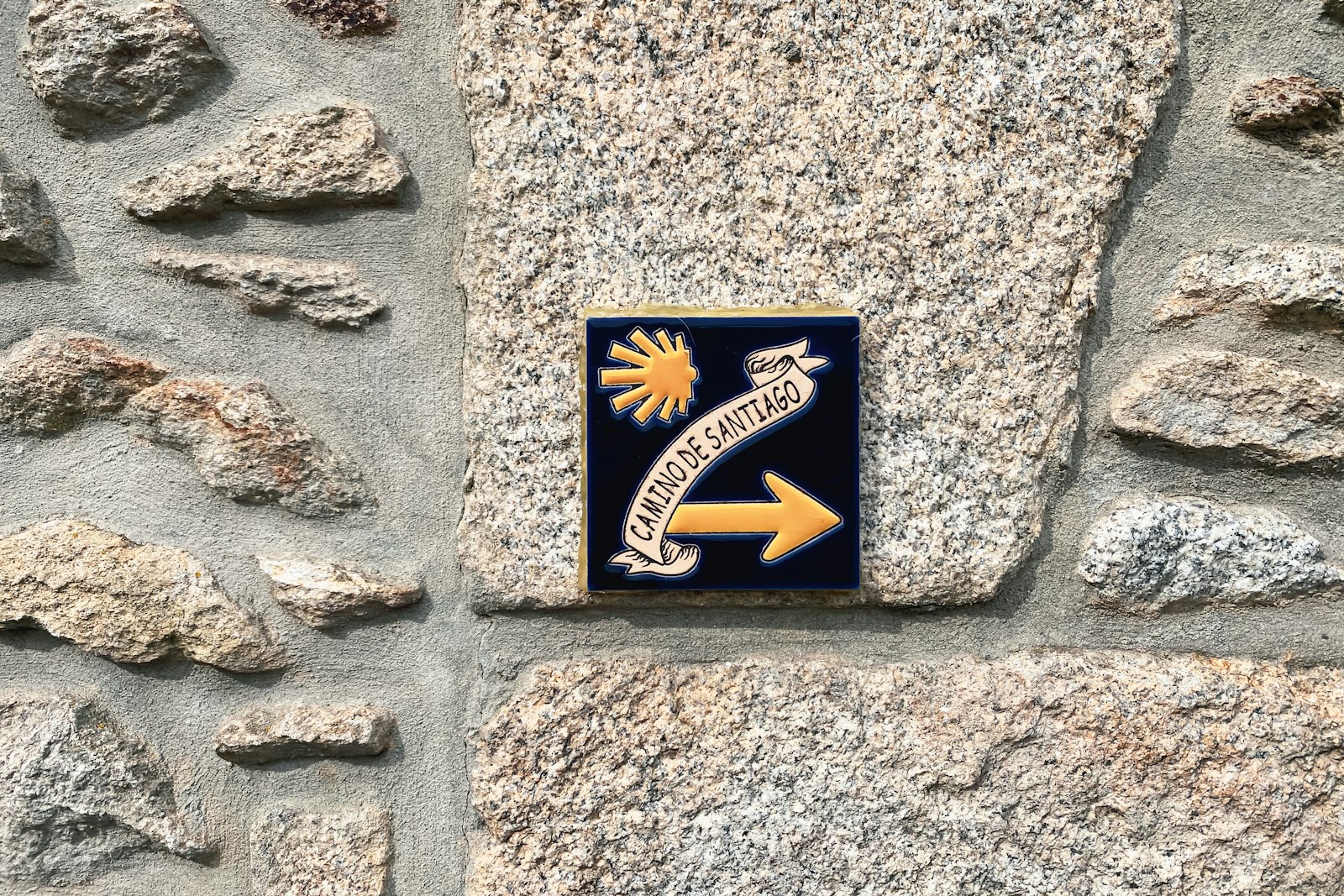
- The scallop shell: the pilgrim’s emblem since the Middle Ages. It hangs from rucksacks and appears on signs, waymarkers and façades.
- The yellow arrow: it shows the way at every junction. Following it is, quite literally, walking the Camino.
- The waymarkers: in Galicia, stone markers (mojones) with the shell and the distance left to Santiago.
- The staff and the gourd: the medieval pilgrim’s walking stick and water container, which still appear in the iconography of Santiago Peregrino.
- The cross of Saint James: a red cross shaped like a sword, the symbol of the Order of Santiago.
And among pilgrims, a greeting: «¡Buen Camino!», which you will hear dozens of times a day.
How the Camino works: albergues, hospitaleros and services
One of the things that most surprises newcomers is how well organised it is. Along the routes there is a network of pilgrim albergues: public ones (in Galicia, the Xunta network charges €10 a night), association, parish, donation-based and private ones. Many are run by volunteer hospitaleros who were once pilgrims and are giving back the welcome they received. On top of that there are guesthouses, hotels and rural houses, bars with a pilgrim menu, fountains, pharmacies and luggage-transfer services.
That infrastructure is what makes it possible to walk the Camino with no previous experience and without carrying a tent or food for days. You can see all the places to stay in each village in our accommodation finder and understand their rules in how albergues work.
The credential and the Compostela
The credential is the pilgrim’s «passport»: it is stamped at albergues, churches and bars along the route and gives access to pilgrim albergues. On arrival in Santiago, the Pilgrim’s Reception Office checks it and, if you have covered at least the last 100 km on foot or on horseback (200 km by bike) with two stamps a day on that section, gives you the Compostela free of charge, a document in Latin that certifies the pilgrimage. The whole process is in how to get the Compostela.
What the Camino de Santiago means today
Although its roots are Christian, the Camino has become an experience open to everyone. Many walk it out of faith; others seek a physical challenge, time to think, a way through grief, a way to mark a stage of life or a simple, human adventure. That mix of people and motivations, the hospitality of the villages and albergue life is what makes the Camino unique.
It is also a way of travelling slowly. For days or weeks, life comes down to walking, eating, resting and talking. Many pilgrims say the most valuable thing was not reaching Santiago but what they learned along the way, and the proof is that a good number come back.
Arriving in Santiago
All the Caminos end in the Plaza del Obradoiro, in front of the Baroque façade of the Cathedral. There strangers hug, exhausted pilgrims lie down on the flagstones and a journey that for many has lasted weeks comes to a close. Then comes the ritual: collecting the Compostela, visiting the apostle’s tomb in the crypt, embracing the statue of Saint James on the high altar and attending the pilgrims’ Mass. On special occasions the botafumeiro flies, the huge censer swung by eight tiraboleiros. The visit is explained in our guide to Santiago Cathedral.
Many pilgrims do not stop there and carry on for three or four more days to Fisterra and Muxía, on the Costa da Morte, where tradition placed the end of the world known in Antiquity.
Today the Camino is also prepared with a phone in your hand. Before setting off, many pilgrims choose a route with a quiz, split the stages with a planner, check the places to stay in each village and download maps in case there is no signal. Once under way, the experience is the same as ever: walking, stamping the credential and letting yourself be surprised. At BuenCaminoSantiago.com we bring those tools together free of charge so your phone helps you prepare the Camino and then you can forget about it.
World Heritage and European Cultural Route
The Camino is also cultural heritage of the first order. The old town of Santiago has been a UNESCO World Heritage Site since 1985. In 1987 the Council of Europe declared the Camino the First European Cultural Route. UNESCO inscribed the Camino Francés as a World Heritage Site in 1993, the routes of Santiago in France in 1998 and, in 2015, extended the listing to the Northern Routes of Spain, including the Primitivo and the Coastal route. Along the way follow cathedrals such as those of Burgos and León, monasteries, medieval bridges and hundreds of Romanesque churches. You can find out more on the Xunta de Galicia’s Camino portal.
The Jacobean Holy Year
When 25 July falls on a Sunday, the Compostelan Holy Year or Xacobeo is celebrated. Throughout that year the Holy Door of the Cathedral is open and pilgrims can gain the jubilee. The next one is Xacobeo 2027, and record numbers are expected. We explain what it is and how to go through it in the Holy Door of Santiago, and how to prepare in how to prepare for Xacobeo 2027.
How to start your Camino
- Choose the route according to your days and what you are looking for: the which Camino should I walk? quiz will help.
- Choose the dates: compare weather and crowds in when to walk the Camino.
- Split the stages with the planner.
- Work out your budget with the Camino cost calculator.
- Prepare your rucksack and credential: what to pack and where to get the credential.
- Find somewhere to sleep in the accommodation finder.
If it is your first time, read our 12 tips for your first Camino first.
Official link: For official information, see the website of the Pilgrim’s Reception Office in Santiago and that of Santiago Cathedral.
FAQ
What exactly is the Camino de Santiago?
It is the set of historic pilgrimage routes that end at the cathedral of Santiago de Compostela, where according to tradition the tomb of the apostle Saint James lies.
Why do people walk the Camino de Santiago?
For very different reasons: faith, sport, culture, personal challenge, grief or simply to live a different experience. You do not need to be religious to do it.
How many people walk the Camino de Santiago?
In 2025 the Pilgrim’s Office issued 530,987 Compostelas, an all-time record. The real figure is higher, because not every pilgrim collects one.
Which is the most popular route?
The Camino Francés, walked by around 46% of pilgrims in 2025. It is followed by the Portugués and its coastal variant.
How long does it take to walk the Camino de Santiago?
It depends on the route: from 5-6 days (the last 100 km from Sarria, Tui or Ferrol) to more than a month (the full Francés or the Norte).
When did the Camino de Santiago begin?
The pilgrimage began in the 9th century, after the discovery of the apostle’s tomb, and enjoyed its heyday in the Middle Ages. Today it is more alive than ever.
Where does the Camino de Santiago start?
Wherever you decide: each route has its traditional starting point (Saint-Jean-Pied-de-Port, Porto, Irún, Oviedo…), but for the Compostela it is enough to walk the last 100 km. That is why Sarria is the most popular start.
Is the Camino de Santiago expensive?
It does not have to be. Sleeping in albergues and eating the pilgrim menu, it can be done on a tight budget; with guesthouses and hotels it costs quite a bit more. Work out your case with our budget calculator.
Who was the apostle Saint James?
Saint James the Great, one of the twelve apostles. According to tradition, he preached in the peninsula and his remains are venerated in the cathedral of Santiago.
Is the Camino de Santiago only religious?
No. Although its origin is Christian, today people of all beliefs walk it for very different reasons.
Now that you know what the Camino de Santiago is, the next step is to choose your route and read our tips for your first time.