
Knowing how to get the Compostela saves you the most typical disappointment at the end of the Camino: arriving in Santiago and finding you are missing a stamp or that you started too close. The Compostela is the certificate in Latin that the Cathedral’s Pilgrim’s Office issues free of charge to those who have made the pilgrimage to the apostle’s tomb meeting some very specific requirements. In this guide you have them all: how many kilometres you need, how many stamps, where to start on each route, how the compulsory online registration works and what other certificates you can ask for.
Contents
What the Compostela is
The Compostela is the document certifying that you have completed the pilgrimage to Santiago. It is written in Latin, carries your name in Latin and is issued by the Cathedral Chapter through the Pilgrim’s Office. It originates in the letters and certificates the Church gave in the Middle Ages to those who reached Compostela, proof that they had completed the journey which allowed them, among other things, to be looked after in pilgrim hospitals on the way home.
Today it is above all a keepsake with a lot of meaning. It gives no special rights and is not needed for anything practical, but for most pilgrims collecting it is the moment that closes the journey. That is why it is worth planning your Camino with it in mind from day one, not in the Praza do Obradoiro.
Requirements to get the Compostela
The conditions are few, but there are no shortcuts. To be given it you have to meet all four at once:
- Minimum distance: cover at least the last 100 km on foot or on horseback, or the last 200 km by bike, on a recognised route ending in Santiago.
- Stamped credential: carry the pilgrim credential with the stamps of the places you pass through, with two stamps a day over those last 100 km (or 200 km by bike).
- Online registration: register on the Pilgrim’s Office website before going to collect it. Without the code they give you when you register you cannot enter the building.
- Motivation: walk the Camino with a religious or spiritual purpose, even if it is in a spirit of searching. If your reason is different, the Office offers you a different certificate, which we discuss below.
The minimum section has to be continuous and end in Santiago. You can walk the Camino in stages over several years, but the last 100 km must be recorded in your credential without gaps: walking 60 km, taking a bus and doing the final 40 does not count.
Where to start to get the Compostela
As what counts is the last 100 km, each route has a classic starting point for those who want the Compostela in the fewest days. These are the distances to Santiago according to our planner:
| Route | Usual start | Km to Santiago | Approx. stages |
|---|---|---|---|
| Camino Francés | Sarria | 114.2 km | 5 |
| Camino Portugués | Tui | 115.6 km | 5-6 |
| Portuguese Coastal Way | Baiona | 125.1 km | 6 |
| Camino Inglés | Ferrol | 111.5 km | 5 |
| Camino del Norte | Vilalba | 119 km | 5 |
| Camino Primitivo | O Cádavo | 128.8 km | 5-6 |
| Vía de la Plata (Sanabrés) | Ourense | 104.3 km | 5 |
Watch out for two common traps. Lugo, on the Primitivo, is 99.3 km from Santiago, and Vigo, on the Portuguese Coastal Way, 99.1 km: if you start in either of them you fall short of the minimum. You need to start earlier, for example at O Cádavo or Baiona. By bike, the reference on the Francés is Ponferrada, 203.6 km away.
Sarria is by far the most popular starting point: in 2025 more than 32% of the pilgrims who collected the Compostela started there. If you are going to walk that section, you have the full route, with accommodation and services village by village, in our guide to the Camino from Sarria and in the Camino from Sarria in 5 days.
Credential stamps: how many and where
The credential is proof that you have walked the Camino. Along the whole route one stamp a day is enough, but over the last 100 km the Office requires at least two stamps a day. This is the rule that complicates the most Compostelas, because many people only get a stamp at the albergue in the evening.
Getting stamps is easy and free. Albergues, most hotels and guesthouses, churches, bars and cafés on the Camino, town halls and tourist offices all have stamps. A good habit is to ask for a stamp halfway through the stage, at the breakfast bar or in a church, and another at the place where you sleep. If the stamp has no date, write it by hand next to it.
- One stamp a day for the whole Camino.
- Two stamps a day over the last 100 km on foot (or 200 km by bike).
- The first stamp at your real starting point.
- Better too many stamps than too few: there are plenty of boxes.
If you use the digital credential, remember that it complements the paper one; what you present at the Office is the stamped credential. It is explained in the guide to the pilgrim credential.
The online registration for the Compostela
The Pilgrim’s Office works with a prior online registration that is compulsory for collecting the Compostela. You can do it from your phone or computer whenever you like: before you start walking, during the Camino or on the day you arrive. There is one form for individual pilgrims and another for groups.
In the individual registration they ask for the Camino you have walked and your starting point, how you travelled (on foot, by bike or on horseback), your personal details, the reason for your pilgrimage and the approximate start and arrival dates, plus an email address. You can also request the distance certificate there. When you finish you receive an alphanumeric code by email: save it on your phone or write it on your credential, because you need it to get in.
Groups register with the group name, an email address, the expected arrival date and the details of each member. Afterwards, a single person can collect all the Compostelas at once with everyone’s credentials.
Where and how to collect the Compostela in Santiago
The Compostela is collected in person at the Pilgrim’s Office, at Rúa das Carretas 33, a few steps from the Praza do Obradoiro. The process is simple:
- You arrive with your registration code and your stamped credential.
- You take a queue ticket. Its QR code lets you check the waiting time on your phone, so you don’t have to stay in the queue.
- When you are called, you present your credential at the desk you are directed to.
- They check the stamps and give you the Compostela with your name in Latin and, if you requested it, the distance certificate.
Also bring your ID card or passport: they don’t always ask for it, but it is best to have it to hand. On the busiest days the Office does not guarantee same-day issue, so if you arrive in midsummer or in the week of 25 July, don’t leave collecting it until the last moment before your train. Opening hours change with the season; check them on the official website before you go.
The Office also has left luggage for backpacks, bike parking and toilets, which is very useful if you reach Santiago before you can check in to your accommodation.
Compostela, distance certificate and other documents
The Compostela is not the only document the Pilgrim’s Office issues. It is worth knowing what each one is so you ask for the right one:
| Document | Who it is for | Price |
|---|---|---|
| Compostela | Those who meet the distance, stamps and religious or spiritual motivation | Free |
| Distance certificate | Any pilgrim who wants to certify the kilometres, starting point and dates | €3 |
| Welcome certificate | Those who do not meet the Compostela requirements or reach the Cathedral without having walked the Camino | Ask at the Office |
| La Bolecha | Young children who have walked the Camino with their parents and have not yet made their First Communion | Ask at the Office |
The distance certificate is the favourite of those who have walked a long Camino: it records that you set off, for example, from Saint-Jean-Pied-de-Port, 762.9 km away, and not just that you finished in Santiago. Sales of these certificates help to maintain the welcome service, which is free.
How to get the Compostela by bike or on horseback
Cyclists need twice the distance of walkers: 200 km as a minimum, also ending in Santiago and with two stamps a day over that section. On the Francés that means starting at Ponferrada at the latest. On the Portugués, a little south of Ponte de Lima, which is 152.1 km away. If you are cycling, see our guide to the Camino de Santiago by bike.
Those who make the pilgrimage on horseback have the same minimum as walkers, 100 km. It is a minority option and requires careful planning of where the animals rest each night.
Example: Compostela stamps from Sarria
To show you how the two-stamp rule applies, this is a typical five-stage plan from Sarria, with the distances to Santiago from our planner. Each day, just ask for one stamp along the way and another when you arrive:
| Day | Stage | Stamp along the way | Stamp on arrival |
|---|---|---|---|
| 1 | Sarria – Portomarín (starts at 114.2 km; arrives at 92.0 km) | Bar or church halfway through the stage | Albergue or hotel in Portomarín |
| 2 | Portomarín – Palas de Rei | Bar on the route | Accommodation in Palas de Rei |
| 3 | Palas de Rei – Arzúa (via Melide, at 52.8 km) | Octopus restaurant or church in Melide | Accommodation in Arzúa (38.7 km) |
| 4 | Arzúa – O Pedrouzo | Bar on the route | Accommodation in O Pedrouzo |
| 5 | O Pedrouzo – Santiago | Starting accommodation or bar | Church or accommodation in Santiago |
Add the starting stamp in Sarria on the first day, for example at your accommodation or one of its churches, and you will have a flawless credential. If you walk the section in more days, the rule is the same: two stamps a day.
What to do if you lose your credential
Losing your credential halfway through the Camino is upsetting, but it doesn’t have to cost you your Compostela. Get another one as soon as possible at the next albergue, parish or tourist office that has them and keep collecting stamps as normal from that day. Keep as supporting evidence any photos you took of the lost credential, your accommodation bookings and tickets, and explain what happened at the Pilgrim’s Office. To avoid getting to that point, the most effective thing is to carry it in a waterproof sleeve and photograph it every night.
Mistakes that leave pilgrims without a Compostela
Most problems at the Office repeat themselves every year and are easy to avoid:
- Starting under 100 km away, for example in Lugo or Vigo, thinking it is enough.
- Only one stamp a day on the final section, or days with no stamps at all.
- Skipping a section by bus or taxi within the last 100 km.
- Forgetting the online registration and finding out at the Office door.
- Losing your credential or getting it wet. Keep it in a waterproof bag and take a photo of it every night.
If you are still missing a stamp, explain your case honestly at the Office. But it is best not to take the risk: two stamps a day, every day of the final section.
After the Compostela: Fisterra and Muxía
Many pilgrims don’t stop in Santiago and carry on to the ocean on the Camino to Fisterra and Muxía, 86.2 km to Fisterra according to our planner. There, a separate certificate is issued, the Fisterrana, and in Muxía the Muxiana, which certify that extension to the Costa da Morte.
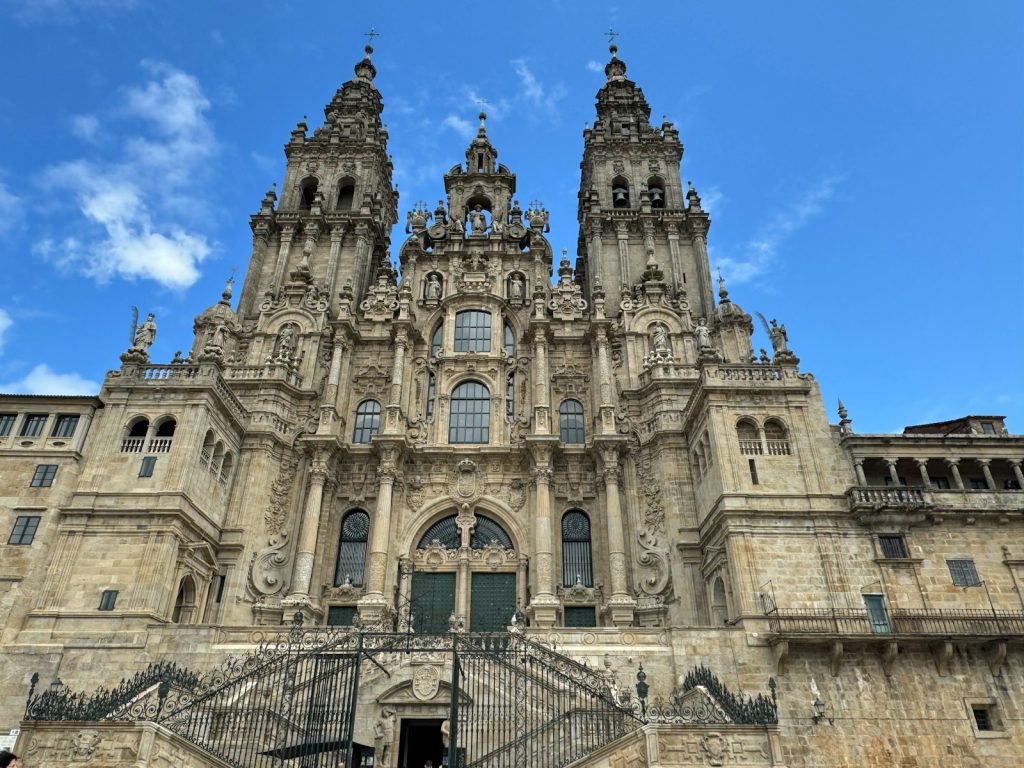
Before leaving Santiago, tradition calls for attending the pilgrims’ Mass in the Cathedral, visiting the apostle’s crypt and taking a breather in the Obradoiro. If you are going in 2027, bear in mind that it is a Holy Year and you will be able to walk through the Holy Door.
The Compostela in the 2027 Xacobeo
In 2027, 25 July falls on a Sunday, so it will be a Compostela Holy Year and the year is expected to bring the most pilgrims in history. In 2025 the Office already issued 530,987 Compostelas, a record, and 2026 is running ahead. In practice, that means longer queues at the Office, especially from May to September and in the week of 25 July. Register online in advance, arrive with time to spare and, if you can, collect your Compostela first thing. You have more tips in how to prepare for the 2027 Xacobeo.
Official link: the Pilgrim’s Office publishes the online registration, current opening hours and the Compostela requirements on its website.
FAQ
How many kilometres do you have to walk to get the Compostela?
The last 100 km on foot or on horseback, or the last 200 km by bike, continuously and ending in Santiago.
Is the Compostela free?
Yes. The Compostela is free. The distance certificate, which is optional, costs €3.
Is online registration compulsory to collect the Compostela?
Yes. You have to register on the Pilgrim’s Office website and bring the code they email you; without it you cannot go in to collect it.
How many stamps do I need on my credential?
One a day for the whole Camino and at least two a day over the last 100 km on foot or 200 km by bike.
Can I start in Lugo or Vigo?
It won’t count for the Compostela: Lugo is 99.3 km and Vigo 99.1 km from Santiago. You have to start earlier, for example at O Cádavo or Baiona.
Do I need to be Catholic to get the Compostela?
You don’t need to be practising, but you do need to walk the Camino with a religious or spiritual purpose, even if it is one of searching. If that is not your case, the Office offers you the welcome certificate.
Do children get the Compostela?
Children who walk the route can receive it. For the youngest, who have not yet made their First Communion, there is a separate document called the Bolecha.
Can someone else collect the Compostela for me?
In registered groups, a single person can collect all the Compostelas with everyone’s credentials. Individual pilgrims collect it in person.
What is the shortest starting point that counts for the Compostela?
Among the usual starting points, Ourense, on the Vía de la Plata via the Sanabrés, 104.3 km from Santiago. On the Francés, Sarria, 114.2 km away.
What is the difference between the Compostela and the distance certificate?
The Compostela certifies the pilgrimage and is free; the distance certificate, optional and costing €3, details the kilometres covered, the starting point and the dates.
Do I have to carry the paper credential?
Yes. The digital credential complements the paper one, but what you present at the Office is the stamped credential.
With the Compostela clear, all that is left is to decide which Camino to walk and when to go, and find where to sleep in the accommodation finder.