
Camino Catalán
The Camino Catalán (Catalan Way) is the Camino de Santiago that leaves Barcelona, climbs to Montserrat and crosses Catalonia and Upper Aragon via Tàrrega, Monzón and Huesca to Santa Cilia, where it joins the Camino Aragonés after passing the monastery of San Juan de la Peña. It covers 382.4 km in 16 stages, and about 1,173 km to Santiago.
It is a route of monasteries, castles and Romanesque churches, with two variants: the Baix Llobregat one, which leaves Barcelona along the river, and the one that goes via Lleida and Zaragoza instead of Huesca. It has 30 albergues, 23 of them public, and 90% are open all year. In this guide you have the map, the stages, the variants, what to see, when to go, how to get there and where to sleep.
- The stages
- Key facts
- Stages by section
- The variants
- What to see
- When to go
- Getting there
- From Santa Cilia to Santiago
- Where to sleep
- Tips
- Credential and Compostela
- FAQ
The stages of the Camino Catalán
The map shows the main route from Barcelona to Santa Cilia via Sant Cugat, Montserrat and Huesca and below it all the stages, including those of the variants. Tap one to see its route, the villages, what to see and where to sleep.
Tap a point to see the stage; zoom in to see the numbers. On mobile, tap the map to move it. Route: © OpenStreetMap contributors (ODbL).
Easy Moderate Hard
Camino Catalán key facts
| Fact | Camino Catalán |
|---|---|
| Route | Barcelona › Santa Cilia (382.4 km in 16 stages) |
| To Santiago | About 1,173 km from Barcelona, continuing along the Camino Aragonés and the Camino Francés |
| Variants | Baix Llobregat (45.8 km, 2 stages) and via Lleida and Zaragoza to El Burgo de Ebro (193.5 km, 7 stages) |
| Average per stage | 23.9 km; the longest, 31 km (La Peña Estación › Santa Cilia) |
| Total ascent | About 5,724 m from Barcelona to Santa Cilia |
| Highest point | 1,224 m, on the climb to San Juan de la Peña |
| Albergues | 30 (23 public), with 758 beds; 27 open all year |
| Albergue bed | €18.70 on average; double room, €68 |
| Asphalt or paved | 42% of the route; 14% on roads with traffic |
| Longest section without a fountain, bar or shop | 20.5 km, between Tamarite de Litera and Monzón |
| Longest section without accommodation | 28.6 km |
| Medium difficulty | 2.4 out of 5 |
| Backpack transfer with Correos | Not available on this route |
The stages of the Camino Catalán by section
The stages of the Catalán are of medium length, from 12 to 31 km. The route is flat in Lleida and on the Llanos de Huesca, and has its two big climbs at the beginning and the end: Montserrat and San Juan de la Peña.
From Barcelona to Montserrat: 3 stages and 61.6 km
It leaves Barcelona over Collserola towards Sant Cugat del Vallès and continues via Terrassa, with the churches of Sant Pere, Ullastrell and Olesa de Montserrat to Esparreguera. The third stage, Esparreguera › Monestir de Montserrat, is short, 11.8 km, but climbs 689 m via Collbató to the monastery.
From Montserrat to Tàrrega: 3 stages and 77.4 km
It descends from Montserrat to Igualada, with the basilica of Santa María, and continues via Jorba and La Panadella to the Segarra. The stage La Panadella › Tàrrega, 28.6 km, passes through Cervera, with its old university and walled old town, before reaching Tàrrega.
From Tàrrega to Monzón: 4 stages and 96.2 km
The main route crosses the plain of Lleida via Linyola, Balaguer, Algerri and Alfarràs and enters Aragon at Tamarite de Litera. The stage Tamarite de Litera › Monzón has the longest stretch of the route without a fountain, bar or shop, 20.5 km, and ends in Monzón, at the foot of its castle.
From Monzón to Huesca: 3 stages and 65.8 km
Via Selgua and Berbegal, Pertusa and Antillón, the route crosses the cereal country of the Somontano and the Llanos to Pueyo de Fañanás and Huesca. See the stage Pueyo de Fañanás › Huesca.
From Huesca to Santa Cilia: 3 stages and 81.4 km
The finish is the best section: from Huesca to Bolea, and from there via Loarre, with its castle, and Sarsamarcuello to La Peña Estación. The last stage, La Peña Estación › Santa Cilia, is the longest and hardest, 31 km and 951 m of climbing: it passes Ena and Botaya, climbs to the new and old monasteries of San Juan de la Peña and descends via Santa Cruz de la Serós and Binacua to Santa Cilia, already on the Camino Aragonés.
The variants of the Camino Catalán
- Baix Llobregat variant, from Barcelona to Esparreguera in 2 stages and 45.8 km: Barcelona › Molins de Rei and Molins de Rei › Esparreguera. It goes via L’Hospitalet, Cornellà, Sant Joan Despí and Martorell, with its Devil's Bridge. It is flatter than the Sant Cugat route, but with more urban stretches.
- Variant via Lleida and Zaragoza, from Tàrrega to El Burgo de Ebro in 7 stages and 193.5 km: via Bellpuig, Lleida, with its two cathedrals, Fraga, Candasnos, Bujaraloz and Pina de Ebro. It crosses Los Monegros, with the 38.3 km stage Bujaraloz › Pina de Ebro, and reaches the gates of Zaragoza, where you can continue along the Camino del Ebro.
What to see on the Camino Catalán
Monasteries, castles and Romanesque. These are the places you should not miss:
- Cathedral of Santa Eulalia and basilica of Santa María del Mar, in Barcelona
- Churches of Sant Pere, in Terrassa (on the World Heritage tentative list)
- Devil's Bridge, in Martorell (Baix Llobregat variant)
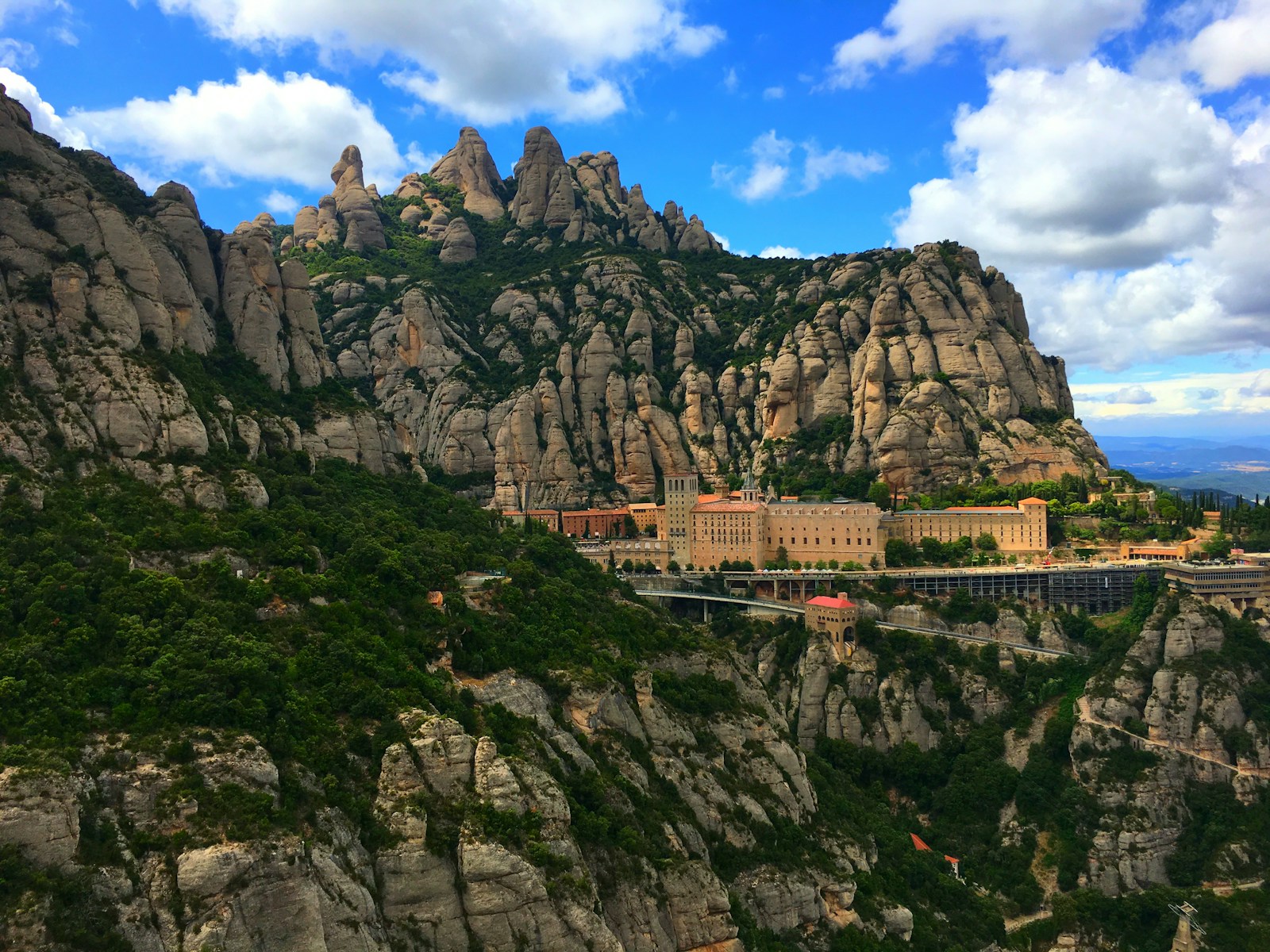
- Monastery of Montserrat, in Montserrat
- Basilica of Santa María, in Igualada
- University, walls and old town, in Cervera
- Castle, in Tàrrega
- Castle, in Monzón
- Loarre Castle, in Loarre
- Monasteries of San Juan de la Peña, in San Juan de la Peña
- Churches of Santa María and San Caprasio, in Santa Cruz de la Serós
- Old Cathedral and New Cathedral, in Lleida (variant via Lleida and Zaragoza)
The churches of Santa Cruz de la Serós, Binacua and Santa Cilia and the monastery of San Juan de la Peña are part of the World Heritage Camino de Santiago.
When to walk the Camino Catalán
It can be walked all year: of the 30 albergues, between 25 and 28 are open each month. The best seasons are spring, from April to June, and autumn, from September to October. In summer it is hot on the plain of Lleida and Huesca: the average high is 31 °C in July. In winter average lows drop to 2.5 °C in January, and the climb to San Juan de la Peña, above 1,200 m, may have snow.
| Month | Average high | Average low | Rainy days | Albergues open |
|---|---|---|---|---|
| January | 10 °C | 2.5 °C | 4.7 | 27 of 30 |
| February | 12.6 °C | 3.1 °C | 3.8 | 27 of 30 |
| March | 16.4 °C | 5.4 °C | 4.3 | 27 of 30 |
| April | 18.6 °C | 7.3 °C | 5.9 | 28 of 30 |
| May | 22.7 °C | 11 °C | 6.2 | 28 of 30 |
| June | 27.7 °C | 14.9 °C | 3.8 | 28 of 30 |
| July | 31 °C | 17.7 °C | 2.3 | 28 of 30 |
| August | 30.6 °C | 17.8 °C | 3.3 | 27 of 30 |
| September | 26.1 °C | 14.7 °C | 4.6 | 27 of 30 |
| October | 20.6 °C | 11 °C | 6 | 28 of 30 |
| November | 14.3 °C | 6.1 °C | 5.1 | 27 of 30 |
| December | 10.2 °C | 3.2 °C | 5 | 25 of 30 |
Temperatures and rain: route averages, using the normals from the weather station closest to each stage end. Open albergues: our own analysis of each albergue's opening dates.
How to get to Barcelona to start the Camino Catalán
From Madrid there are 25 direct trains a day to Barcelona-Sants, the fastest in 3 h 02 min (AVE). Barcelona also has an airport and connections with the whole of Spain. To get back from Santa Cilia, the easiest is to go to Jaca, a few kilometres away, which has buses and trains.
Source: Renfe timetables checked on 12/11/2026. Check those for the day you travel at renfe.com.
If you have fewer days, you can start in Montserrat, Tàrrega or Huesca. With the planner you choose the starting point and the days you have.
From Santa Cilia to Santiago
At Santa Cilia the Camino Catalán joins the Camino Aragonés, which continues via Arrés, Ruesta and Sangüesa to Puente la Reina, where it joins the Camino Francés. The next stage is Jaca › Arrés, which passes through Santa Cilia. From Barcelona to Santiago it is about 1,173 km.
Where to sleep on the Camino Catalán
There are 30 albergues on the Camino Catalán and its variants, 23 of them public, with 758 beds, and 189 places to stay in total. An albergue bed costs €18.70 on average and a double room €68.
This table shows what there is at each stage end. The accommodation finder for the Camino Catalán has them all, with price, phone number and website.
| Stage | Stage end | Albergues | Bed from | Other accommodation |
|---|---|---|---|---|
| 1 | Sant Cugat del Vallès | 0 | — | 4 |
| 2 | Esparreguera | 0 | — | 1 |
| 3 | Monestir de Montserrat | 1 | 10 € | 2 |
| 4 | Igualada | 1 (1 pub.) | 22 € | 3 |
| 5 | La Panadella | 0 | — | 1 |
| 6 | Tàrrega | 1 (1 pub.) | 10 € | 4 |
| 7 | Linyola | 0 | — | 3 |
| 8 | Algerri | 1 (1 pub.) | 10 € | 1 |
| 9 | Tamarite de Litera | 1 (1 pub.) | Donation | 1 |
| 10 | Monzón | 1 (1 pub.) | 13 € | 5 |
| 11 | Berbegal | 1 (1 pub.) | 10 € | 1 |
| 12 | Pueyo de Fañanás | 1 (1 pub.) | 10 € | 0 |
| 13 | Huesca | 1 (1 pub.) | 10 € | 12 |
| 14 | Bolea | 1 (1 pub.) | — | 1 |
| 15 | La Peña Estación | 0 | — | 1 |
| 16 | Santa Cilia | 1 (1 pub.) | Donation | 0 |
Indicative prices of the cheapest albergue bed; "—" means we do not have the price.
Tips for the Camino Catalán
- Save energy for the end. The last stage, from La Peña Estación to Santa Cilia, is 31 km with 951 m of climbing. If you are short of strength, you can split it.
- Carry water. The longest stretches without a fountain, bar or shop are 20.5 km on Tamarite de Litera › Monzón; 16.3 km on Monestir de Montserrat › Igualada; 15.2 km on Huesca › Bolea; 14.2 km on Igualada › La Panadella.
- Book in Montserrat. It is a very popular place: book the accommodation next to the monastery well in advance.
- Choose your variant before you set off: the Sant Cugat route has fewer urban stretches than the Baix Llobregat one, and the Huesca route passes Loarre and San Juan de la Peña, while the Lleida and Zaragoza route has longer stages across Los Monegros.
- Count the daylight hours. In January there are about 9.4 hours of daylight a day and in June, up to 15.3.
- There is no Correos backpack transport on this route.
- Prepare the trip with our guides to the first-aid kit, useful apps and the monasteries of the Camino.
Credential and Compostela
The credencial is the document that identifies you as a pilgrim: it gives access to the albergues and is the proof you need to request the Compostela. The official model is issued by the Pilgrimage Office of Santiago Cathedral and can be obtained from parishes, Friends of the Camino associations, albergues and authorised confraternities. More details in our guide to the pilgrim credencial.
For the Compostela you must walk at least the last 100 consecutive km to Santiago (200 km by bike), getting your credencial stamped twice a day on that stretch. Continuing along the Camino Francés, the nearest qualifying start is A Pena (Paradela), 100 km away. It is collected in person at the Pilgrim Office.
Camino Catalán FAQ
How many kilometres is the Camino Catalán?
382.4 km from Barcelona to Santa Cilia in 16 stages, and about 1,173 km to Santiago continuing along the Camino Aragonés and the Camino Francés.
How many days does it take to walk the Camino Catalán?
16 days from Barcelona to Santa Cilia, at an average of 23.9 km a day. With the planner you can spread it over the days you have.
Where does the Camino Catalán start?
In Barcelona. There are two ways out: via Sant Cugat and Terrassa, the main route, or via the Baix Llobregat, through Molins de Rei and Martorell. The two meet at Esparreguera.
Where does the Camino Catalán join the Camino Aragonés?
At Santa Cilia, after passing San Juan de la Peña. The variant via Lleida and Zaragoza ends at El Burgo de Ebro, where you can continue along the Camino del Ebro.
Is the Camino Catalán hard?
Its average difficulty is 2.4 out of 5. The hardest parts are the climb to Montserrat and the last stage to San Juan de la Peña, 31 km with 951 m of climbing.
When is the best time to walk the Camino Catalán?
In spring and autumn. It can be walked all year because almost all the albergues are always open, but in summer it is hot on the plain and in winter it may snow at San Juan de la Peña.
Are there albergues on the Camino Catalán?
Yes: 30 albergues, 23 of them public, at an average of €18.70 per bed. You will find them in the accommodation finder.
Can you get the Compostela by walking the Camino Catalán?
Yes, if you reach Santiago on foot and walk at least the last 100 km getting stamped twice a day. The Camino Catalán only goes as far as Santa Cilia: you have to continue along the Aragonés and the Francés.
Plan your days with the planner and, from Santa Cilia, continue along the Camino Aragonés. To prepare the trip see the practical guides to the Camino de Santiago or compare other routes in all the Caminos.