
Camino de Fisterra and Muxía
The Camino de Fisterra is the only one that starts in Santiago: it leads to the sea, to Cape Fisterra (Finisterre in Spanish), which for centuries was considered the end of the known world, and to Muxía, next to the sanctuary of the Virxe da Barca. It covers 86.2 km from Santiago to Fisterra in four stages, plus 3.2 km to the lighthouse, or 85.3 km to Muxía; many pilgrims do both, linking them along the coast in a 27.6 km stage.
In this guide to the Camino de Fisterra and Muxía you have the key facts, the map, the stages, how to combine Fisterra and Muxía, the must-see places, when to go, how to get back to Santiago, where to sleep, what to eat and the certificates you receive on arrival. It is the epilogue to many caminos and also a complete route in its own right, with woods, the Xallas valley and the Costa da Morte.
- The stages
- Key facts
- Stages by section
- Stage by stage
- Fisterra and Muxía
- Must-sees
- When to go
- Getting back
- Where to sleep
- What to eat
- Tips
- Credencial and certificates
- FAQ
The stages of the Camino de Fisterra and Muxía
The map shows the whole route and below it each stage with its start, finish and distance. Tap one to see its elevation profile, the villages along the way and where to sleep.
Tap a point to see the stage; zoom in to see the numbers. On mobile, tap the map to move it. Route: © OpenStreetMap contributors (ODbL).
Easy Moderate Hard
Camino de Fisterra key facts
| Fact | Camino to Fisterra and Muxía |
|---|---|
| Route | Santiago › Fisterra (86.2 km in 4 stages) and 3.2 km more to the lighthouse |
| To Muxía | 85.3 km; the turn-off leaves from Olveiroa |
| Between Muxía and Fisterra | 27.6 km along the coast, via Lires |
| Fisterra and Muxía together | About 113.8 km from Santiago, in five stages |
| Total ascent | About 1,682 m from Santiago to the lighthouse |
| Highest point | 476 m |
| Albergues | 74 (7 public); 31 open all year |
| Albergue bed | €17.40 on average |
| Asphalt or paved | 45% of the route |
| Longest section without a fountain, bar or shop | 8.5 km |
| Backpack transfer with Correos | Yes, from March to October |
The stages of the Camino de Fisterra by section
The Camino de Fisterra starts in the Obradoiro and soon leaves the city through woods and hamlets. The hardest stage is the second, from Negreira to Olveiroa; then the path splits and descends towards the coast, to Fisterra or to Muxía.
| Section | From › to | Stages | Km |
|---|---|---|---|
| From Santiago to Olveiroa | Santiago de Compostela › Olveiroa | 1–2 | 54.2 |
| From Olveiroa to Fisterra | Olveiroa › Fisterra lighthouse | 3–4 | 35.2 |
| From Olveiroa to Muxía | Olveiroa › Muxía | 5 | 31.1 |
| From Muxía to Fisterra | Muxía › Fisterra | 6 | 27.6 |
From Santiago to Olveiroa: 54.2 km
Two stages and 54.2 km. The first reaches Negreira over the medieval bridge of Ponte Maceira; the second, 33.6 km, is the longest and hardest of the route, with about 630 m of climbing and small hamlets as far as the Xallas valley. See the stage Negreira › Olveiroa.
From Olveiroa to Fisterra: 35.2 km to the lighthouse
Two stages to the end of the world. On the way down to Cee the sea finally appears, and the path descends to the Corcubión estuary and follows the coast, with Langosteira beach, to Fisterra and the lighthouse. See the stage Cee › Fisterra lighthouse.
From Olveiroa to Muxía: 31.1 km
A long stage, 31.1 km, that leaves the Fisterra route after Olveiroa and reaches Muxía past the Romanesque church of San Julián de Moraime. See the stage Olveiroa › Muxía.
From Muxía to Fisterra: 27.6 km
27.6 km along the Costa da Morte linking the two finishes, with Lires halfway. It can be walked in both directions. See the stage Muxía › Fisterra.
The Camino de Fisterra and Muxía stage by stage
A summary of each stage of the Camino de Fisterra and Muxía: distance, climbing, villages on the way and where there is accommodation. Each stage page has the map, the profile and all the services.
Stage 1: Santiago de Compostela › Negreira. 20.6 km and about 470 m of climbing; easy. It passes through Quintáns, Alto do Vento, Ventosa, Augapesada, Trasmonte and Ponte Maceira. Before the end there is accommodation in Ventosa (1), in case you want to shorten it. See the stage.
Stage 2: Negreira › Olveiroa. 33.6 km and about 610 m of climbing; hard. It passes through Zas, A Pena, Vilaserío, O Cornado, As Maroñas and Santa Mariña. Before the end there is accommodation in A Pena (2), Vilaserío (3), Santa Mariña (2) and Lago (1), in case you want to shorten it. See the stage.
Stage 3: Olveiroa › Corcubión. 21.4 km and about 260 m of climbing; easy. It passes through O Logoso, Hospital and Cee. Before the end there is accommodation in O Logoso (3), Hospital (1) and Cee (11), in case you want to shorten it. See the stage.
Stage 4: Cee › Fisterra lighthouse. 15.9 km and about 350 m of climbing; easy. It passes through Corcubión, Estorde and Sardiñeiro de Abaixo. Before the end there is accommodation in Corcubión (6), Estorde (2) and Sardiñeiro de Abaixo (2), in case you want to shorten it. See the stage.
Stage 5: Olveiroa › Muxía. 31.1 km and about 480 m of climbing; moderate. It passes through O Logoso, Hospital, Dumbría, Trasufre, Senande and A Grixa. Before the end there is accommodation in O Logoso (3), Hospital (1), Dumbría (3) and A Grixa (3), in case you want to shorten it. See the stage.
Stage 6: Muxía › Fisterra. 27.6 km and about 600 m of climbing; moderate. It passes through Xurarantes, Morquintián, Guisamonde, Frixe, Lires and A Canosa. Before the end there is accommodation in Frixe (1), Lires (11) and As Escaselas (3), in case you want to shorten it. See the stage.
Fisterra and Muxía: how to combine them on the Camino de Fisterra
There are three usual ways to walk this route. The most classic is to go only to Fisterra: 86.2 km in four stages, and the final walk to the lighthouse to watch the sunset. The second, going only to Muxía: 85.3 km in three stages, the last one long. The third, the most complete, is to do both, first Fisterra and then Muxía along the coast, or the other way round: about 113.8 km in five stages.
| Option | Km from Santiago | Stages |
|---|---|---|
| Fisterra only | 86.2 (plus 3.2 to the lighthouse) | 4 |
| Muxía only | 85.3 | 3 |
| Fisterra and Muxía | 113.8 | 5 |
To get back to Santiago from either there are direct buses, so there is no need to walk back.
Must-sees on the Camino de Fisterra
The places worth a stop on the Camino de Fisterra, in the order they appear.
- Ponte Maceira · Ponte Maceira (stage 1). A 13th-century five-arched bridge over the Tambre, built on Roman foundations, in a medieval ensemble that is a listed heritage site.
- Pazo do Cotón · Negreira (stage 1). A manor house of medieval origin with battlements and a three-arched gallery that the path passes under; next to it, the Monument to the Emigrant.
- Olveiroa · Olveiroa (stage 2). A traditional hamlet in the Xallas valley, with stone lanes and many hórreos, and dolmens and rock carvings nearby.
- Church of San Marcos · Corcubión (stage 3). In an old quarter that is a listed historic ensemble, it keeps the 15th-century Venetian carving of San Marcos da Cadeira.
- Santa María das Areas · Fisterra (stage 4). A 12th and 13th-century church you pass on the way to the cape, with a pilgrim mass every evening. In the town there are also the 18th-century castle of San Carlos, with a small fishing museum, and the three-kilometre Langosteira beach, with the Cruz de Baixar wayside cross.
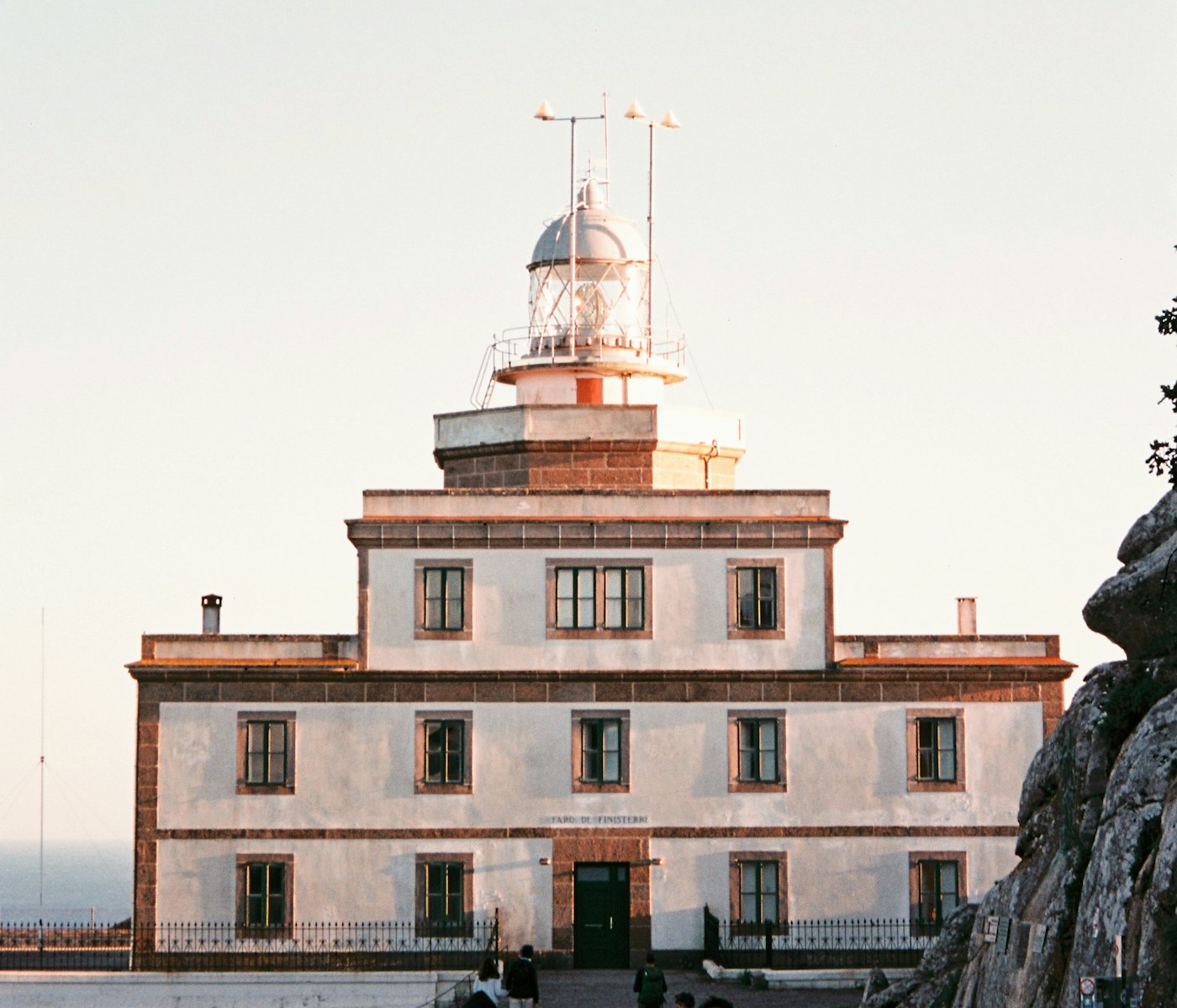
- Cape and lighthouse of Fisterra · Fisterra lighthouse (stage 4). The goal of the old pilgrimages to the end of the earth: the mid-19th-century lighthouse and the rocks where you watch the sunset.
- San Julián de Moraime · Moraime (stage 5). A 12th-century Romanesque church at the gates of Muxía.
- Virxe da Barca and the Pedras Santas · Muxía (stage 5). The wave-battered sanctuary, surrounded by rocks credited with healing powers since prehistoric times.
When to walk the Camino de Fisterra
On the Costa da Morte the climate is mild all year, between an average high of 12.2 °C in January and 25.5 °C in August, but it rains often and the wind can be strong on the coast. From April to October almost all the albergues are open; in winter, fewer than half. The best time is May to September.
| Month | Avg. high | Avg. low | Albergues open |
|---|---|---|---|
| January | 12.2 °C | 5.4 °C | 42 % |
| February | 13.5 °C | 5.5 °C | 43 % |
| March | 16.1 °C | 6.8 °C | 68 % |
| April | 17.0 °C | 7.5 °C | 95 % |
| May | 19.8 °C | 9.9 °C | 97 % |
| June | 23.2 °C | 12.6 °C | 97 % |
| July | 25.3 °C | 14.1 °C | 97 % |
| August | 25.5 °C | 14.4 °C | 97 % |
| September | 23.3 °C | 13.0 °C | 97 % |
| October | 19.0 °C | 10.8 °C | 91 % |
| November | 14.9 °C | 7.9 °C | 62 % |
| December | 12.8 °C | 6.3 °C | 45 % |
How to get back to Santiago from Fisterra or Muxía
The route starts in the Plaza del Obradoiro, so you need no transport to reach the start. To get back, from Fisterra there are several buses a day to Santiago, taking 1 h 15 min to 3 h depending on the service, and from Muxía about four a day; in Santiago you connect with trains or flights.
| From | To Santiago |
|---|---|
| Fisterra | Bus, several a day, 1 h 15 min to 3 h |
| Muxía | Bus, about 4 a day |
Where to sleep on the Camino de Fisterra and Muxía
Between Santiago, Fisterra and Muxía there are 74 albergues, only 7 of them public, and 31 are open all year. A dormitory bed costs €17.40 on average. Each stage lists the accommodation at the end of the day with price, beds and phone number, and in the accommodation finder you can filter them by town.
Many pilgrims end the third stage in Cee instead of Corcubión, because it has more private albergues; the two towns are about 2 km apart.
What to eat on the Camino de Fisterra
It is a route that ends at the sea, and you notice it at the table: scallops in Fisterra, fish and seafood from the fish market in Muxía and, along the way, hearty stews in the inland hamlets.
- At Carnival (Entroido), filloas in Negreira, from the traditional ones made with pig's blood to filled ones.
- In Olveiroa, hearty stews: caldo gallego, cocido, tripe with chickpeas and homemade flan.
- In Fisterra, scallops cooked a thousand ways (and their shell, as a keepsake for your backpack), and in Muxía, fish and seafood from the fish market.
- In August, Corcubión holds its clam festival, with tastings washed down with albariño and ribeiro.
Tips for the Camino de Fisterra
- If you come from another camino, rest a day in Santiago before continuing: the stage from Negreira to Olveiroa is long.
- Decide in Olveiroa whether you go first to Fisterra or to Muxía: the two routes split a few kilometres later.
- Reach the lighthouse in time to watch the sunset and walk back to town with a torch.
- Bring warm clothes and a rain jacket: on the coast the wind blows even in summer.
- With only seven public albergues, in summer it is worth booking the private ones.
Credencial, Fisterrana and Muxiana
To sleep in the albergues you need the credencial, the same one from your camino to Santiago or a new one, which you can get from parishes, Friends of the Camino associations and authorised albergues.
The Compostela is requested in Santiago, at the Pilgrim Office, and this route does not earn it, because it does not end there. Instead, on arrival you can ask for two certificates of its own: the Fisterrana, in Fisterra, and the Muxiana, in Muxía, by showing your credencial stamped from Santiago. For opening hours and services at the destination, see the official website of the Concello de Fisterra.
Camino de Fisterra FAQ
How many kilometres is it from Santiago to Fisterra?
86.2 km to the town of Fisterra, in four stages, and 89.4 km to the lighthouse.
How many kilometres is it from Santiago to Muxía?
85.3 km, in three stages. The turn-off to Muxía leaves from Olveiroa.
How many days does it take to walk the Camino de Fisterra?
Four days to Fisterra, three to Muxía or five to do both. With the planner you can spread it over the days you have.
Which is better, Fisterra or Muxía?
Fisterra has the lighthouse and the end-of-the-world sunset; Muxía, the sanctuary of the Virxe da Barca by the sea and fewer people. If you have five days, do both.
Does the Camino de Fisterra earn the Compostela?
No, because it does not end in Santiago. In Fisterra they give the Fisterrana and in Muxía the Muxiana, on showing your stamped credencial.
Which is the hardest stage of the Camino de Fisterra?
The one from Negreira to Olveiroa: 33.6 km and about 630 m of climbing, with few services.
How do you get back from Fisterra to Santiago?
By Monbus bus: there are several a day, taking 1 h 15 min to 3 h depending on the service. From Muxía there are about four a day. From Santiago there are trains to Madrid and the rest of Spain.
Can you walk from Fisterra to Muxía?
Yes: it is 27.6 km along the coast, via Lires, and the stage is waymarked in both directions, so you can also walk it from Muxía to Fisterra and finish watching the sunset at the lighthouse.
How many albergues are there on the Camino de Fisterra and Muxía?
There are 74 albergues, seven of them public. From May to September 72 are open; in January, only 31, so out of season it is worth phoning before you set off.
How much does it cost to sleep on the Camino de Fisterra?
A dormitory bed costs €17.40 on average, so the five nights of the full itinerary to the lighthouse come to about €87 in albergues.
Is there much asphalt on the Camino de Fisterra?
A little under half of the route, around 45%, is on asphalt or paving. The longest stretch without a fountain, bar or shop is 8.5 km, so always set out with water.
Is the climbing on the Camino de Fisterra hard?
It is moderate: about 1,682 m of cumulative climbing over 89.4 km to the lighthouse, and the highest point barely exceeds 470 m. What tires you is the length of the second stage, not the hills.
Plan your days with the planner. If you have not yet reached Santiago, look at the Camino Francés, the Camino Portugués or the Camino Inglés, and to prepare the trip see the practical guides to the Camino de Santiago or compare routes in all the Caminos.
All 6 stages, one by one
Each stage with its distance and difficulty. Tap a stage to see the map, the villages and where to sleep.