
Camino Aragonés
The Camino Aragonés is the entry of the Camino de Santiago over the Somport pass, in the Aragonese Pyrenees, at 1,630 m. It covers 162.2 km in 6 stages through the Jacetania and the Canal de Berdún, with Canfranc, Jaca, Sangüesa and Monreal, until it joins the Camino Francés near Puente la Reina, in Navarre.
It is the Spanish continuation of the Via Tolosana, one of the four French routes described in the Codex Calixtinus, and the other great Pyrenean entry of the Camino besides Roncesvalles. It has long stages, very few people and first-rate Romanesque heritage. In this guide to the Camino Aragonés you have the key facts, the stages by section, a summary of each stage, the profile, the must-see places, when to go, how to get to Somport, where to sleep, what to eat and how to continue to Santiago.
- The stages
- Key facts
- Stages by section
- Stage by stage
- The profile
- History
- Must-sees
- When to go
- Getting there
- Where to sleep
- What to eat
- Tips
- Credential and Compostela
- FAQ
The stages of the Camino Aragonés
The map shows the whole route and below it each stage with its start, finish and distance. Tap one to see its elevation profile, the villages along the way and where to sleep.
Easy Moderate Hard
Camino Aragonés key facts
| Fact | Camino Aragonés |
|---|---|
| Route | Somport › Puente la Reina: 162.2 km in 6 stages |
| To Santiago | About 836 km from Somport, continuing along the Camino Francés |
| Average per stage | 27.0 km; the longest, 30.6 km |
| Total ascent | About 2,028 m |
| Highest point | 1,630 m, at the Somport pass |
| Albergues | 26 (10 public); 9 open all year |
| Albergue bed | €18.00 on average |
| Asphalt or paved | 22% of the route |
| Longest section without a fountain, bar or shop | 13.2 km |
| Backpack transfer with Correos | From Somport, on request and Monday to Friday |
The stages of the Camino Aragonés by section
The Camino Aragonés descends from the Pyrenees to Jaca, crosses the Canal de Berdún from east to west, alongside the river Aragón and the Yesa reservoir, and enters Navarre at Sangüesa to finish at Puente la Reina.
The Pyrenees and the Jacetania: 2 stages and 55.0 km
The first stage leaves the Somport pass and descends for 30.2 km down the Aragón valley, through Canfranc-Estación, Canfranc, Villanúa and Castiello de Jaca, to Jaca: far more downhill than uphill, only 155 m of climbing. The second, from Jaca to Arrés, is one of the easiest, through Santa Cilia and Puente la Reina de Jaca. See the stage Somport › Jaca.
The Canal de Berdún and the Yesa reservoir: 2 stages and 49.4 km
Two lonely stages through the Canal de Berdún, between cereal fields and hilltop villages such as Artieda, to Ruesta, an abandoned village beside the Yesa reservoir. Then, via Undués de Lerda, you enter Navarre and reach Sangüesa. There are few services: set out with water and food. See the stage Arrés › Ruesta.
Navarre to Puente la Reina: 2 stages and 57.8 km
From Sangüesa to Monreal, through Rocaforte, Izco, Abínzano and Salinas de Ibargoiti, with 531 m of climbing, and from Monreal to Puente la Reina, the longest stage, 30.6 km, via Tiebas and the chapel of Santa María de Eunate, until it joins the Francés at Obanos, at the gates of Puente la Reina. See the stage Monreal › Puente la Reina.
The Camino Aragonés stage by stage
A summary of each stage of the Camino Aragonés: distance, climbing, villages on the way and where there is accommodation. Each stage page has the map, the profile and all the services.
Stage 1: Somport › Jaca. 30.2 km and about 180 m of climbing; moderate. It passes through Canfranc-Estación, Canfranc, Villanúa and Castiello de Jaca. Before the end there is accommodation in Canfranc-Estación (8), Canfranc (4), Villanúa (3) and Castiello de Jaca (2), in case you want to shorten it. See the stage.
Stage 2: Jaca › Arrés. 24.8 km and about 220 m of climbing; easy. It passes through Santa Cilia and Puente la Reina de Jaca. Before the end there is accommodation in Santa Cilia (1) and Puente la Reina de Jaca (2), in case you want to shorten it. See the stage.
Stage 3: Arrés › Ruesta. 27.4 km and about 280 m of climbing; moderate. It passes through Artieda. Before the end there is accommodation in Artieda (3), in case you want to shorten it. See the stage.
Stage 4: Ruesta › Sangüesa. 22 km and about 410 m of climbing; easy. It passes through Undués de Lerda. Before the end there is accommodation in Undués de Lerda (1), in case you want to shorten it. See the stage.
Stage 5: Sangüesa › Monreal. 27.2 km and about 630 m of climbing; moderate. It passes through Rocaforte, Izco, Abínzano and Salinas de Ibargoiti. Before the end there is accommodation in Izco (1) and Abínzano (1), in case you want to shorten it. See the stage.
Stage 6: Monreal › Puente la Reina. 30.6 km and about 430 m of climbing; moderate. It passes through Yárnoz, Otano, Ezperun, Guerendiain, Tiebas and Muruarte de Reta. Before the end there is accommodation in Tiebas (2), Enériz (2) and Obanos (5), in case you want to shorten it. See the stage.
The Camino Aragonés profile
After the descent from the Pyrenees, the Camino Aragonés is a route of moderate gradients: 2,028 m of climbing over 162.2 km. What makes it demanding is the distance, with stages of 22 to 30.6 km and few villages where you can split them.
| Stage | From › to | Km | Ascent | Max. altitude | Difficulty |
|---|---|---|---|---|---|
| 1 | Somport › Jaca | 30.2 | 155 m | 1,630 m | Moderate |
| 2 | Jaca › Arrés | 24.8 | 245 m | 831 m | Easy |
| 3 | Arrés › Ruesta | 27.4 | 287 m | 704 m | Moderate |
| 4 | Ruesta › Sangüesa | 22.0 | 404 m | 863 m | Easy |
| 5 | Sangüesa › Monreal | 27.2 | 531 m | 783 m | Moderate |
| 6 | Monreal › Puente la Reina | 30.6 | 406 m | 628 m | Moderate |
History of the Camino Aragonés
The name Somport comes from the Latin Summus Portus, the highest pass: the Roman road linking Zaragoza with southern France crossed the Pyrenees here, and centuries later it was used by pilgrims arriving on the Via Tolosana from Arles and Toulouse. Next to the pass stood the hospital of Santa Cristina, which the Codex Calixtinus names as one of the three great hospitals of Christendom, along with those of Jerusalem and the Great St Bernard; its ruins survive today near Candanchú.
Jaca, the first capital of the kingdom of Aragon, built one of the first Romanesque cathedrals in the Iberian Peninsula in the 11th century, and along the route there are churches, bridges and hospitals from that period.
Must-sees on the Camino Aragonés
The places worth a stop, in the order they appear on the Camino Aragonés.
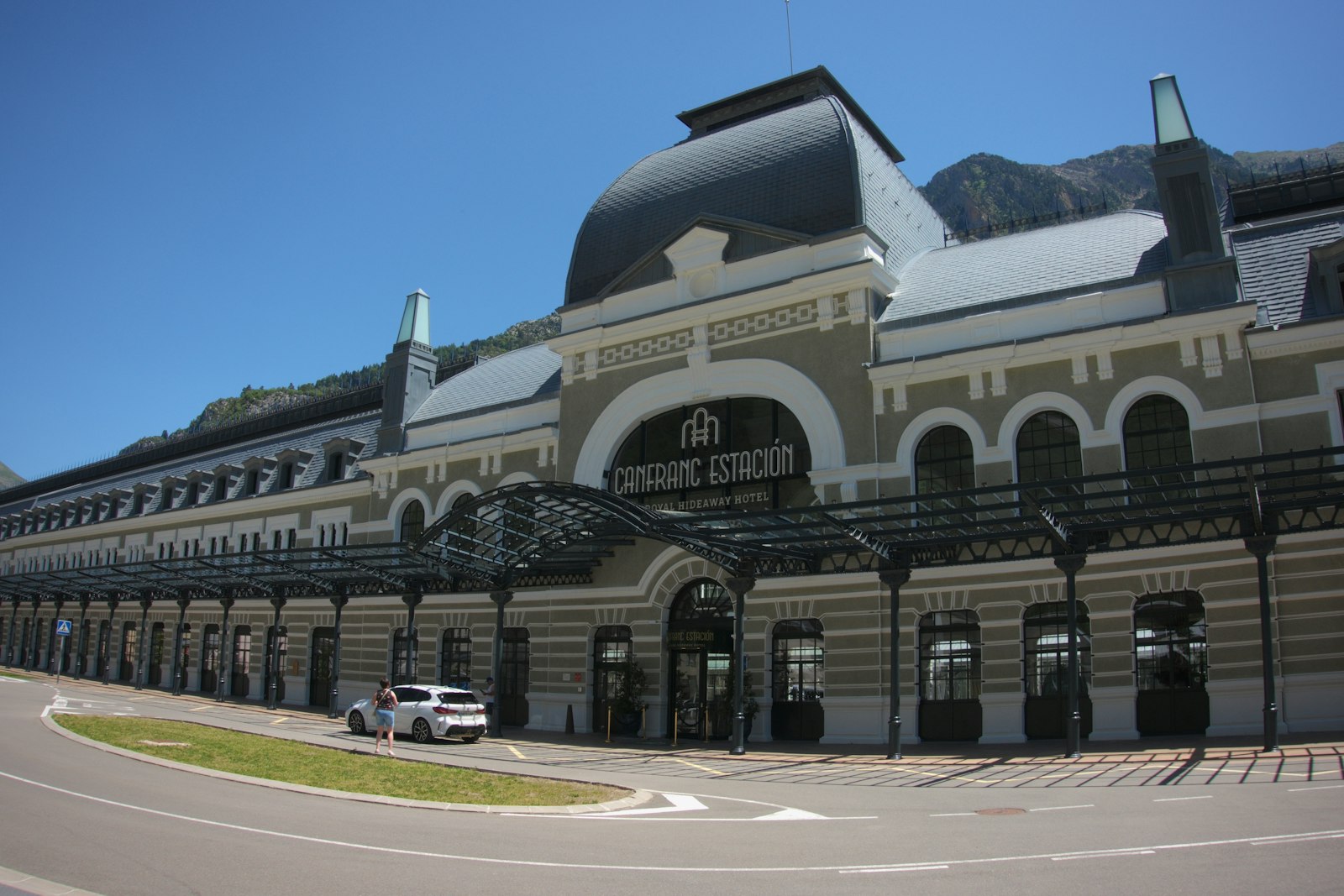
- Canfranc International Station · Canfranc-Estación (stage 1). A gigantic Modernist station and National Monument, opened in 1928 by Alfonso XIII when the Somport rail tunnel was completed.
- Canfranc · Canfranc (stage 1). A border village documented in the 11th century, whose name is said to come from Campus Francus, for the tolls collected there; it had a pilgrim hospital.
- Cathedral of San Pedro · Jaca (stage 1). One of the first Romanesque buildings in Spain (11th-12th centuries), a model for others, with the chrismon between two lions on the tympanum; free entry and Diocesan Museum.
- Arrés · Arrés (stage 2). A hamlet on the slope of a hill crowned by the remains of a Gothic fortress, with the church of La Concepción.
- Artieda · Artieda (stage 3). A hilltop village with a well-preserved medieval core and the church of San Martín, Romanesque in origin.
- Santa María la Real · Sangüesa (stage 4). A 12th and 13th-century Romanesque church by the bridge, with a superb doorway shaped like a stone altarpiece and an octagonal Gothic tower.
- Monreal · Monreal (stage 5). One of the friendliest villages on the route: in the 12th century it already had pilgrim hospitals and the Codex Calixtinus names it as the end of a stage.
- Santa María de Eunate · Muruzábal (stage 6). A 12th-century octagonal Romanesque chapel, surrounded by an arcaded cloister, shortly before joining the Camino Francés.
- Romanesque bridge · Puente la Reina (stage 6). The 11th-century bridge over the Arga that gave the town its name, one of the most important on the whole Way of St James.
When to walk the Camino Aragonés
The best seasons are May to June and September to October. In winter the Somport pass has snow and only 9 of the 26 albergues are open all year; in summer the Canal de Berdún is very hot, with long stretches without shade, and the route’s average highs reach 29.3 °C in July.
| Month | Avg. high | Avg. low | Albergues open |
|---|---|---|---|
| January | 9.1 °C | 1.4 °C | 31 % |
| February | 11.1 °C | 1.8 °C | 31 % |
| March | 15.0 °C | 4.0 °C | 50 % |
| April | 16.9 °C | 5.6 °C | 77 % |
| May | 21.3 °C | 9.0 °C | 81 % |
| June | 26.2 °C | 12.5 °C | 81 % |
| July | 29.3 °C | 15.0 °C | 81 % |
| August | 29.2 °C | 15.2 °C | 81 % |
| September | 25.0 °C | 12.5 °C | 81 % |
| October | 19.5 °C | 9.3 °C | 69 % |
| November | 13.2 °C | 4.9 °C | 46 % |
| December | 9.5 °C | 2.1 °C | 31 % |
How to get to Somport
From Madrid there is a direct train to Zaragoza, the fastest in 1 h 35 min. From Zaragoza three regional trains a day run to Jaca, in about 3 h 30 min, and two continue to Canfranc. From Jaca, the bus to Astún stops at Somport, with five services a day and a journey of about 35 minutes. When you finish in Puente la Reina you can continue along the Francés or return from Pamplona, about 25 km away.
Where to sleep on the Camino Aragonés
There are 26 albergues, 10 of them public, and 98 places to stay in total. An albergue bed costs €18.00 on average: the 6 nights come to about €108. Out of season many close, so phone ahead, especially in Arrés and Ruesta. Each stage lists the accommodation with price, beds and phone number, and in the accommodation finder you can filter by town.
What to eat on the Camino Aragonés
- In Jaca, its pastry shops: jaqueses, coronitas de Santa Orosia, condes, patatas de Jaca, teclas or pastillas ansotanas.
- From the cooking of the Jacetania, Aragonese migas with egg and grapes, roast ternasco lamb and the hearty olla jacetana stew.
- In Navarre, at the end of the route, vegetables from the Ribera, asparagus, pochas beans and D.O. Navarra wine.
Tips for the Camino Aragonés
- Be ready for long stages: the average is 27.0 km and there are few villages where you can split them.
- Carry water and food in the Canal de Berdún: there is a 13.2 km stretch without a fountain, bar or shop.
- If the first stage looks too much, start in Canfranc or Jaca: the descent from Somport is long.
- In summer, set out early: there is hardly any shade in the Canal de Berdún.
- Check which albergues are open out of season and book in Arrés, which has few beds.
Credential and Compostela
To sleep in the albergues you need the credencial, which you can get from parishes, Friends of the Camino associations and authorised albergues, including in Jaca.
The Camino Aragonés ends at Puente la Reina, where it joins the Camino Francés. For the Compostela you have to continue to Santiago, about 675 km away, and walk at least the last 100; it is requested at the Pilgrim Office.
Camino Aragonés FAQ
How many kilometres is the Camino Aragonés?
162.2 km from Somport to Puente la Reina, in 6 stages, and about 836 km to Santiago continuing along the Camino Francés.
Where does the Camino Aragonés start?
At the Somport pass, on the border with France, at 1,630 m. Some people start in Canfranc or Jaca.
Where does the Camino Aragonés join the Francés?
At Obanos, at the gates of Puente la Reina, in Navarre, after passing the chapel of Santa María de Eunate.
Which is the hardest stage of the Camino Aragonés?
By distance, the one from Monreal to Puente la Reina, 30.6 km; by climbing, the one from Sangüesa to Monreal, with 531 m of ascent.
When is the best time to walk the Camino Aragonés?
In spring and autumn. In winter there is snow at Somport and many albergues close, and in summer it is very hot in the Canal de Berdún.
What is the Via Tolosana?
One of the four French pilgrim routes in the Codex Calixtinus: it starts in Arles, passes through Toulouse and crosses the Pyrenees at Somport, where it continues as the Camino Aragonés until it joins the Francés in Navarre.
What is there to see on the Camino Aragonés?
Canfranc station, the Romanesque cathedral of Jaca, the hilltop villages of the Canal de Berdún, Santa María la Real in Sangüesa, Monreal, the chapel of Eunate and the bridge at Puente la Reina.
How do you get to Somport?
By train to Zaragoza and Jaca, and from Jaca on the Astún bus, which stops at Somport.
How many albergues are there on the Camino Aragonés?
26, 10 of them public, with an average bed price of €18.00.
How many days does it take to walk the Camino Aragonés?
About 6 days on foot, or seven or eight if you split the longest stages. With the planner you can split it at your own pace.
Plan your days with the planner, continue to Santiago along the Camino Francés and to prepare the trip see the practical guides to the Camino de Santiago or compare routes in all the Caminos.