
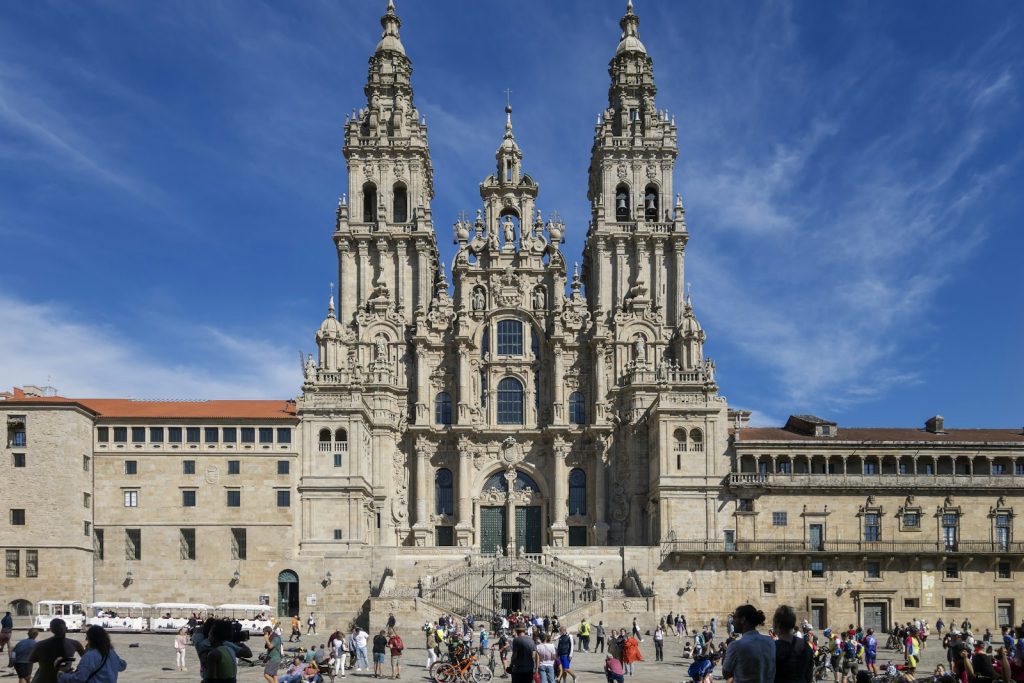
The 2027 Xacobeo is the next Compostela Holy Year: 25 July 2027, the feast of Saint James the Apostle, falls on a Sunday, and that makes the whole year a Jubilee Year. The Holy Door of the Cathedral opens on the last night of 2026, and the Camino de Santiago will have its most special year since 2021–2022. In this guide you have the key dates, what changes (and what doesn’t) for pilgrims, how many people are expected and how to organise your Camino de Santiago in 2027 so you can enjoy it without stress.
Contents
What the Compostela Holy Year is and why 2027 is a Xacobeo Year
The Compostela Holy Year, also called the Jacobean Year, Xacobeo Year or Jubilee Year, is celebrated whenever the feast of Saint James the Apostle, on 25 July, falls on a Sunday. In 2027 that happens, so it is a Holy Year from start to finish. Xacobeo is the Galician word and the official brand under which the Xunta de Galicia organises the celebration; Jacobeo is the Spanish form. They mean the same.
Because of the way the calendar works, Holy Years recur at intervals of 6, 5, 6 and 11 years. After 2027, the next will be 2032. The previous one was 2021, which was exceptionally extended to 2022 because of the pandemic.
The Holy Door: when it opens and where it is
The Holy Door of Santiago Cathedral is on the Praza da Quintana, at the back of the cathedral. It stays walled up in ordinary years and only opens in a Holy Year. For the 2027 Xacobeo it will open at midday on 31 December 2026, in a solemn ceremony presided over by the Archbishop of Santiago, and will remain open throughout 2027. This is new: in recent Holy Years the ceremony took place in the late afternoon, and the Archdiocese announced in September 2026 that this time it is being brought forward to midday. Check the exact time on the Cathedral website a few days beforehand, because it is a very busy event with limited access.
Entering the Cathedral through the Holy Door is one of the most moving moments for anyone arriving in Santiago in a Holy Year. Expect long queues in summer and on the big dates, especially around 25 July.
How to gain the Jubilee in 2027
For Catholics, the Holy Year allows you to gain the Jubilee, that is, the plenary indulgence. The Church sets three conditions:
- Visit the Apostle’s tomb in Santiago Cathedral and say a prayer there (at least the Creed and the Our Father, and pray for the Pope’s intentions).
- Go to confession in the fifteen days before or after the visit.
- Receive Communion.
Entering through the Holy Door or embracing the Apostle are much-loved traditions, but they are not requirements for gaining the Jubilee. And you don’t need to have walked the Camino: the Jubilee is gained in the Cathedral.
The Compostela in 2027: the requirements don’t change
The Holy Year does not change the conditions for the Compostela. To get it at the Pilgrim’s Office you need to:
- Cover at least the last 100 km on foot or on horseback, or the last 200 km by bike, to Santiago.
- Carry the pilgrim credential stamped along the way, with at least two stamps a day over the last 100 km (or 200 km by bike).
- Walk the Camino as a pilgrimage, whether religious, spiritual or a personal search.
If you are going to start right at the 100 km limit, check carefully where you are starting from: our page for each town has the exact distance to Santiago on each Camino. For example, Sarria is 114 km away on the Camino Francés and Tui 116 km on the Camino Portugués.
How many people will be on the Camino in 2027?
No one has yet published an official forecast of pilgrims for 2027, but everything points to a record year. In 2025 the Pilgrim’s Office issued more than 530,000 Compostelas, the highest figure in its history, and 2026 passed half a million as early as October. The Xunta expects an increase for the Holy Year.
What we do know is when people are concentrated. This is how pilgrims were spread across the months in 2025, according to the Pilgrim’s Office:
| Month | Share of the year’s pilgrims | Numbers |
|---|---|---|
| September | more than 15% | Very high |
| May | almost 15% | Very high |
| August | 14.5 % | Very high |
| June | almost 14% | High |
| July | more than 12% | High |
| October | almost 12% | High |
| April | more than 10% | Medium |
| November to March | about 7% across the five months | Low |
Another key fact: almost a third of pilgrims start in Sarria, and Porto and Tui are the next most common starting points. In the Holy Year, those sections and the week of 25 July will be the busiest.
When to walk the Camino de Santiago in 2027
- To avoid the crowds: March, the first half of April (outside Easter), late October and November. Fewer people and lower prices, in exchange for more rain and fewer albergues open.
- For good weather with slightly fewer people: the second half of April, June and the first half of October.
- To experience the Holy Year atmosphere: the second half of July, with the Apostle Festivities and 25 July on a Sunday. Book well in advance and assume everything will be full.
- In winter: the Camino has a special charm and the Holy Door will already be open from 1 January, but many private albergues close. Check which ones are open on each stage.
Which Camino to choose in the Holy Year
The Camino Francés received close to half of all pilgrims in 2025, and the Portuguese and Portuguese Coastal Caminos together had more than 190,000. In 2027 they will be the fullest, especially on their last 100 km. If you want peace and quiet, these are good alternatives:
- Camino Primitivo: the original, from Oviedo, with mountain scenery and smaller groups.
- Camino del Norte: along the Cantabrian coast, ideal for those with more than a month.
- Camino Inglés: from Ferrol, about 112 km, perfect for a week.
- Camino de Invierno and Camino Sanabrés: little-walked routes to enter Galicia without the crowds.
- Vía de la Plata: the great southern route, long and very quiet.
We compare them in more detail in the least crowded Caminos for the 2027 Xacobeo, and in how to prepare for the Xacobeo you have a step-by-step plan.
Where to sleep in 2027: book early
In a Holy Year beds fill up sooner. If you are travelling in high season or on the busiest sections, book private accommodation as soon as you have dates, and always have a plan B for each stage: the next village with an albergue. In our accommodation finder you will find more than 10,500 albergues, hotels, guesthouses and houses, sorted by Camino, stage and town, with their price and services.
The 2027 Xacobeo programme
The Xunta de Galicia is preparing a cultural programme for the whole year, with music, performing arts, heritage and food, and will present it before the end of 2026. In addition, its O teu Xacobeo programme funds activities organised by businesses, associations and town councils all along the Camino. We will keep this guide updated in News as concerts, events and official news are published.
Camino figures before the 2027 Xacobeo
The 2027 Xacobeo arrives with the Camino de Santiago at record levels. These are the most recent official figures:
| Fact | Figure | Source |
|---|---|---|
| Compostelas in 2025, an all-time record | 530,987 (+6 %) | Pilgrim’s Office, via the Xunta |
| International pilgrims in 2025 | 57 % (297,557) | Xunta de Galicia |
| Compostelas in the first half of 2026 | More than 243,700 (+5%) | Xunta de Galicia |
| International pilgrims in mid-2026 | 67 % | Xunta de Galicia |
| Compostelas in early October 2026 | More than 500,000 (+8%) | Xunta de Galicia |
| Pilgrims who started in Sarria in 2025 | More than 32% | Pilgrim’s Office |
With an ordinary year like 2026 already above half a million before it ends, everything points to 2027 breaking every record. For pilgrims, that means planning further ahead than ever, especially if you are going to walk the last 100 km in high season.
A practical pilgrim calendar for 2027
- 31 December 2026: opening of the Holy Door at midday. The Holy Year begins.
- January to mid-March: the quietest months, with cold, rain and some services closed.
- Easter: in 2027, Easter Sunday falls on 28 March. It will be one of the first peaks of pilgrims of the year.
- May and June: good weather and lots of people, with very busy long weekends.
- July and August: high season with the school holidays. On the night of 24 July, the Apostle fireworks in the Obradoiro; on the 25th, Saint James’s Day, on a Sunday.
- September: in 2025 it was the month with the most Compostelas; in 2027 it is expected to be just as busy.
- October and November: the best option to experience the Holy Year with fewer people.
- December 2027: the last weeks to pass through the Holy Door before it closes.
You have the month-by-month comparison in when to walk the Camino de Santiago.
The Holy Year without walking the Camino
The Xacobeo is not only for walkers. Anyone can visit the Cathedral, pass through the Holy Door and, if Catholic, gain the Jubilee by meeting its conditions, without having walked the Camino. Many visitors use the Holy Year to travel to Santiago with family or with older people who cannot walk. However, the Compostela is only given to those who have made the pilgrimage meeting the distance and stamp requirements; we explain them in how to get the Compostela.
Mistakes to avoid in the 2027 Xacobeo
- Booking late for accommodation on the final section in high season.
- Starting in Sarria in the week of 25 July without having booked anything.
- Assuming there will be room in the public albergues, which cannot be booked and will fill up sooner.
- Forgetting the Pilgrim’s Office online registration for the Compostela.
- Leaving collection of the Compostela until the last moment before your train or flight.
- Choosing the busiest route without considering less crowded alternatives.
Pilgrim checklist for the Holy Year
- Choose your route and dates, considering the less crowded routes and the quiet months.
- Plan your stages with the planner.
- Book accommodation for the final section as soon as possible.
- Get your credential and note the two-stamps-a-day rule.
- Buy your outward and return tickets.
- Train with the footwear and backpack you will use.
- Do the Pilgrim’s Office online registration before you arrive.
You have the step-by-step guide in how to prepare for the 2027 Xacobeo.
Where the Holy Year will be felt most
The Xacobeo will not feel the same on every route. It will be felt most on the final section of the Camino Francés from Sarria, which in 2025 was already the starting point for more than 32% of pilgrims, and on the last kilometres of all the routes, which converge on Santiago. The Portugués, the second most popular route, will also be very busy. On the other hand, routes such as the Primitivo, the Inglés, the Sanabrés or the Camino de Invierno will remain much quieter for most of their length. We compare them in less crowded Caminos for the 2027 Xacobeo.
The city of Santiago in 2027
The Holy Year also transforms the city. As well as pilgrims, Santiago will receive many visitors coming to pass through the Holy Door without having walked the Camino, to gain the Jubilee or simply to soak up the atmosphere. That means more demand for hotels in the city, longer queues at the cathedral and more life in the streets of the old town. If you are going to finish your Camino in Santiago, also book your night or nights in the city, and spread out your visits: the Compostela first thing, the Holy Door and the crypt calmly, and the afternoon to stroll around the old town and the Alameda.
The Holy Year programme and the Xacobeo 27 brand
The Xunta de Galicia organises the Holy Year under the Xacobeo 27 brand, with which it promotes the Camino and its programme of activities. Throughout 2026 and 2027, cultural events, concerts and exhibitions linked to the celebration will be announced. Check the official news close to your dates, because some events draw big crowds and may affect where and when it suits you to sleep in Santiago.
Tips for older pilgrims or those with reduced mobility
The Holy Year attracts many people who walk their first Camino at an advanced age or with some limitation. For them, planning is even more important: shorter stages, accommodation always booked, a backpack transport service and dates away from the peaks of heat and crowds. The section from Sarria, spread over 7 or 8 days, is a very manageable option. And if walking is not possible, the Holy Year can still be experienced by visiting Santiago and the cathedral.
Whatever way you choose to experience it, walking, cycling or visiting the city, the advice is the same for the whole Holy Year: decide early, book early and leave time to enjoy, without rushing, a year that will not come round again until 2032.
Plan your Holy Year Camino in a minute. Choose your route, starting point and days, and take away your stage-by-stage plan as a PDF, with where to sleep each night.
FAQ about the 2027 Xacobeo
Why is 2027 a Holy Year?
Because 25 July 2027, the feast of Saint James the Apostle, falls on a Sunday. Whenever that happens, the Compostela Holy Year is celebrated.
When does the Holy Door open for the 2027 Xacobeo?
At midday on 31 December 2026, in Santiago Cathedral. It remains open throughout 2027.
Do the Compostela requirements change in the Holy Year?
No. You still need the last 100 km on foot or on horseback, or 200 km by bike, with a stamped credential and at least two stamps a day on the final section.
Do you need to walk the Camino to gain the Jubilee?
No. The Jubilee is gained by visiting the Apostle’s tomb in the Cathedral, praying there, going to confession in the fifteen days before or after, and receiving Communion.
What is the best month to walk the Camino in 2027?
If you want good weather and slightly fewer people, the second half of April, June or the first half of October. September, May and August are the months with the most pilgrims.
When is the next Holy Year after 2027?
In 2032.
Pilgrim figures: Pilgrim’s Office of Santiago de Compostela (2025). Dates: Santiago Cathedral and Xunta de Galicia. Guide updated in November 2026.