
Knowing what to pack in your Camino de Santiago rucksack makes the difference between enjoying and suffering every stage. The most widespread recommendation among pilgrims and associations is that your loaded rucksack should not exceed 10% of your body weight: about 6-8 kg for most people. Everything you pack «just in case» you will carry for hundreds of kilometres. In this guide you have the full list, how to choose the rucksack, what changes with the season and the route, what not to take and how to get rid of the weight on days when you cannot manage it.
Unsure about footwear, rucksack or clothing? In gear for the Camino de Santiago we explain how to choose each piece of kit.
Contents
The ideal weight of your Camino de Santiago rucksack
The 10% rule is a guideline, not a law, but it works: for a person weighing 60 kg it is 6 kg; for someone weighing 80 kg, 8 kg. The day’s water and food come on top and easily add another kilo. Above that weight, strain on knees, ankles and shoulders increases, which together with blisters is the most common reason for giving up.
The trick to meeting it is to weigh each item on a kitchen scale before packing it. Three cotton T-shirts can weigh twice as much as three technical ones; a «normal» toiletry bag, half a kilo more than a travel one. When it is ready, weigh the whole rucksack, walk with it for an afternoon and take out what you do not need. If it is over 8 kg, something is definitely surplus.
How to choose a rucksack for the Camino
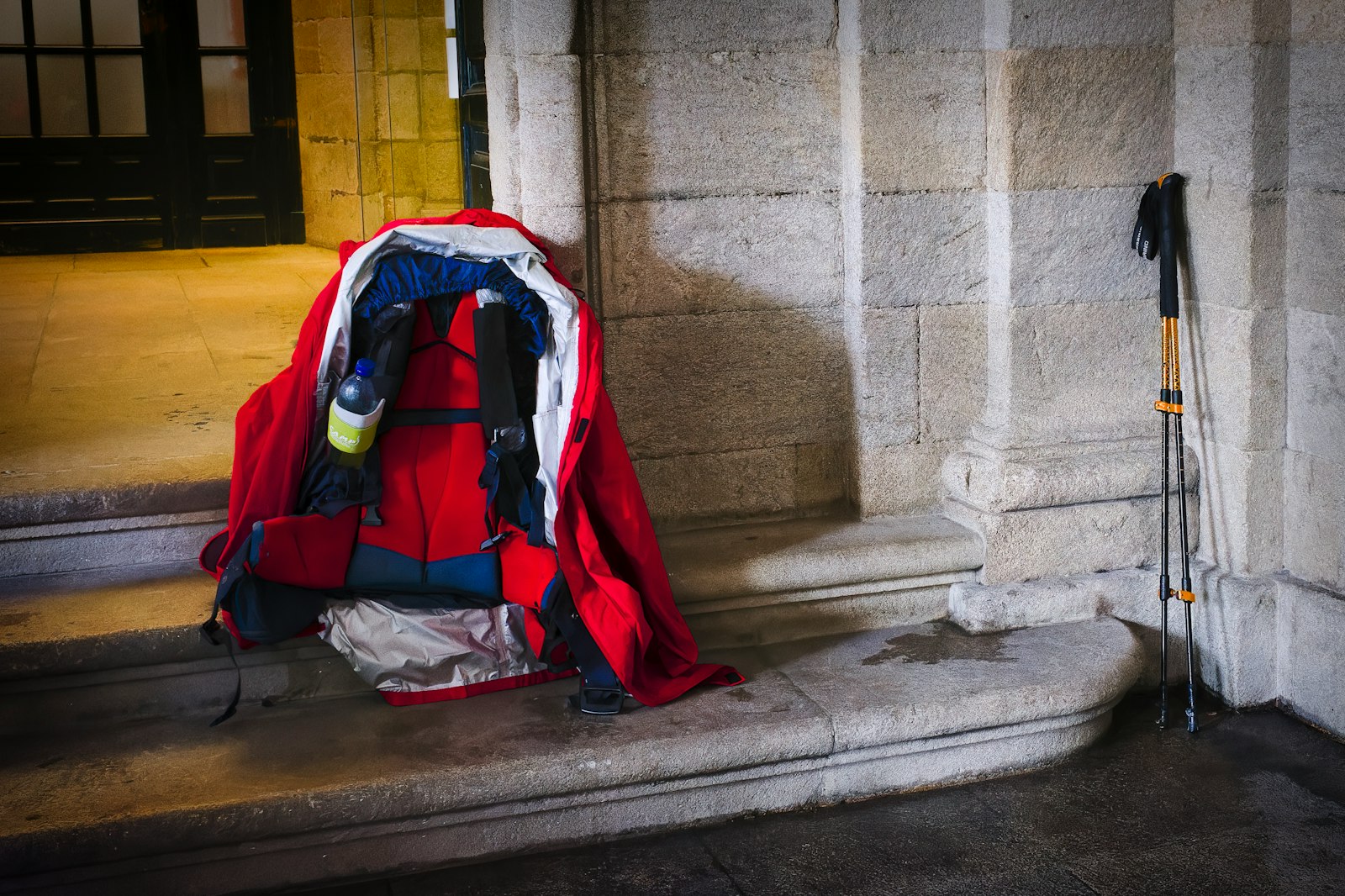
For a route of several days staying in albergues, 30-40 litres is enough; with 40-50 litres you have plenty of room even in winter. More capacity only invites you to carry too much. Look at four things:
- A padded hip belt. It is what transfers the weight to your hips. A rucksack without a hip belt forces your shoulders to carry everything.
- An adjustable, ventilated back. Try it loaded in the shop: the hip belt should sit on your hip bones, not your waist.
- Empty weight. There are 40-litre rucksacks under 1.2 kg. Every gram of rucksack is a gram less margin for everything else.
- A rain cover. Many have one built in. Even so, put your clothes and sleeping bag in dry bags or plastic bags: in several hours of rain, the cover alone is not enough.
Break in the rucksack before the Camino, just like your boots. A few weekend outings with the real weight will tell you whether it rubs or needs adjusting. In our guide to how to train for the Camino you have a plan of progressive outings.
Rucksacks for women: fit is the key
Many brands make women’s versions of their rucksacks, with a shorter back length, narrower curved shoulder straps and a hip belt designed for the female hip. It is not a marketing ploy: if the back length does not match yours, the weight ends up on your shoulders instead of your hips. When you try one, load a few kilos, adjust the hip belt first over the crests of your hips, then the shoulder straps and finally the chest strap and load lifters. If your shoulders hurt after an hour of walking, the rucksack is not your size. You have tips for travelling alone in walking the Camino de Santiago alone.
Footwear, the most important thing
Trekking boots or shoes that are already broken in (never new on the Camino) are your best insurance against blisters. Choose half a size larger than usual: with heat and kilometres your feet swell. On flat, dry routes such as the Francés from Sarria many pilgrims wear trail shoes; in mountains such as the Camino Primitivo or with frequent rain, a boot with ankle support is better.
Socks matter as much as footwear: technical, seamless and in your size. Take three pairs and change them mid-stage if your feet sweat a lot. Flip-flops or light sandals are essential for the shower and to rest your feet in the afternoon.
Clothing: the 2+1 rule
Take two sets and wear one: wash every afternoon and dry overnight. Choose technical fabrics or merino wool, which dry quickly and smell less than cotton. Enough for the whole Camino:
- 2 technical T-shirts and 1 long-sleeved top
- 2 pairs of light trousers (one convertible into shorts is ideal)
- 3 pairs of technical socks and 3 sets of underwear
- 1 fleece or light down jacket
- 1 rain jacket or waterproof poncho (essential all year round in Galicia and on the Norte)
- A cap or hat, and a buff or neck gaiter
- Flip-flops for the shower and for resting at the albergue
For layering, think in threes: the technical T-shirt that wicks sweat, the fleece that keeps you warm and the rain jacket that blocks wind and rain. Combining those three layers covers almost any day of the year. If you are a woman walking the Camino, our guide to walking the Camino alone has specific tips on clothing and safety.
For sleeping: sleeping bag, sleeping-bag liner and rest in the albergue
What to take for sleeping depends on where and when. In the Xunta de Galicia public albergue network, the €10 price includes a disposable sheet and pillowcase, and many also have blankets. Even so, it is wise to bring something of your own:
- From May to September: a sleeping-bag liner (between 150 and 400 g, depending on the fabric) is usually enough.
- Spring and autumn: a light summer sleeping bag or a thermal liner.
- Winter: a warm sleeping bag; some albergues have weak heating and others are closed.
Add earplugs and an eye mask: shared dormitories are noisy and some people get up at five in the morning. If you want to know how opening times, bookings and rules work, read our guide to Camino de Santiago albergues. And to find somewhere to sleep in each village, use the accommodation finder.
The pilgrim’s first-aid kit
- Blister plasters, plasters, tape and a needle with sterile thread or a blister kit
- Vaseline or anti-chafing cream for feet, groin and armpits
- Your usual painkiller and anti-inflammatory, and your medicines with the prescription or medical report
- Sunscreen, lip balm with sun protection and insect repellent
- Small scissors or nail clippers (no blades: better not to take a knife if you are flying with hand luggage only)
There is no need to carry a whole pharmacy: on the Camino Francés and the Portugués there are pharmacies at almost every stage end. On lonelier routes, such as the Primitivo or the Vía de la Plata, it is wise to be a little better stocked. How to prevent and treat chafing is explained step by step in our guide to blisters on the Camino.
Toiletries: travel size and multi-purpose
- Mild soap, bar or travel-size liquid: it works for body, hair and clothes
- Microfibre towel (dries in an hour)
- Travel toothbrush and toothpaste, small deodorant
- Clothes pegs or safety pins to hang wet clothes on your rucksack
- Toilet paper and small bags to take it away: there are not always toilets between villages
Documents, money and technology
- ID card or passport and health card (the European one if you come from another EU country)
- The pilgrim credential, essential for sleeping in pilgrim albergues and obtaining the Compostela
- Some cash: in many small villages and albergues you cannot pay by card
- Phone, charger, power bank and a multi-socket adapter or two-port charger (sockets in albergues are scarce)
- A head torch or small torch if you are going to set off in the dark
- Trekking poles: they ease your knees on descents and give support on uneven ground
- A 1-1.5 litre bottle or water bladder
What to take on the Camino de Santiago by season
The basic list works all year round, but each season calls for adjustments. If you have not decided on dates yet, compare weather, crowds and prices in our guide to when to walk the Camino de Santiago.
In summer
Very light, light-coloured clothing, a cap or wide-brimmed hat, sunglasses, high-factor sunscreen and more water capacity. On the Meseta of the Camino Francés there are long stretches without shade or villages, such as the one from Carrión de los Condes to Calzadilla de la Cueza; set off early and carry at least a litre and a half. The warm sleeping bag is unnecessary.
In spring and autumn
These are the most rewarding seasons, but the weather changes within the same day. The fleece, the rain jacket and a thin hat take up little space and can save a cold morning. Rain is frequent in Galicia in any month.
In winter
Add gloves, a hat, an extra thermal layer, a warm sleeping bag and a proper rain jacket. The days are short: the head torch becomes essential. Many albergues close in the low season; the Camino planner shows you, for each route and month, what percentage of albergues open according to the published data.
What changes with the route
- Camino Francés: the best equipped. Fountains, bars, pharmacies and shops in almost every village; you can travel light and buy as you go.
- Camino del Norte: more climbing than it seems and a lot of humidity. Prioritise a good rain jacket, quick-drying clothing and footwear with grip.
- Camino Primitivo: real mountains. Boots with a good sole, a warm layer even in summer and extra water and food: the Hospitales variant has no services along the whole section.
- Camino Portugués: plenty of asphalt and cobbles on some sections. Cushioning in your footwear becomes more important.
- Vía de la Plata: long stages and heat from spring onwards. Water capacity of 2 litres or more and serious sun protection.
If you are not sure which route suits you, the which Camino de Santiago should I walk? quiz recommends one in seven questions.
How to place the weight inside your rucksack
A well-packed rucksack feels lighter on your back than a badly packed one with the same contents. The order that works best:
- At the bottom: the sleeping bag or liner and your sleepwear, which you will not need until the afternoon.
- In the middle, close to your back: the heaviest things (spare clothes, toiletry bag, food), at shoulder-blade height.
- On top: the fleece and the rain jacket, so you can take them out without emptying anything.
- Hip-belt pockets and lid: phone, credential, sunscreen, something to eat and the blister kit.
Tighten the hip belt over your hips first, then the shoulder straps and finally the load lifters. If your shoulders feel loaded mid-stage, loosen the shoulder straps and tighten the hip belt again.
What NOT to pack
The mistakes that weigh most: a hairdryer, jeans, paper books, «going-out» clothes for the arrival, large bottles of shower gel and shampoo, a laptop and a whole pharmacy. Nor do you need food for several days on the main routes. If you are unsure about a garment, leave it behind: almost everything can be bought along the way. And if halfway through you find you have something surplus, you can post it home or to Santiago.
Rucksack transfers and poles on the plane
If one day you cannot manage the weight, there is rucksack transfer between stages. The best-known service is Correos’ Paq Mochila: it collects your luggage at your accommodation from 8:00 and delivers it to the next one before 14:30, with a maximum of 15 kg per item. It runs all year between Sarria and Santiago and between Tui and Santiago, and on the other main routes in season, from spring to 31 October. There are also local companies and many places to stay that arrange it. It is not cheating: it is looking after your knees so you can finish.
If you are flying in, bear in mind that trekking poles are usually refused at security checks in Spanish airports as hand luggage (the final decision rests with security staff). Check them in inside your rucksack or buy a cheap pair on arrival. To plan your outward journey, see how to get to the start of the Camino.
Camino de Santiago packing list, to print
Go through it the night before and weigh your rucksack one last time before you leave:
- Footwear: broken-in boots or shoes, flip-flops for the albergue, 3 pairs of technical socks.
- Clothing: 2 technical T-shirts and 1 long-sleeved top, 2 pairs of trousers, 3 sets of underwear, fleece, rain jacket, cap and buff.
- Rest: sleeping-bag liner (or a warm sleeping bag out of season), earplugs and eye mask.
- Toiletries and first aid: travel size, blister kit, Vaseline, your medication, sun protection.
- Documents: credential, ID or passport, health card and cash.
- Useful extras: poles, power bank, reusable bottle, head torch, safety pins and dry bags.
Typical packing mistakes
Almost everyone who suffers more than necessary makes the same mistakes. Packing «going-out» clothes: you do not need a nice outfit for Santiago; it weighs and is hardly used. New footwear: the number one cause of blisters. Carrying too much water: on the Camino Francés there are fountains all the time and half a litre or a litre between villages is enough, except on the long stretches of the Meseta. Not testing the loaded rucksack: what does not rub at home after 2 km can rub after 20. And the «just in case»: the rucksack grows with every doubt.
Getting your Camino de Santiago packing right comes down to one idea: less is more, and every gram counts. With your rucksack packed, work out how much you are going to spend with the Camino budget calculator and split the stages with the planner.
Complete your rucksack with the Camino de Santiago first-aid kit and set up your phone with the apps for the Camino that are really worth it.
Rucksack transfer on the Camino de Santiago: Correos routes and prices
Correos’ Paq Mochila service carries your rucksack from one place to stay to the next. These are the routes and seasons on which it is offered, with prices checked on 12 November 2026 at elcaminoconcorreos.com:
| Camino | March to October | November to March | Price (1 rucksack) |
|---|---|---|---|
| Camino Francés | From Roncesvalles | From Sarria to Santiago | 1 stage: €10. Sarria–Santiago (5 stages): €45 |
| Camino Francés through Aragon | From Somport, on request (Monday to Friday only) | No | Calculated on the website when you book |
| Central Portuguese Camino | From Porto (also the Variante Espiritual) | From Tui to Santiago | Tui–Santiago (6 stages): €60 |
| Portuguese Coastal Way | From A Guarda (Correos also offers it from Porto) | No | Calculated on the website when you book |
| Camino Primitivo | From Oviedo | No | Calculated on the website when you book |
| Camino del Norte | From Irún | No | Calculated on the website when you book |
| Camino Inglés | From Ferrol | No | Calculated on the website when you book |
| Vía de la Plata | Only the Camino Sanabrés from Ourense | No | Calculated on the website when you book |
| Camino to Fisterra and Muxía | Yes | No | Calculated on the website when you book |
| Camino de Invierno (Winter Way) | On request (Monday to Friday only) | No | Calculated on the website when you book |
| Correos only. Other rucksack-transfer companies (private ones or the albergues’ own) cover more routes; ask at each place you stay. | |||
| Correos announces the high season «from March 2027» in one part of its website and «from Easter» in another: confirm it when you book. |
Conditions: Rucksack or cabin suitcase of up to 15 kg; up to 60 km per day; book by 20:00 the day before; leave it at your accommodation before 8:00 and it arrives before 14:30. No service on 24, 25 and 31 December or 1 January. Correos places the start of the high season in March or at Easter depending on the page of its website, so confirm it when you book. On many routes there are also private companies and albergues that offer rucksack transfer.
Official link: The Pilgrim’s Reception Office in Santiago sets out on its website the official requirements for the credential and the Compostela.
FAQ
How much should a Camino de Santiago rucksack weigh?
As a guide, no more than 10% of your body weight, not counting water and food. For a person weighing 70 kg, about 7 kg. Carrying much more is one of the most common causes of injury and of giving up.
How many litres should the rucksack be?
Between 30 and 40 litres is enough if you sleep in albergues in season; between 40 and 50 if you go in winter with a warm sleeping bag. More capacity only invites you to carry extra weight.
Boots or shoes for the Camino?
It depends on the route and the season: trail shoes on flat, dry ground; boots in the mountains or in the rain. The essential thing is that they are worn in and adapted to your feet before you set off.
Do I need a sleeping bag in the albergues?
In summer a sleeping-bag liner is usually enough. The Xunta public albergues provide a disposable sheet and pillowcase and many have blankets, but out of season it is wise to take a warm sleeping bag.
Can I send my rucksack between stages?
Yes. Correos’ Paq Mochila and local companies carry luggage from one place to stay to the next. It is very useful if you are travelling with children or nursing a niggle.
What should I pack for the Camino de Santiago in summer?
Very light clothing, a cap, sunglasses and high-factor sun protection, plus more water for the shadeless stretches of the Meseta. The warm sleeping bag is unnecessary.
What should I pack in winter?
Add gloves, a hat, an extra thermal layer, a warm sleeping bag and a sturdy rain jacket. Check beforehand which albergues are open on your route, as many close in winter.
Which trekking poles should I take?
Telescopic or folding poles made of aluminium or carbon, light and with cork or foam grips. Adjust them so your elbow forms a right angle on the flat, slightly shorter uphill and longer downhill, and take rubber tips for asphalt.
Can I take my poles on the plane?
As hand luggage they are usually refused at security checks in Spanish airports. The safe option is to check them in or buy them on arrival.
So you don’t forget anything, save this page on your phone or print the list. And if you are still unsure which route to walk, start with the which Camino should I walk? quiz.