
Camino de Santiago de Girona
The Camino de Santiago de Girona, also called the Camí de Sant Jaume, enters Spain from France at Le Perthus and La Jonquera and crosses Catalonia via Figueres, Girona, Vic and Manresa to the monastery of Montserrat, where it joins the Camino Catalán. It covers 255.8 km in 11 stages, and about 1,381 km to Santiago continuing along the Catalán, the Aragonés and the Francés.
It is the natural route for those arriving from southern France across the Le Perthus border or who want to start on the Costa Brava, with a variant from El Port de la Selva via the monastery of Sant Pere de Rodes. It has 81 places to stay listed and 10 albergues. In this guide you have the map, the stages, the variants, what to see, when to go, how to get there and where to sleep.
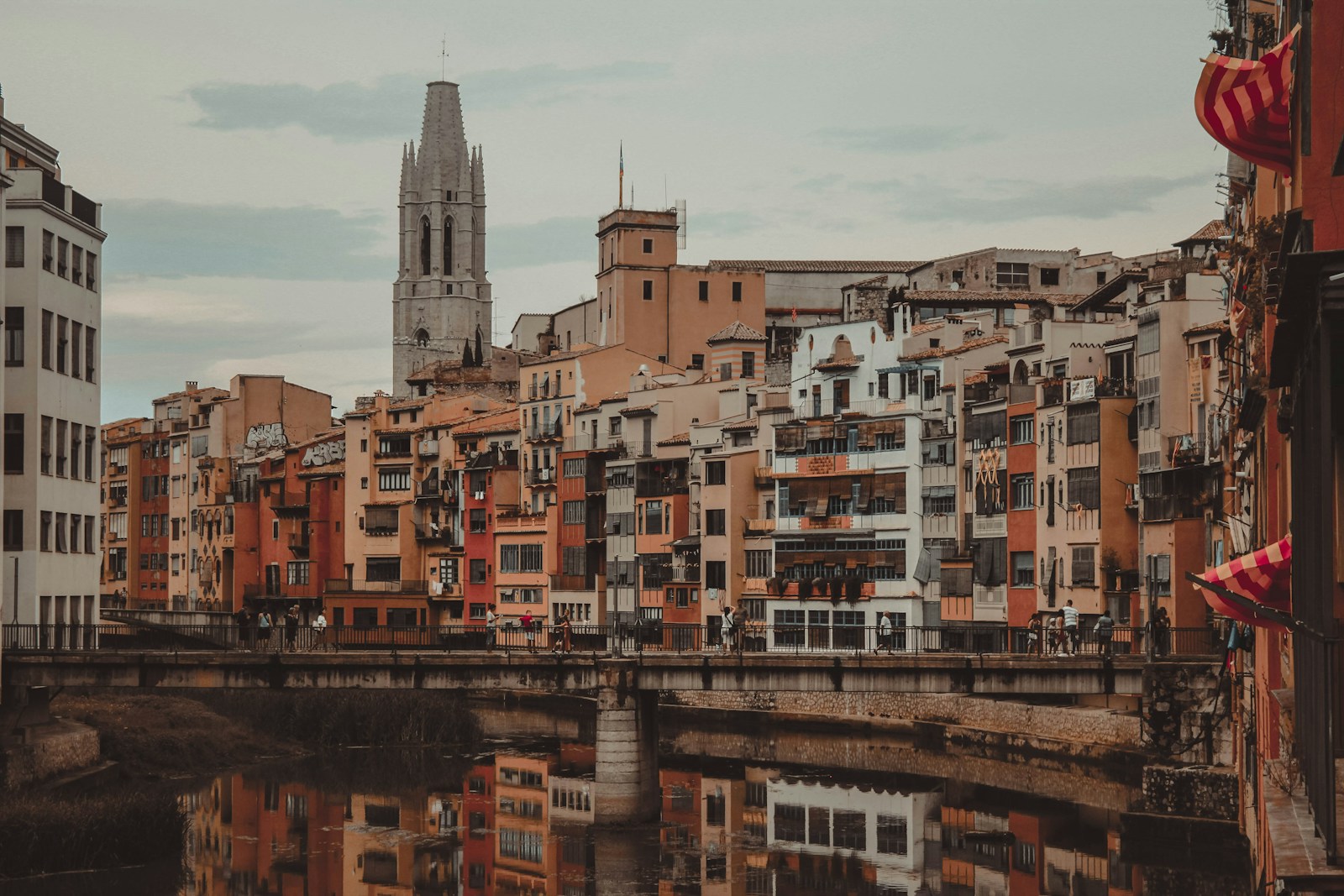
- The stages
- Key facts
- Stages by section
- The variants
- What to see
- When to go
- Getting there
- From Montserrat to Santiago
- Where to sleep
- Tips
- Credential and Compostela
- FAQ
The stages of the Camino de Santiago de Girona
The map shows the route from Le Perthus to Montserrat and below it all the stages, including those of the variants. Tap one to see its route, the villages, what to see and where to sleep.
Tap a point to see the stage; zoom in to see the numbers. On mobile, tap the map to move it. Route: © OpenStreetMap contributors (ODbL).
Easy Moderate Hard
Camino de Santiago de Girona key facts
| Fact | Camino de Santiago de Girona |
|---|---|
| Route | Le Perthus › Montserrat (255.8 km in 11 stages) |
| To Santiago | about 1,381 km from Le Perthus, continuing along the Catalán, Aragonés and Francés routes |
| Variants | From El Port de la Selva via Sant Pere de Rodes to Figueres (29 km) |
| Average per stage | 23.3 km; the longest, 33.3 km |
| Total ascent | About 3,802 m |
| Highest point | 1074 m |
| Places to stay | 81 listed, 10 of them albergues (none public, with 14 beds) |
| Albergue bed | €11 on average; double room, €78 |
| Asphalt or paved | 40% of the route; 7% on roads with traffic |
| Longest section without a fountain, bar or shop | 22.7 km |
| Longest section without accommodation | 23.6 km |
| Backpack transfer with Correos | Not available on this route |
The stages of the Camino de Santiago de Girona by section
The stages of the Camino de Girona are of medium length, from 16 to 33 km, and the route gets harder towards the end: the Garrotxa, the Collsacabra and the climb to Montserrat.
From Le Perthus to Girona: 3 stages and 78.7 km
From the border at Le Perthus, it descends via La Jonquera, Biure and Pont de Molins to Figueres, on the first stage, 33.3 km. It continues through the Empordà, Borrassà, Pontós and Bàscara, and enters Girona via Sarrià de Ter.
From Girona to Vic: 4 stages and 87 km
It follows the Ter upstream via Bescanó, Anglès and La Cellera to Amer, and enters the Garrotxa via Les Planes d’Hostoles and Sant Feliu de Pallerols to Sant Esteve d’en Bas. The stage Sant Esteve d’en Bas › L’Esquirol climbs to the Collsacabra, the highest point of the route, 1,074 m, and via Roda de Ter you reach Vic.
From Vic to Montserrat: 4 stages and 90.1 km
Via Santa Eulàlia de Riuprimer and L’Estany, with its monastery, the path descends into the Bages via Artés and Navarcles to Manresa. The last stage, Manresa › Monestir de Montserrat, climbs 844 m via Castellgalí to the monastery.
The variants of the Camino de Santiago de Girona
- Sant Pere de Rodes variant: El Port de la Selva › Figueres, 29 km and 615 m of climbing. It leaves the coast, climbs to the monastery of Sant Pere de Rodes and descends via Vilajuïga, Peralada and Vilabertran to Figueres, where it joins the main route.
What to see on the Camino de Santiago de Girona
From the Empordà to Montserrat, these are some of the places you will see:
- Viure Castle, in Biure (listed heritage site)
- Empordà Museum, in Figueres (listed heritage site)
- Bàscara Castle, in Bàscara (listed heritage site)
- Girona Cathedral of Santa María, in Girona (listed heritage site)
- Hostalets de Bas, in Els Hostalets d’en Bas (listed heritage site)
- Barrés Castle, in L’Esquirol (listed heritage site)
- Vic Cathedral of San Pedro, in Vic (listed heritage site)
- Monastery of Santa Maria de l'Estany, in L’Estany (listed heritage site)
- Artés Castle, in Artés (listed heritage site)
- Collegiate Basilica of Santa María, in Manresa (listed heritage site)
- Monastery of Santa María de Vilabertrán, in Vilabertran (listed heritage site)
When to walk the Camino de Santiago de Girona
The best seasons are spring and autumn. In summer it is hot in the Empordà and the Bages, and in winter it is cold in the Collsacabra and on the Plana de Vic, where fog is common. The average high on the route is 28.4 °C in July and 28.3 °C in August, and the average low in January, 3.2 °C.
| Month | Average high | Average low | Rainy days | Albergues open |
|---|---|---|---|---|
| January | 11.5 °C | 3.2 °C | 5.1 | 1 of 10 |
| February | 12.5 °C | 3.5 °C | 4.8 | 1 of 10 |
| March | 15.3 °C | 5.6 °C | 5.7 | 1 of 10 |
| April | 17.4 °C | 7.5 °C | 7.4 | 1 of 10 |
| May | 21 °C | 10.9 °C | 7.4 | 1 of 10 |
| June | 25.2 °C | 14.8 °C | 5.4 | 1 of 10 |
| July | 28.4 °C | 17.4 °C | 3.7 | 1 of 10 |
| August | 28.3 °C | 17.5 °C | 5.5 | 1 of 10 |
| September | 24.4 °C | 14.5 °C | 6.2 | 1 of 10 |
| October | 20.1 °C | 11.3 °C | 6.8 | 1 of 10 |
| November | 14.9 °C | 6.7 °C | 5.6 | 1 of 10 |
| December | 12 °C | 4.1 °C | 4.8 | 1 of 10 |
Temperatures and rain: route averages, using the normals from the weather station closest to each stage end.
How to get to Le Perthus to start the Camino de Santiago de Girona
From Madrid there are 6 direct trains a day to Figueres-Vilafant, the fastest in 4 h 21 min (AVE). From Figueres you have to continue by road to the border, at Le Perthus. For the variant, you have to get to El Port de la Selva by road.
Source: Renfe timetables checked on 12/11/2026. Check those for the day you travel at renfe.com.
If you have fewer days, you can start in Girona or Vic. With the planner you choose the starting point and the days you have.
From Montserrat to Santiago
At the monastery of Montserrat the Camino de Girona joins the Camino Catalán, which continues via Igualada, Tàrrega, Huesca and San Juan de la Peña to Santa Cilia, on the Camino Aragonés, and from there to the Camino Francés at Puente la Reina. The next stage is Montserrat › Igualada.
Where to sleep on the Camino de Santiago de Girona
We have 81 places to stay listed on the Camino de Santiago de Girona, including 10 albergues, none of them public. An albergue bed costs €11 on average and a double room €78.
This table shows what there is at each stage end. The accommodation finder for the Camino de Santiago de Girona has them all, with price, phone number and website.
| Stage | Stage end | Albergues | Bed from | Other accommodation |
|---|---|---|---|---|
| 1 | Figueres | 1 | — | 10 |
| 2 | Bàscara | 0 | — | 1 |
| 3 | Girona | 2 | — | 10 |
| 4 | Amer | 0 | — | 1 |
| 5 | Sant Esteve d’en Bas | 1 | — | 3 |
| 6 | L’Esquirol | 0 | — | 2 |
| 7 | Vic | 0 | — | 7 |
| 8 | L’Estany | 0 | — | 1 |
| 9 | Artés | 0 | — | 1 |
| 10 | Manresa | 1 | — | 4 |
| 11 | Monestir de Montserrat | 1 | 10 € | 2 |
Indicative prices of the cheapest albergue bed; "—" means we do not have the price. Always phone the day before.
Tips for the Camino de Santiago de Girona
- Book in Montserrat. It is a very popular place: book the accommodation next to the monastery well in advance.
- Watch the long stages. 1 stage is over 30 km. Use the planner to split the route into days that suit you.
- Carry water. The longest stretches without a fountain, bar or shop are 22.7 km on L’Estany › Artés; 21.1 km on Manresa › Monestir de Montserrat; 16.9 km on Vic › L’Estany.
- Phone the albergues ahead, especially out of season.
- Count the daylight hours. In January there are about 9.4 hours of daylight a day and in June, up to 15.2.
- There is no Correos backpack transport on this route. Travel light.
- Prepare the trip with our guides to the first-aid kit, useful apps and what to pack.
Credential and Compostela
The credencial is the document that identifies you as a pilgrim: it gives access to the albergues and is the proof you need to request the Compostela. The official model is issued by the Pilgrimage Office of Santiago Cathedral and can be obtained from parishes, Friends of the Camino associations, albergues and authorised confraternities. More details in our guide to the pilgrim credencial.
For the Compostela you must walk at least the last 100 consecutive km to Santiago (200 km by bike), getting your credencial stamped twice a day on that stretch. Continuing along the Catalán, Aragonés and Francés routes, the nearest qualifying start is A Pena (Paradela), 100 km away. It is collected in person at the Pilgrim Office.
Camino de Santiago de Girona FAQ
How many kilometres is the Camino de Santiago de Girona?
255.8 km from Le Perthus to Montserrat in 11 stages. To Santiago: about 1,381 km from Le Perthus, continuing along the Catalán, Aragonés and Francés routes.
How many days does it take to walk the Camino de Santiago de Girona?
11 days from Le Perthus to Montserrat, at an average of 23.3 km a day. With the planner you can spread it over the days you have.
Which is the longest stage of the Camino de Santiago de Girona?
The one from Le Perthus to Figueres, with 33.3 km.
Are there albergues on the Camino de Santiago de Girona?
Yes: 10 albergues, none of them public, at an average of €11 per bed. You will find them in the accommodation finder.
Where does the Camino de Santiago de Girona start?
In Le Perthus, on the border with France, or in El Port de la Selva via the Sant Pere de Rodes variant.
Where does the Camino de Santiago de Girona end?
At the monastery of Montserrat, where it joins the Camino Catalán.
Plan your days with the planner and, from Montserrat, continue along the Camino Catalán. To prepare the trip see the practical guides to the Camino de Santiago or compare other routes in all the Caminos.