
Camino Portugués (Portuguese Way)
The Camino Portugués (Portuguese Way) runs from Lisbon to Santiago de Compostela: 608.7 km in 26 stages via Santarém, Coimbra, Porto and Ponte de Lima to Tui, where it enters Galicia. In 2025, 100,803 pilgrims reached Santiago on this route, and another 89,503 on its coastal variant.
This Camino Portugués guide has everything you need to prepare it: the key facts, the stages by section with their difficulty, the variants, the places you shouldn’t miss, when to go month by month, how to get to the start, where to sleep, what to eat and how to get the credential and the Compostela. Further down you’ll find all 26 stages, one by one, each with its map, elevation profile and accommodation.
- The 26 stages
- Key facts
- Stages by section
- Variants
- Must-sees
- When to go
- Getting there
- Where to sleep
- What to eat
- Credential and Compostela
- FAQ
The 26 stages of the Camino Portugués
The map shows the whole route and below it each stage with its start, finish and distance. Tap one to see its elevation profile, the villages along the way and where to sleep.
Tap a point to see the stage; zoom in to see the numbers. On mobile, tap the map to move it. Route: © OpenStreetMap contributors (ODbL).
Easy Moderate Hard
Camino Portugués: key facts
| Fact | Camino Portugués |
|---|---|
| Route | Lisbon › Santiago de Compostela |
| Distance | 608.7 km |
| Stages | 26 (average 23.4 km) |
| Total ascent | About 8,471 m |
| Highest point | 469 m |
| Albergues | 186 (30 public); 109 open all year |
| Albergue bed | €19.60 on average; about €510 for the 26 stages |
| Asphalt or paved | 73% of the route |
| Longest section without a fountain, bar or shop | 14 km |
| Minimum for the Compostela | The last 100 km; Tui is 118.4 km from Santiago |
| Backpack transfer with Correos | From Porto, March to October (also on the Spiritual Variant) |
| Pilgrims in 2025 | 100,803 |
The stages of the Camino Portugués by section
The Camino Portugués crosses Portugal from south to north. The first section, from Lisbon to Coimbra, has the longest days; from Coimbra to Porto the stages are moderate; from Porto to Tui the climbs begin, and from Tui the last 118 km run through Galicia.
| Section | From › to | Stages | Km | Ascent (m) |
|---|---|---|---|---|
| Lisbon to Coimbra | Lisbon › Coimbra | 1–10 | 240.3 | 2,206 |
| Coimbra to Porto | Coimbra › Porto | 11–16 | 127.0 | 1,769 |
| Porto to Tui | Porto › Tui | 17–21 | 125.6 | 2,986 |
| Galicia | Tui › Santiago de Compostela | 22–26 | 118.4 | 1,510 |
Lisbon to Coimbra: 10 stages and 240.3 km
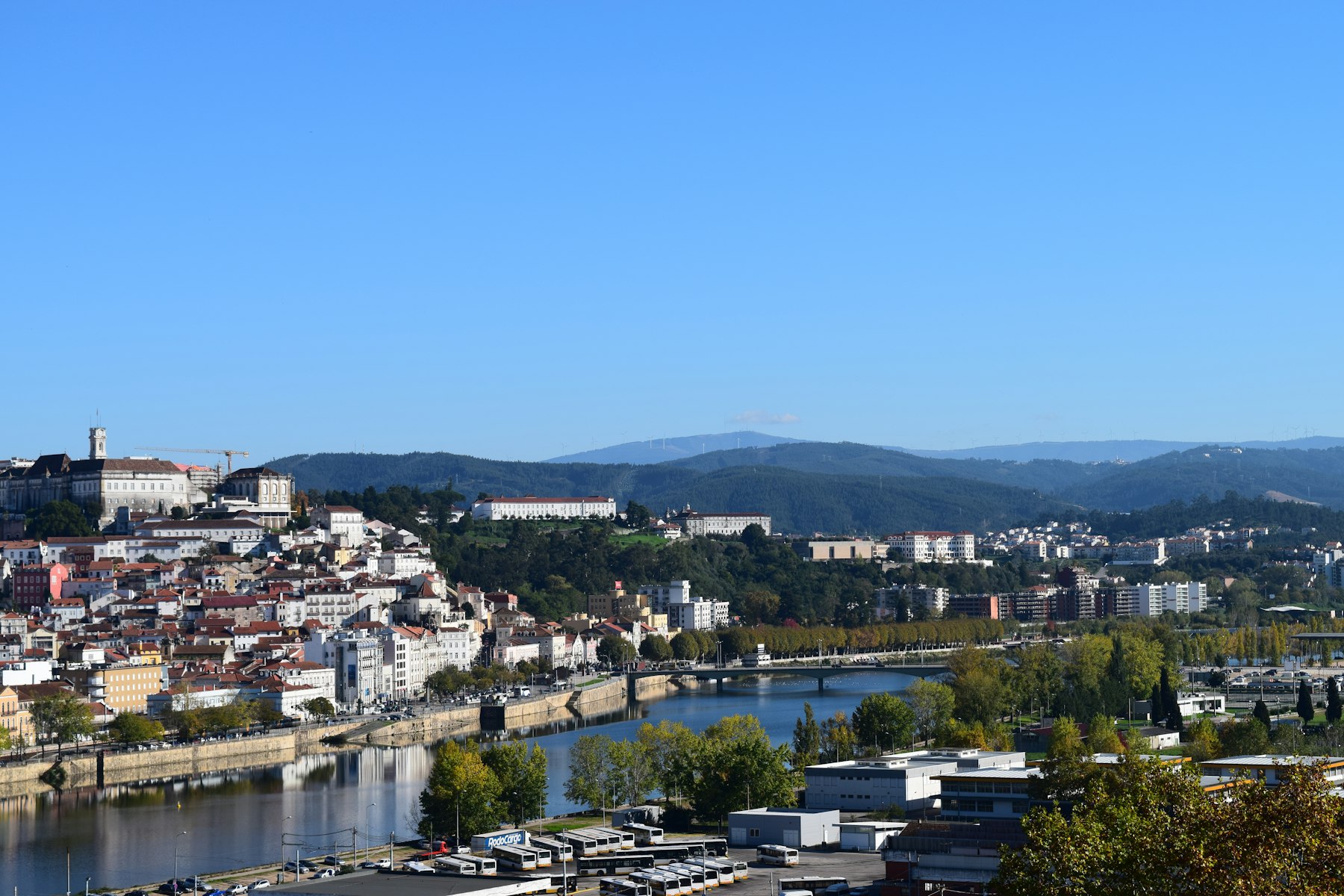
It sets off from the Praça do Comércio and crosses the Ribatejo via Vila Franca de Xira, Azambuja and Santarém to Golegã and Tomar, the city of the Order of Christ. This is the section of long days: four consecutive stages are over 30 km, from Azambuja to Alvaiázere. The hardest is Tomar to Alvaiázere, with 31.7 km and 584 m of ascent. See the Tomar › Alvaiázere stage.
Coimbra to Porto: 6 stages and 127.0 km
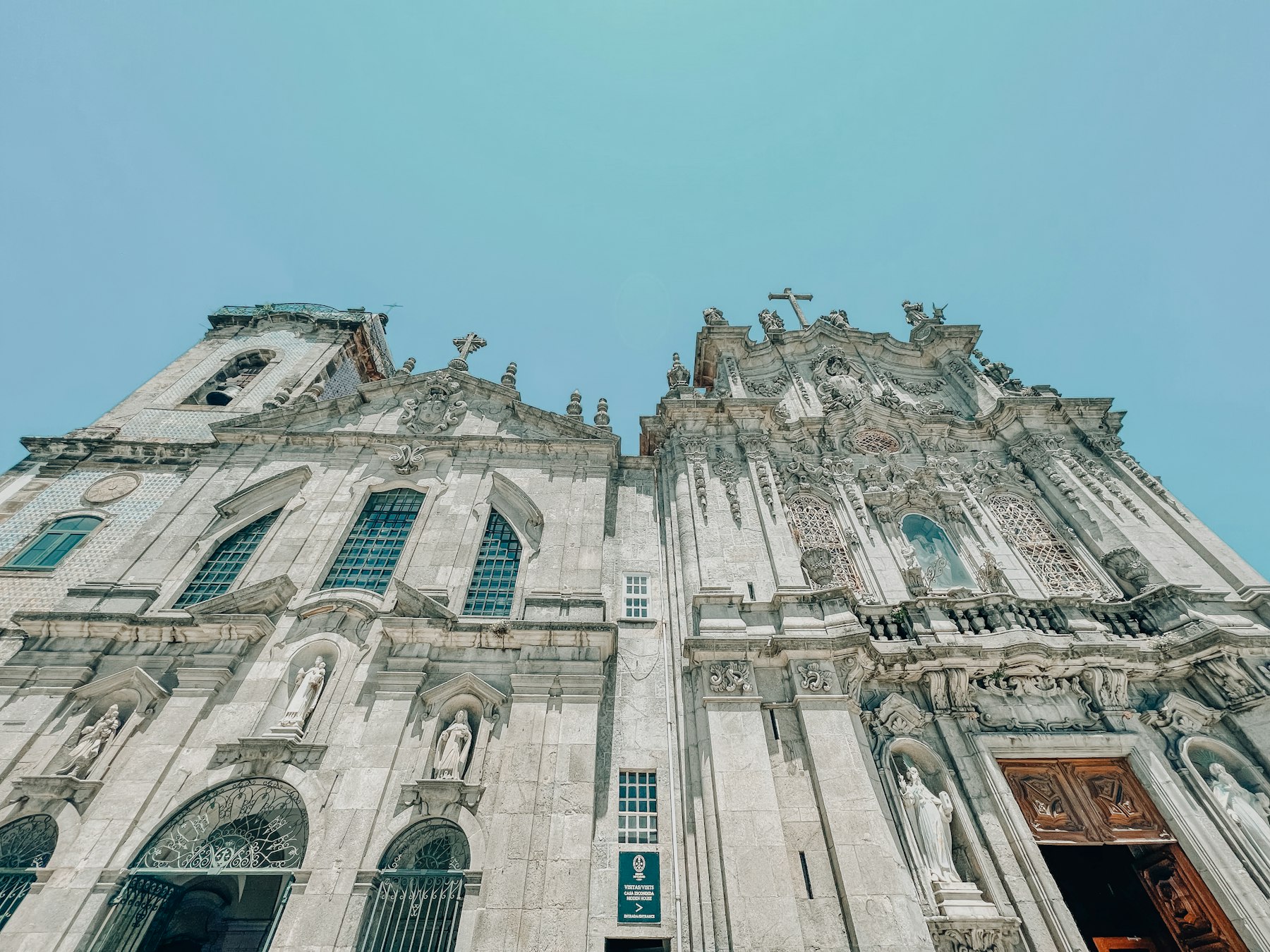
Six stages via Sernadelo, Águeda, Albergaria-a-Velha, São João da Madeira and Grijó to Porto, all moderate and between 15 and 29 km. The longest is Albergaria-a-Velha to São João da Madeira, with 28.8 km and 511 m of ascent. See the Albergaria-a-Velha › São João da Madeira stage.
Porto to Tui: 5 stages and 125.6 km
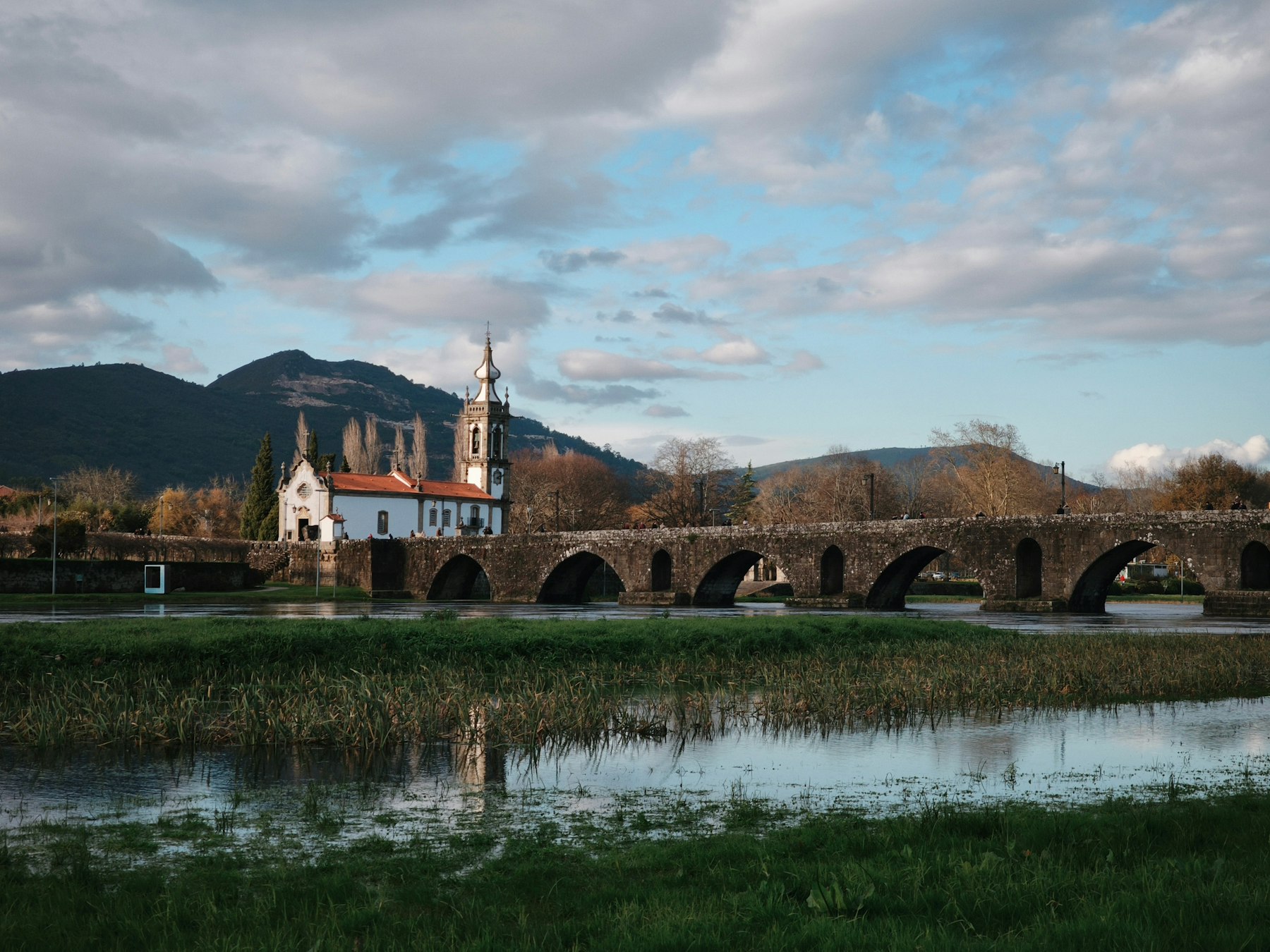
From Porto the Camino heads north via Vilarinho, Barcelos, Ponte de Lima and Rubiães, and reaches Tui, already in Galicia. This is where the biggest climbs of the Camino Portugués are: the stage from Barcelos to Ponte de Lima adds up to 34.5 km and about 968 m of ascent, and the one from Ponte de Lima to Rubiães, 666 m in 17.4 km. See the Barcelos › Ponte de Lima stage.
Galicia: 5 stages and 118.4 km
From Tui to Santiago via Redondela, Pontevedra, Caldas de Reis and Padrón. From Tui, 118.4 km from Santiago, you meet the 100 km minimum for the Compostela. The longest stage is the first, from Tui to Redondela, at 34.5 km; at Redondela the Portuguese Coastal Way joins. See the Tui › Redondela stage.
If you have fewer days: from Porto or from Tui
You don't have to start in Lisbon. From Porto there are 244 km left in 10 stages, from 17 to 26: first the section with the most climbing, via Barcelos and Ponte de Lima, and then Galicia. There is no direct train from Madrid to Porto; the options are flying or the bus.
From Tui it is 118.4 km in five stages, enough for the Compostela: Tui › Redondela (34.5 km), Redondela › Pontevedra (19.8 km), Pontevedra › Caldas de Reis (21.1 km), Caldas de Reis › Padrón (18.6 km) and Padrón › Santiago (24.4 km). If the first feels too long, you can split it at O Porriño, where there is an albergue. To reach Tui, take the train from Madrid to Vigo, about 4 hours, and from Vigo to Tui by train or bus, half an hour.
Variants of the Camino Portugués
- Portuguese Coastal Way: it also starts in Porto and follows the Atlantic coast via Viana do Castelo, Caminha, A Guarda, Baiona and Vigo until it joins the Central route at Redondela: 187.0 km in 9 stages to Redondela.
- Spiritual Variant: between Pontevedra and Padrón, a three-stage alternative via A Armenteira and Vilanova de Arousa, with 78.9 km instead of the 39.7 km of the route through Caldas de Reis.
Must-sees on the Camino Portugués
Nine places worth stopping for, in the order they appear on the Camino.
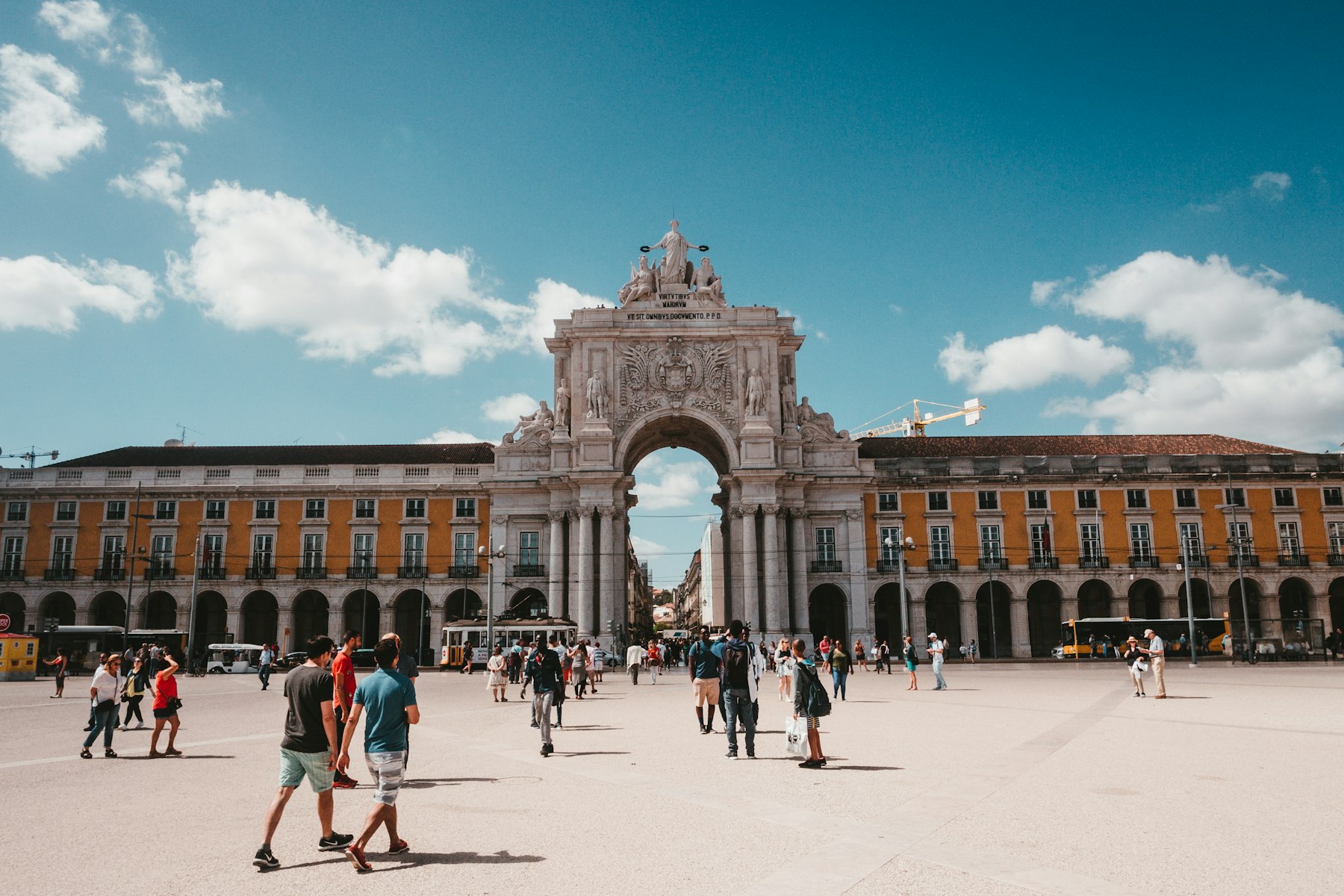
- Praça do Comércio · Lisbon (stage 1). The starting point, in Lisbon's Baixa, a city that deserves at least two days: Alfama and São Jorge Castle, Belém, the Chiado or the Santa Justa lift.
- Parish church and pillory · Azambuja (stage 3). Both from the 16th century; the Manueline pillory, opposite the church, was the column where wrongdoers were displayed and punished.
- Cathedral and Graça church · Santarém (stage 4). Besides the cathedral, the Gothic church of Nossa Senhora da Graça holds the tomb of Pedro Álvares Cabral, the first European to land in Brazil, in 1500; and Santa Maria de Marvila is Manueline, from the 16th century.
- Convent of Christ · Tomar (stage 6). Tomar was the seat of the Order of Christ, the successor of the Templars in Portugal after their dissolution in 1319.
- Roman villa · Rabaçal (stage 9). Ruins of a Roman villa declared a National Monument, with mosaics.
- University of Coimbra · Coimbra (stage 10). Portugal's first university and one of the oldest in Europe; during term, students make up almost a third of the population.
- Cabeço do Vouga · Pedaçães (stage 13). An archaeological site right on the route.
- Cruceiro de Pinheiro da Bemposta · Bemposta (stage 14). A covered cross declared a National Monument, next to the pillory and the old Curval coaching stop.
- Porto Cathedral · Porto (stage 16). Romanesque, from the 12th and 13th centuries, with Gothic and Baroque additions; nearby are the 76 m Clérigos Tower and São Bento station, with twenty thousand azulejo tiles.
When to walk the Camino Portugués
From April to September more than nine out of ten albergues are open and average highs range from 18.8 °C in April to 27.6 °C in August. In winter just over half are open: 106 of 186 in December and January. September and May were the months with the most pilgrims in 2025, with 15,744 and 14,845; from December to February fewer than 800 a month arrived.
| Month | Pilgrims 2025 | Avg. high | Avg. low | Albergues open |
|---|---|---|---|---|
| January | 498 | 13.8 °C | 5.2 °C | 57 % |
| February | 773 | 15.2 °C | 5.9 °C | 62 % |
| March | 2,970 | 17.9 °C | 7.6 °C | 81 % |
| April | 11,504 | 18.8 °C | 8.8 °C | 92 % |
| May | 14,845 | 21.3 °C | 11.1 °C | 92 % |
| June | 12,801 | 25.1 °C | 13.9 °C | 93 % |
| July | 12,633 | 27.2 °C | 15.3 °C | 93 % |
| August | 14,691 | 27.6 °C | 15.4 °C | 93 % |
| September | 15,744 | 25.8 °C | 14.1 °C | 93 % |
| October | 11,555 | 21.3 °C | 11.7 °C | 88 % |
| November | 2,109 | 16.9 °C | 8.5 °C | 69 % |
| December | 680 | 14.3 °C | 6.5 °C | 57 % |
How to get to the start of the Camino Portugués from Madrid
How to get from Madrid to Lisbon, Porto and Tui. Where there is a train, the time shown is for the fastest one to the nearest station.
| Start | Fastest train | How |
|---|---|---|
| Lisbon | No direct train | There is no direct Madrid–Lisbon train. Options: a direct flight or a bus (Alsa, FlixBus) of about 6–8 h. |
| Porto | No direct train | There is no direct Renfe train. Options: a direct flight to Porto or the bus. |
| Tui | 3 h 59 min | Train to Vigo, then from Vigo to Tui by train or bus (Lugove), about 30 min. |
If you start in Portugal, carry your European Health Insurance Card: it is free, entitles you to the healthcare you need during your trip and is requested from your national health service (Spanish residents apply on the Social Security website; if it does not arrive in time, you can download the Provisional Replacement Certificate). 112 is the emergency number in Spain and Portugal.
Where to sleep on the Camino Portugués
The Camino Portugués has 186 albergues, 30 of them public, and 109 are open all year. A dormitory bed costs €19.60 on average, so sleeping in albergues for the 26 stages comes to about €510. Each stage lists the accommodation at the end of the day with price, beds and phone number, and in the accommodation finder you can filter them by town.
What to eat on the Camino Portugués
Lisbon to Coimbra
- In Lisbon, bacalhau in any of its thousand preparations and pastéis de nata, originally from Belém but found in every pastry shop; Alfama is full of traditional restaurants and fado houses.
- In the Ribatejo the cooking is hearty: the pratos do dia in Azambuja are ensopado de borrego, leitão assado, cozido à portuguesa, feijoada à transmontana or chanfana.
- In Golegã, cheap home-cooked set menus in traditional taverns.
- In Rabaçal you must try the cheese, from small family dairies, with smooth, fruity wines.
Porto and the Minho
- Porto has its own cod dish, bacalhau à Gomes de Sá (flaked, soaked in milk and baked with garlic, onion, olives and boiled egg), pastry shops everywhere and, of course, port wine.
- In Barcelos, roast cockerel, the light, slightly tart, sparkling local wine with designation of origin, and queijadinhas made with almond, candied fruit and cheese.
- In Ponte de Lima, leite-creme queimado.
Galicia
- In Tui, seafood from the Rías Baixas and the Miño, and the almond pececitos made by the Poor Clares.
- O Porriño holds festivals of tripe and of wild mushrooms.
- Redondela looks out over the Vigo estuary: spider crabs, mussels, zamburiña scallops, turbot, conger eel, hake and, above all, cuttlefish in its ink, with rice or in empanada.
- In Pontevedra, Galician tapas and raciones (raxo, zorza, pig's ear, lacón, octopus, lamprey).
- In Caldas de Reis, trout and lamprey from the Umia, lamprey empanada, corn bread and, at Easter, roscón; and an Albariño at the O Muiño tavern, from 1947.
- Padrón means its peppers («some are hot and some are not», brought by the Franciscans of Herbón in the late 16th century), octopus houses and, on Sundays, producers of cheese, chorizo, bread and empanadas next to the market.
Camino Portugués guides by starting point
If you're not walking the whole route, we have a complete guide for each usual starting point, with its stages, accommodation, elevation gain and when to go:
- Camino Portugués from Porto: 241.4 km and 10 stages.
- Camino Portugués from Tui: 115.8 km and 5 stages.
Credential and Compostela
The credential is the document that identifies you as a pilgrim: it gives you access to albergues and is the proof you need to request the Compostela. The official model is distributed by the Pilgrim's Office of Santiago Cathedral and is available from parishes, Friends of the Camino associations, albergues and authorised confraternities. Stamps are given mainly in albergues, but also in parishes, monasteries, cathedrals, hostels and town halls.
To get the Compostela you must walk at least the last 100 km to Santiago without interruption (200 km by bike). If you only walk the minimum distance, get a stamp at the start and end of each stage, with the date. It is free and is collected in person at the Pilgrim's Office, at Rúa Carretas 33, open every day from 10:00 to 19:00 except 25 December and 1 January; you need to register beforehand with a QR code.
2027 is a Compostela Holy Year because 25 July falls on a Sunday: there will be more pilgrims than usual and it is best to book further ahead, especially on the last 100 km.
Frequently asked questions about the Camino Portugués
How long is the Camino Portugués?
From Lisbon it is 608.7 km in 26 stages, averaging 23.4 km. From Porto there are 244 km left in 10 stages, and from Tui, 118.4 km in 5.
Where do you have to start the Camino Portugués to get the Compostela?
You must walk at least the last 100 km. From Tui, 118.4 km from Santiago, you meet that minimum in five stages.
What is the hardest stage of the Camino Portugués?
In terms of climbing, Barcelos to Ponte de Lima: 34.5 km and about 968 m of ascent. The longest are that one and Tui to Redondela, both 34.5 km.
How much does it cost to sleep on the Camino Portugués?
An albergue bed costs €19.60 on average, about €510 if you sleep in albergues for all 26 stages. There are 186 albergues, 30 of them public.
What is the best time of year to walk the Camino Portugués?
From April to September more than nine out of ten albergues are open and average highs range from 18.8 to 27.6 °C. September and May are the months with the most pilgrims.
What is the difference between the Central Portuguese Camino and the Coastal one?
Both start in Porto. The Central route goes inland, via Barcelos, Ponte de Lima and Tui; the Coastal route follows the Atlantic coast and joins the Central one at Redondela.
Can you send your backpack ahead on the Camino Portugués?
Yes: Correos offers backpack transport from Porto from March to October, and also on the Spiritual Variant.
If you prefer the sea, see the Portuguese Coastal Way, and with the planner you choose your days and we prepare the itinerary for you. To prepare your trip, see the Camino de Santiago practical guides or compare other routes on all the Caminos.
All 26 stages, one by one
Each stage with its distance and difficulty. Tap a stage to see the map, the villages and where to sleep.