
Doing the Camino de Santiago by bike is a great way to experience the pilgrimage at a different pace: in a week you cover what would take a month on foot, cross more landscapes and still arrive in the Plaza del Obradoiro with a credential full of stamps. It also has its own rules and challenges: the minimum distance for the Compostela is double, the terrain is not always rideable and you have to share the way with pilgrims on foot. In this guide we tell you everything you need to know, from which route and bike to choose to how to plan your stages and where to sleep.
Contents
The Compostela by bike: 200 km
To get the Compostela by bike you need to cover at least the last 200 km to Santiago, compared with the 100 km required on foot, continuously and with your credential stamped, with two stamps a day on that section. In addition, like any pilgrim, you must register online on the Pilgrim’s Office website before collecting it.
According to the distances in our planner, these are starting points that exceed 200 km on the main routes:
| Route | Start for the Compostela by bike | Km to Santiago |
|---|---|---|
| Camino Francés | Ponferrada | 203.6 |
| Camino Portugués | Porto | 241.2 |
| Camino Primitivo | Oviedo | 306.0 |
| Camino del Norte | Avilés | 307.8 |
| Camino Sanabrés | Puebla de Sanabria | 244.9 |
Watch out for starting points that work on foot but not by bike: Sarria (114.2 km), Tui (115.6 km), Ourense (104.3 km) or Ribadeo (192.9 km) fall short. And the Camino Inglés, which leaves Ferrol 111.5 km away, does not reach 200 km by bike on its own.
The best routes for cycling the Camino
- Camino Francés: the most rideable and the best equipped. It has many sections of track and wide paths, and alternatives on minor roads when the trail gets tricky. It is the bike pilgrims’ classic.
- Camino Portugués: a good option to start cycling, with many comfortable sections and some areas of cobbles and Roman road that are best taken calmly.
- Vía de la Plata and Sanabrés: long, lonely and with lots of wide tracks; perfect for those after kilometres and peace, with great heat in summer in the south.
- Primitivo and Norte: very demanding by bike because of the climbs, narrow trails and mud, and on some sections you have to detour by road. Only for experienced cyclists.
If you are still unsure, our which Camino de Santiago should I walk quiz helps you choose according to your days and your level.
Which bike to take on the Camino
The most advisable is a mountain bike or a gravel bike, because much of the Camino runs along dirt tracks, loose stone and the odd stretch of trail. Road bikes are only suitable if you are always going to ride on asphalt, following roads parallel to the Camino. What matters:
- A full service before you set off: brakes, drivetrain, tyres and spokes.
- Tyres with some tread and, if possible, puncture protection.
- Low gears for climbing with weight: the Pyrenees, O Cebreiro or the passes of the Primitivo make themselves felt with panniers.
- A sturdy rack if you are going to carry panniers.
Many bike pilgrims hire a bike at the starting point and return it in Santiago, which avoids having to transport it. If you are taking your own, check beforehand how to travel with it by train, bus or plane; we explain it in how to get to the start of the Camino.
Luggage: panniers rather than a rucksack
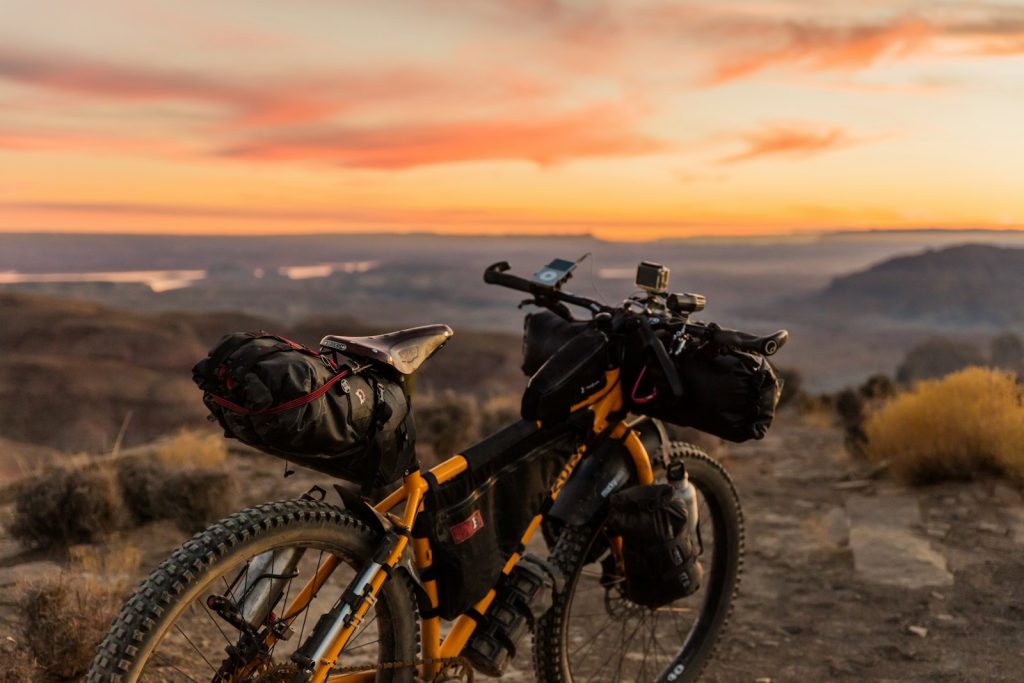
On a bike, the weight should go on the bike and not on your back. The usual set-up is two rear panniers, sometimes with a handlebar or frame bag for what you need to hand. Try not to exceed 10-12 kg in total and prioritise:
- Technical cycling clothing for two or three days and a change of clothes for the afternoon.
- A rain jacket, gloves and a warm layer.
- A repair kit: spare inner tubes, patches, tyre levers, pump, multi-tool, quick chain link and lube.
- A lock to leave the bike at albergues and stops.
- Front and rear lights and a reflective garment.
- First-aid kit and chamois cream.
What the bike pilgrim wears
Clothing makes the difference on long days in the saddle. Take two pairs of cycling shorts with a good chamois, so you can wash one every afternoon, quick-drying technical jerseys, a windproof, a proper waterproof for Galicia, cycling gloves and, if you are going in spring or autumn, arm and leg warmers, which come off when the temperature rises. For the afternoon, a light change of clothes and trainers or sandals. Glasses protect you from sun, dust and insects.
How to stamp your credential by bike
On a bike you pass through many more villages a day, so getting the two daily stamps on the last 200 km is easy, but you have to remember. Use your coffee stops, an open church or the lunchtime bar to ask for a stamp, and your accommodation for the last one of the day. Keep your credential in a waterproof sleeve inside your handlebar bag, to hand and protected from the rain.
How many kilometres a day by bike
It depends on your fitness, the terrain and how much you want to enjoy the villages. As a guide, many bike pilgrims ride between 50 and 80 km a day on the Camino Francés, somewhat less on routes with a lot of climbing. For the 203.6 km from Ponferrada, for example, a comfortable split would be three or four days. Work out your stages with the Camino planner, which gives you the kilometres, the cumulative climbing and the places to stay on each section.
Example: Ponferrada to Santiago by bike in 4 days
This is a realistic split of the minimum section for the Compostela by bike on the Camino Francés, with the distances and cumulative ascent from our planner:
| Day | Stage | Km | Ascent |
|---|---|---|---|
| 1 | Ponferrada – O Cebreiro | 51.0 | about 1,080 m |
| 2 | O Cebreiro – Portomarín | 60.6 | about 1,020 m |
| 3 | Portomarín – Arzúa | 53.3 | about 1,010 m |
| 4 | Arzúa – Santiago | 38.7 | about 670 m |
The first day is the hardest: the climb to O Cebreiro, at 1,294 m above sea level, is one of the great passes of the Camino Francés. From there, Galicia is a constant up and down that your legs will feel even without big passes. The last day is short so you arrive in Santiago with time to collect the Compostela and enjoy the city.
What to see along the way from Ponferrada
Cycling does not mean riding straight past. On the section from Ponferrada it is worth stopping at Ponferrada’s own Templar castle, at Villafranca del Bierzo and its church of Santiago, at the pallozas of O Cebreiro, at Portomarín, whose most valuable buildings were moved stone by stone when the old village was flooded by the Belesar reservoir in 1963, and at Melide, to try the octopus. With panniers there is no rush: plan stages that leave you time to look around.
The Camino Portugués by bike
From Porto it is 241.2 km to Santiago, a comfortable distance for four or five days by bike. The route passes Ponte de Lima, crosses the Minho between Valença and Tui, and continues through Redondela, Pontevedra, Caldas de Reis and Padrón. Take care on the sections of cobbles and old paved road, which are uncomfortable on a loaded bike, and with traffic on the approaches to the cities. You have the full route in the Camino Portugués.
Where to sleep when cycling
Bike pilgrims can sleep in pilgrim albergues, but with an important nuance: in the Xunta public albergues in Galicia, when demand is high, pilgrims on foot have priority over those on horseback or by bike. In practice, if you arrive by bike at a busy stage end in high season, there may be no bed. That is why it is advisable to:
- Book private albergues or guesthouses at the busiest stage ends.
- Ask whether the accommodation has a safe place to keep your bike.
- Sleep away from the walkers’ classic stage ends.
We explain in detail how they work in Camino albergues, and you have all the places to stay on each stage in the accommodation finder.
As a group or with a support vehicle
Many groups of friends cycle the Camino with a support van carrying the luggage. It is convenient, but it has two consequences: in the Xunta public albergues, those travelling with a support vehicle come last in the priority for beds, so it is best to book private accommodation; and for the Compostela, what counts is that you have pedalled the last 200 km and stamped your credential every day. Organise who drives and where you meet so you do not waste time at each stage.
Sharing the way with pilgrims on foot
On the Camino, walkers have priority. A few basic rules mean everyone enjoys it:
- Warn people when overtaking with your bell or your voice, in good time and politely.
- Slow down on narrow sections, on descents with people and when entering villages.
- Use the parallel road when the trail is crowded or too narrow.
- Don’t skid or descend at full speed on shared trails.
E-bikes on the Camino
More and more pilgrims do the Camino on an e-bike, which lets them tackle the passes with less effort and lengthen their stages. If you are considering this option, bear three things in mind. Battery range drops a lot with climbing and weight, so plan stages according to real consumption and not the manufacturer’s figure. Charging requires a socket every night: ask when booking whether the accommodation lets you charge the battery and store the bike. And if your goal is the Compostela, check the current conditions for pilgrims on e-bikes with the Pilgrim’s Office beforehand. We tell you more in our article on the Camino by e-bike.
Safety and rules for cyclists
Part of the route runs along or crosses roads, so traffic rules apply. In Spain, helmets are compulsory for cyclists on inter-urban roads, and wearing one at all times is the most sensible thing to do. If you ride at night, at dawn or through tunnels, use front and rear lights and a reflective garment. Ride on the right, in single file when there is traffic, and take extreme care at junctions with main roads.
Daily bike maintenance
A five-minute check every afternoon prevents most breakdowns:
- Check your tyre pressure.
- Check that the brakes respond well, especially before a stage with long descents.
- Clean and lube the chain if it has rained or the terrain was dusty.
- Look for loose bolts on the rack, stem and saddle.
- Check the wear on your brake pads.
In the cities on the Camino, such as Ponferrada, Lugo or Santiago itself, there are bike workshops for more serious repairs.
How to train for the Camino by bike
Although the bike lets you cover more kilometres, stringing together several days of 50-80 km with weight requires preparation. Start two or three months beforehand with progressive rides, include long climbs and do at least a couple of weekends with two consecutive days of riding with loaded panniers. That way you will test the saddle, your position and the chamois, which are the source of a lot of discomfort. Practise basic repairs too: changing an inner tube on the roadside in the rain is not the time to learn. You have more ideas in how to train for the Camino de Santiago.
How much the Camino by bike costs
The daily budget by bike is similar to a walker’s, with two differences: you spend fewer nights because you cover more ground each day, and you add costs of your own such as bike hire or transport, the odd repair and, often, more food to replenish your energy. You can do the sums with our how much does the Camino de Santiago cost calculator, entering the number of days you are going to ride.
Common bike-pilgrim mistakes
- Starting in Sarria thinking it is enough for the Compostela by bike.
- Carrying a rucksack on your back instead of panniers.
- Setting off without a repair kit or without knowing how to use it.
- Planning stages that are too long without taking the climbing into account.
- Counting on a bed in public albergues in high season.
- Riding on trails crowded with walkers instead of using the parallel road.
When to cycle the Camino
Spring and autumn are the best times: mild temperatures, fewer people on the trails and less competition for beds. In summer, the heat is punishing on the Meseta and in the south, and the trails of the final section are full of walkers. In winter, snow on the mountain passes and Galician rain make progress much harder. We explain it in detail in when to walk the Camino de Santiago.
Official link: the Pilgrim’s Reception Office publishes the Compostela requirements and the online registration, also for those making the pilgrimage by bike.
Where to leave your bike in Santiago
When you reach Santiago you cannot take your bike into the cathedral or the Pilgrim’s Office. The Office has bike parking, and many places to stay in the city have a space to store bikes. If you hired your bike, confirm in advance where and when you return it, so you are not left with it on the day you travel home.
FAQ
How many kilometres do you need to ride for the Compostela?
The last 200 km to Santiago, continuously, with two stamps a day on your credential on that section.
Where should I start the Camino Francés by bike?
For the Compostela, from Ponferrada at the latest, 203.6 km from Santiago. Sarria, 114.2 km away, is not enough by bike.
Which bike is best for the Camino de Santiago?
A mountain bike or a gravel bike, serviced before you set off and with low gears for climbing with weight.
Can cyclists sleep in albergues?
Yes, although in the Xunta public albergues, when demand is high, pilgrims on foot have priority. In high season it is advisable to book.
How many days does it take to cycle the Camino Francés?
It depends on your pace. Riding between 50 and 80 km a day, the full Francés, about 763 km, takes a couple of weeks.
Is a helmet compulsory when cycling the Camino?
In Spain it is compulsory for cyclists on inter-urban roads, and it is highly advisable to wear one at all times.
Can I cycle the Camino with panniers and sleep in albergues?
Yes, it is the most common way. Always ask where to store your bike and carry a lock.
Are there bike workshops on the Camino?
In the cities and in some large towns along the route, yes. Even so, carry what you need for basic repairs.
Which is the easiest route to do by bike?
The Camino Francés and the Portugués are the most rideable, with lots of tracks and road alternatives. The Primitivo and the Norte are the most demanding.
With your route chosen, pack your luggage, get your credential and plan your stages with the planner.