
The Holy Door of Santiago only opens in a Holy Year, and the one for Xacobeo 2027 will open on 31 December 2026 at midday, a change from the traditional mid-afternoon ceremony, as announced by the Archdiocese of Santiago in September 2026. It is the great symbol of the Compostelan Jubilee and is linked to the plenary indulgence. In this guide you have what it is, where it is, what the opening ceremony is like, what you have to do to gain the jubilee and how to organise your visit in a year expected to break records.
Contents
What the Holy Door of Santiago is
The Holy Door, also called the Door of Forgiveness, is one of the entrances to the Cathedral of Santiago de Compostela. Its special feature is that it remains walled up during ordinary years and only opens during the Compostelan Holy Year. Going through it has a deep symbolic meaning for believers: it represents the passage from sin to grace, the «narrow gate» of the Gospel. Inside, it leads almost immediately to the ambulatory of the high altar, where the image of the apostle stands, and to the crypt that holds his relics.
Where the Holy Door is
It is at the east end of the Cathedral, on the façade facing the Praza da Quintana, that is, at the back of the church if you arrive via the Obradoiro. The Quintana has two levels: the Quintana de Mortos, the lower part, which was a cemetery until the 18th century, and the Quintana de Vivos, the upper part, separated by a broad flight of steps. The Holy Door opens onto the lower part, facing the steps.
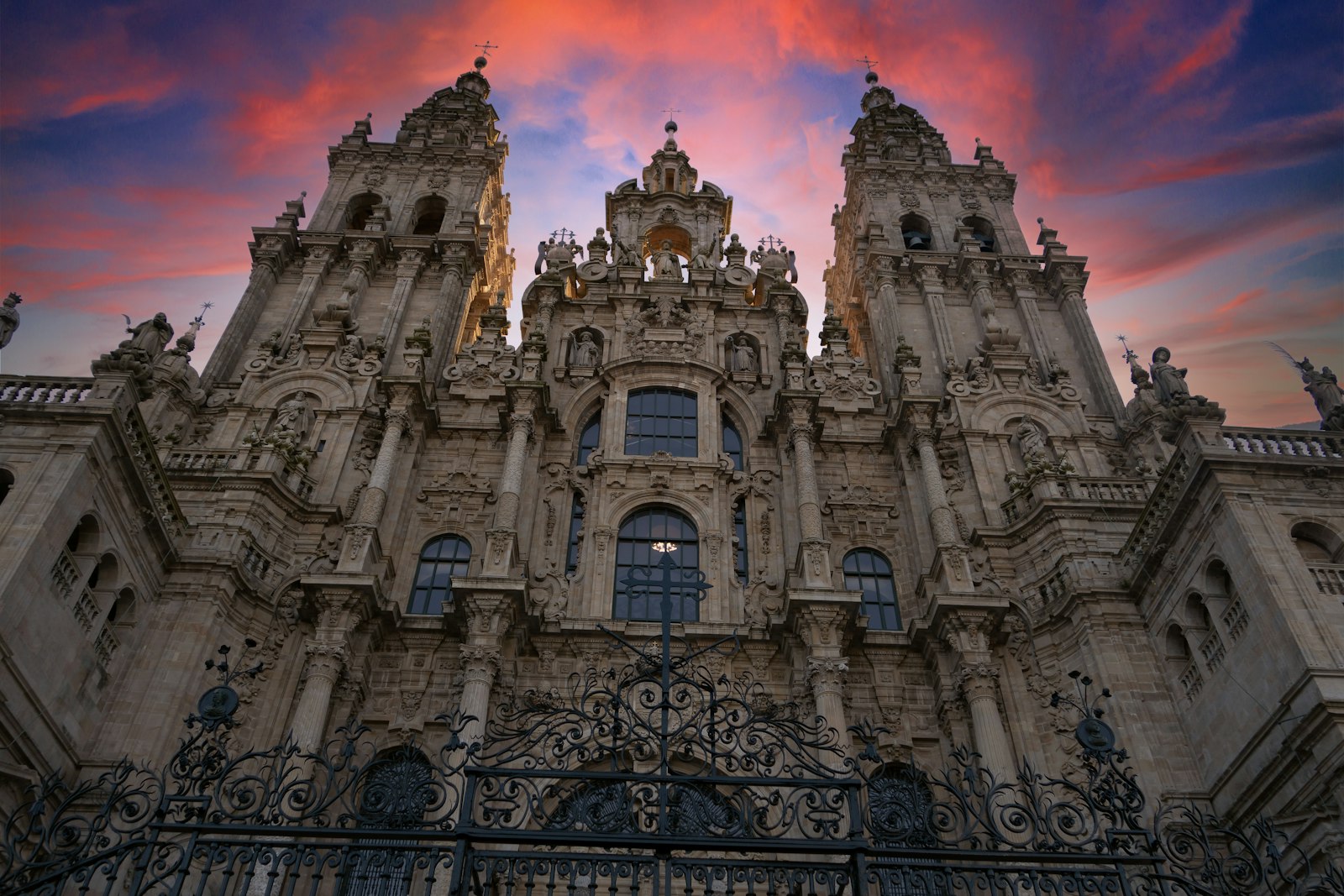
What you see from the square is actually an outer portico, built between 1611 and 1616, which protects the real door, set a few metres further in. The portico is flanked by 24 Romanesque sculptures of prophets, apostles and patriarchs that come from Master Mateo’s old stone choir, dismantled in the 17th century. It is crowned by an image of Santiago Peregrino with his disciples Athanasius and Theodore. The current inner door, made of bronze, is the work of Compostela sculptor Suso León and was installed for the 2004 Holy Year, with reliefs of the life of the apostle.
When it opens: the Compostelan Holy Year
The Holy Year is celebrated when 25 July, the feast of Saint James, falls on a Sunday. Because of the way the calendar works, this happens at intervals of 6, 5, 6 and 11 years. The most recent and the next ones are:
- 2010
- 2021, extended into 2022 because of the pandemic
- 2027, the next Xacobeo
- 2032
- 2038
Throughout the Holy Year, the Holy Door remains open and pilgrims can gain the jubilee. Everything worth knowing about the next one is in our guide to Xacobeo 2027.
The opening ceremony on 31 December 2026
The Holy Year begins the day before, on 31 December. For Xacobeo 2027, the Archdiocese announced on 24 September 2026 that the ceremony will be held at midday, about five hours earlier than usual in recent Holy Years. The rite keeps its traditional elements: the Archbishop of Santiago, Francisco José Prieto, strikes the wall sealing the door three times with a silver hammer, the wall is knocked down to free the door, and then the Eucharist is celebrated. The Cathedral will publish the exact time in its liturgical calendar: it is worth checking close to the date.
Attending in person is difficult: the Praza da Quintana and the interior of the Cathedral fill up many hours in advance and part of the capacity is reserved. The ceremony is usually broadcast on television and streamed live online.
By tradition, the Holy Door is walled up again in another ceremony on 31 December of the Holy Year, when the jubilee ends. After that it will not open again until 2032.
History of the Holy Year and the Holy Door
According to tradition, it was Pope Callixtus II who instituted the Compostelan Holy Year in 1122, and his successor Alexander III confirmed it in 1179 with the bull Regis aeterni, which granted the jubilee in perpetuity. The Holy Door as such is documented from the early modern period, and its current appearance is the result of the Baroque alterations of the 17th and 18th centuries, when the Quintana portico was built and the sculptures from Mateo’s choir were placed there.
In the 20th century the Holy Year became the great driving force behind the revival of the Camino. The 1993 Holy Year, with the Xunta de Galicia’s first Xacobeo campaign, marked the modern take-off of the pilgrimage, and since then every Holy Year has broken arrival records. The 2021 one had a unique feature: because of the pandemic, the Vatican also extended it into 2022.
The last Holy Year, which was extended to 2022, ended with more than 400,000 Compostelas issued in that year alone, a record for its time that has been broken every year since. Everything suggests that 2027 will break it again.
The plenary indulgence: what it is
In Catholic doctrine, an indulgence is the remission of the temporal punishment for sins whose guilt has already been forgiven. It is plenary when it removes it completely. The Compostelan jubilee allows it to be gained throughout the Holy Year, and that is the underlying religious reason for the Xacobeo.
It is worth clearing up a very widespread confusion: going through the Holy Door does not automatically grant the indulgence. Entering through it is the custom and a gesture of great symbolic value, but the grace requires certain specific conditions to be met.
How to gain the jubilee in the Holy Year
The conditions set by the Church for obtaining the plenary indulgence in the Compostelan Holy Year are three:
- Visit the Cathedral of Santiago de Compostela, where the apostle’s relics are venerated, on any day of the Holy Year.
- Say a prayer, such as the Creed or the Lord’s Prayer, and pray for the Pope’s intentions. Attending Mass is recommended.
- Go to confession and receive Communion, on the same day or within the fifteen days before or after the visit, in the Cathedral or in any other church.
You do not have to have walked the Camino to gain it: the indulgence is linked to the visit and these conditions, not to the kilometres. According to doctrine, it can also be applied to the deceased.
How to go through the Holy Door step by step
- Leave your rucksack. You are not allowed into the Cathedral with a rucksack or luggage. There are left-luggage lockers near the church.
- Go to the Praza da Quintana and find the Holy Door queue. In a Holy Year there are usually two separate queues: one to go through the Holy Door and another to get inside through the general entrance.
- Go through the door in silence. Many pilgrims stop for a moment to pray or simply to remember the way they have come.
- Climb up to the camarín to give the traditional embrace to the image of the apostle, behind the high altar.
- Go down to the crypt, where the silver urn with the relics of Saint James is kept.
The whole visit takes a few minutes, but the wait can be long in summer, at Easter and around 25 July.
The embrace of the apostle and the botafumeiro
The embrace of the apostle consists of climbing a narrow staircase behind the high altar and embracing from behind the Romanesque image of Saint James, clad in silver. It is one of the most deeply rooted gestures of arriving in Santiago, and in a Holy Year it is a natural part of the Holy Door route.
The botafumeiro, the Cathedral’s great censer, is about 1.6 metres tall and weighs more than 50 kilos; it is swung across the transept by eight tiraboleiros. It does not fly at every Mass: it is used at the solemnities of the liturgical calendar and when a group requests it with a donation to the Cathedral. If you coincide with it, it is unforgettable. Check the schedule when you arrive, because it changes.
What to see in the Praza da Quintana
While you wait your turn, it is worth looking around: the Quintana is one of the most beautiful squares in Santiago. On the same façade of the Cathedral there is also the Puerta Real, and at the corner with Platerías rises the Clock Tower, known as the Berenguela. Opposite, closing the square to the east, stands the long wall of the monastery of San Paio de Antealtares, of Benedictine nuns. In the upper part, the Casa da Parra stands out, a Baroque building with bunches of grapes carved in stone.
At night, the Quintana holds one of the most photographed curiosities in the city: the shadow of a column next to the Clock Tower which, with the night lighting, looks like the silhouette of a pilgrim with his staff. We tell this and other stories in legends and curiosities of the Camino.
The Cathedral’s other doors and façades
The Holy Door is just one of the entrances. The best-known façade is the Obradoiro, the Baroque one facing the square where the Camino ends, which protects Master Mateo’s Pórtico de la Gloria. To the north is the Azabachería façade, opposite the monastery of San Martiño Pinario, and to the south the Platerías façade, the only Romanesque one that survives. You have the full visit in our guide to Santiago Cathedral.
What to expect from the 2027 Holy Year
Holy Years always send pilgrim numbers soaring, and 2027 arrives with the Camino at historic highs: in 2025 the Pilgrim’s Office issued 530,987 Compostelas, and in the first half of 2026 the figure grew by another 5%. Everything points to 2027 being the year with the most pilgrims in history. That means more atmosphere and celebrations, but also longer queues at the Cathedral, full albergues in high season and higher prices in Santiago.
The good news is that the Holy Year lasts twelve months. If you can choose, spring and late autumn offer the same jubilee with far fewer people. Compare month by month in when to walk the Camino de Santiago.
Other jubilees: Liébana, Rome and more
Santiago is not the only place with a Jubilee Year. In Cantabria, the monastery of Santo Toribio de Liébana, which according to tradition keeps the largest surviving fragment of the cross of Christ, celebrates its Lebaniego Jubilee Year when 16 April falls on a Sunday, and it also has its own Door of Forgiveness. The Camino Lebaniego, which connects with the Camino del Norte, leads there. Rome, for its part, celebrates its ordinary jubilees every 25 years, the last in 2025, with Holy Doors in its four major basilicas.
How to reach the Holy Door as a pilgrim
To go through it as a pilgrim you first have to walk to Santiago. In a Holy Year the routes fill up, especially the last 100 km. These are the options:
- The last 100 km from Sarria, the most popular option: you have it stage by stage in Xacobeo 2027 from Sarria.
- The Portugués from Tui or the Inglés from Ferrol, just as short and a little less busy.
- Quieter routes, such as the Primitivo, the Norte or the Camino de Invierno: we recommend them in less crowded Caminos for Xacobeo 2027.
The Compostela requirements do not change in a Holy Year: the last 100 km on foot (200 km by bike) and two stamps a day on your credential. Split the stages with the planner and book as soon as possible in the accommodation finder: in 2027 demand will be very high. You have a checklist in how to prepare for Xacobeo 2027.
The pilgrims’ Mass and the Compostela in a Holy Year
As well as going through the Holy Door, arriving in Santiago has two other rituals. The pilgrims’ Mass, held every day at midday in the Cathedral, is when those who have just arrived are welcomed; in a Holy Year it fills up early, so it is best to go in with time to spare. And the Compostela, collected at the Pilgrim’s Reception Office on Rúa das Carretas, a few metres away: complete the online registration beforehand to speed up the wait.
A practical order for the day you arrive: leave your rucksack at your accommodation or in a locker, register and collect the Compostela, go through the Holy Door and attend Mass. If you arrive in the afternoon, save the Holy Door for first thing the next day, when the queues are shorter.
Tips for your visit in a Holy Year
- Go early or at the end of the day: the first and last hours have shorter queues.
- Weekdays are better: weekends and public holidays concentrate organised groups.
- Avoid peak dates if you want peace and quiet: Easter, July, August and September, and especially the days around 25 July.
- Arrange confession in good time if you want to gain the jubilee: you can go to confession in your own parish in the fifteen days beforehand.
- Respect the silence and worship: tourist visits are restricted during services.
- Check the official calendar of the Cathedral before you go: times and access may change during the Holy Year.
Official link: Mass times, the Holy Year calendar and the conditions for the jubilee are published on the official website of Santiago Cathedral.
How to combine the Holy Door with your Camino
If you walk into Santiago in 2027, organise the day you arrive so you have time for everything: collect the Compostela with your online registration code, go through the Holy Door in the Praza da Quintana, visit the apostle’s crypt and attend a Mass. In high season there will be queues, so it is wise to book at least one night in the city. You have the itinerary for the last few days in the Camino from Sarria in 5 days.
FAQ
When does the Holy Door of Santiago open?
On 31 December 2026, the eve of the 2027 Holy Year. As announced by the Archdiocese, the ceremony will be at midday and not mid-afternoon as in previous Holy Years.
Where is the Holy Door?
On the façade facing the Praza da Quintana, at the back of Santiago Cathedral.
Does going through the Holy Door grant the indulgence?
Not on its own. It is a symbolic gesture; the indulgence requires visiting the Cathedral, praying for the Pope’s intentions and going to confession and Communion within the set period.
Do you have to have walked the Camino to gain the jubilee?
No. The indulgence is linked to the visit to the Cathedral and the spiritual conditions, not to the kilometres walked.
Can I go through the Holy Door with a rucksack?
No. The Cathedral does not allow access with rucksacks or luggage; there are left-luggage lockers nearby.
When does the Holy Door close?
By tradition, on 31 December 2027, when the Holy Year ends. It will open again for the next one, in 2032.
How many times can you gain the jubilee?
According to Church doctrine, the plenary indulgence can be gained once a day by meeting the conditions, and it can be applied to oneself or to someone who has died.
Do you have to pay to go through the Holy Door?
No. Access to the Cathedral for worship and going through the Holy Door are free. You only pay for visits such as the museum or the rooftops.
When are the next Holy Years?
2027, 2032 and 2038: whenever 25 July falls on a Sunday.