
Camino Baztanés
The Camino Baztanés, also called the Camino de Baztán, links Bayonne, in the French Basque Country, with the Camino Francés at the gates of Pamplona. It covers 104.1 km in 6 stages through Lapurdi, the Baztán valley and the Belate pass, the highest point, at 930 m, to Villava, where it joins the Francés by the bridge of Trinidad de Arre.
It is a short, green, mid-mountain route, with villages of houses bearing coats of arms, meadows and woods, and very few pilgrims. It links the French Coastal Way with the Francés without going through Roncesvalles, or lets you walk a complete route from France in a week. In this guide to the Camino Baztanés you have the key facts, the stages by section, a summary of each stage, the profile, the history, the must-see places, when to go, how to get to Bayonne, where to sleep, what to eat and how to continue to Santiago.
- The stages
- Key facts
- Stages by section
- Stage by stage
- The profile
- Which to choose
- History
- Must-sees
- When to go
- Getting there
- Where to sleep
- What to eat
- Tips
- Credential and Compostela
- FAQ
The stages of the Camino Baztanés
The map shows the whole route and below it each stage with its start, finish and distance. Tap one to see its elevation profile, the villages along the way and where to sleep.
Easy Moderate Hard
Camino Baztanés key facts
| Fact | Camino Baztanés |
|---|---|
| Route | Bayonne › Villava: 104.1 km in 6 stages |
| To Santiago | About 805 km from Bayonne, continuing along the Camino Francés from Pamplona |
| Average per stage | 17.3 km; the longest, 21.7 km, and the shortest, 9.5 km |
| Total ascent | About 2,600 m |
| Highest point | 930 m, at the Belate pass |
| Albergues | 23 (8 public); 18 open all year |
| Albergue bed | €17.70 on average |
| Asphalt or paved | 60% of the route |
| Longest section without a fountain, bar or shop | 9.1 km |
| Backpack transfer with Correos | No Correos service on this route |
The stages of the Camino Baztanés by section
The Camino Baztanés leaves Bayonne southwards through the villages of Lapurdi, crosses the border at Dantxarinea, climbs the Otsondo pass to drop into the Baztán valley, goes up the Belate pass and descends the Ultzama valley to Villava, on the outskirts of Pamplona.
Lapurdi, in the French Basque Country: 2 stages and 35.6 km
The first stage is short and almost flat: 13.9 km from Bayonne to Ustaritz, with barely 60 m of climbing, perfect for setting off in the afternoon or after visiting the cathedral. The second, 21.7 km, rolls up and down between hills and farmhouses through Souraïde and Ainhoa, one of the prettiest villages in the French Basque Country, and crosses the border at Dantxaria and Dantxarinea to reach Urdax, the first Navarrese village. See the stage Ustaritz › Urdax.
The Baztán valley: 2 stages and 28.1 km
From Urdax you climb to the Otsondo pass, at about 576 m, and descend into the Baztán valley through Amaiur/Maya, Arizkun and Elbete to Elizondo, the capital of the valley: 18.6 km and about 620 m of climbing. The fourth stage is the shortest of the route, 9.5 km through Irurita and Ziga to Berroeta, and saves energy for the next day. See the stage Urdax › Elizondo.
Belate and the Ultzama to Villava: 2 stages and 40.4 km
The fifth is the queen stage: from Berroeta to Olagüe, 20.0 km with about 790 m of climbing via Almándoz and the Venta de San Blas to the Belate pass, at 930 m, with a stretch of very steep ramps, and a descent through Lantz. The last, 20.4 km, is almost flat: it descends the Ultzama valley, Ostiz and Sorauren to Trinidad de Arre, where it joins the Francés, and Villava. See the stage Berroeta › Olagüe.
The Camino Baztanés stage by stage
A summary of each stage of the Camino Baztanés: distance, climbing, villages on the way and where there is accommodation. Each stage page has the map, the profile and all the services.
Stage 1: Bayonne › Ustaritz. 13.9 km and about 60 m of climbing; easy. See the stage.
Stage 2: Ustaritz › Urdax. 21.7 km and about 620 m of climbing; moderate. It passes through Souraïde/Zuraide, Ainhoa, Dantxaria and Dantxarinea. Before the end there is accommodation in Souraïde/Zuraide (1), Ainhoa (5), Dantxaria (1) and Dantxarinea (1), in case you want to shorten it. See the stage.
Stage 3: Urdax › Elizondo. 18.6 km and about 620 m of climbing; moderate. It passes through Amaiur/Maya, Urrasun, Ordoki, Arizkun and Elbete. Before the end there is accommodation in Amaiur/Maya (3), Ordoki (1) and Elbete (1), in case you want to shorten it. See the stage.
Stage 4: Elizondo › Berroeta. 9.5 km and about 340 m of climbing; easy. It passes through Uharte, Irurita, Zigaurre and Ziga. Before the end there is accommodation in Uharte (1) and Ziga (1), in case you want to shorten it. See the stage.
Stage 5: Berroeta › Olagüe. 20 km and about 790 m of climbing; moderate. It passes through Almándoz, Venta de San Blas and Lantz. Before the end there is accommodation in Almándoz (1), Venta de San Blas (1) and Lantz (2), in case you want to shorten it. See the stage.
Stage 6: Olagüe › Villava. 20.4 km and about 150 m of climbing; moderate. It passes through Leazkue, Etuláin, Ostiz, Endériz, Oláiz and Sorauren. Before the end there is accommodation in Trinidad de Arre (1), in case you want to shorten it. See the stage.
The Camino Baztanés profile
The Camino Baztanés is a mid-mountain route: about 2,600 m of climbing over 104.1 km, concentrated on three high points, Otsondo, Belate and the hills of Lapurdi. The stages are short or medium, between 9.5 and 21.7 km, and there are almost always villages with accommodation to split them.
| Stage | From › to | Km | Ascent | Max. altitude | Difficulty |
|---|---|---|---|---|---|
| 1 | Bayonne › Ustaritz | 13.9 | 60 m | 26 m | Easy |
| 2 | Ustaritz › Urdax | 21.7 | 620 m | 299 m | Moderate |
| 3 | Urdax › Elizondo | 18.6 | 620 m | 576 m | Moderate |
| 4 | Elizondo › Berroeta | 9.5 | 340 m | 396 m | Easy |
| 5 | Berroeta › Olagüe | 20.0 | 790 m | 930 m | Moderate |
| 6 | Olagüe › Villava | 20.4 | 150 m | 587 m | Moderate |
The climbing and altitude of each stage are calculated from the route track and are approximate.
Camino Baztanés, Roncesvalles or Camino del Norte?
From Bayonne there are three ways to continue towards Santiago. Along the coast, the Camino del Norte crosses to Irún and continues through San Sebastián and Bilbao, with more stages and more people. Inland, the classic route climbs to Saint-Jean-Pied-de-Port and crosses the Pyrenees via Roncesvalles, the most famous stage of the Camino Francés. The Camino Baztanés is the middle way: it reaches Pamplona in 6 days, with lower passes than Roncesvalles, almost no pilgrims and accommodation in almost every village. It is a good option if you already know Roncesvalles, if you are looking for peace and quiet or if you set out in winter, when the Napoleon route is closed.
History of the Camino Baztanés
For centuries, the Baztán valley and the Otsondo and Belate passes were the natural route between Bayonne and Pamplona, and it was used by pilgrims who came along the coast from Bordeaux and preferred to enter Navarre without climbing to Roncesvalles. At the top of Belate lie the ruins of the old monastery of Santa María de Belate, which took in travellers and pilgrims on the pass.
Amaiur/Maya keeps the memory of 1522, when the last defenders of the kingdom of Navarre held out in its castle against the Castilian troops; a monolith on the hill commemorates it. The grand houses with coats of arms in Elizondo, Arizkun or Irurita are, in many cases, the work of indianos who made their fortune in the Americas and returned to the valley.
Must-sees on the Camino Baztanés
The places worth a stop, in the order they appear on the Camino Baztanés.
- Cathedral of Sainte-Marie · Bayonne (stage 1). A Gothic cathedral from the 13th to the 16th century, a World Heritage Site as part of the Routes of Santiago in France, with two towers completed in the 19th century and a 14th-century cloister; entry is free.
- Château Lota and church of Saint-Vincent · Ustaritz (stage 1). Two monuments almost on the path: Château Lota, from 1864, home of the Basque Cultural Institute, and the 19th-century neo-Gothic church of Saint-Vincent.
- Church of Notre-Dame de l’Assomption · Ainhoa (stage 2). A 14th-century church with a cemetery of disc-shaped and tabular gravestones from the 16th and 17th centuries, on a main street of white houses with red timber framing.
- Urdax/Urdazubi · Urdax (stage 2). A hamlet in a quiet valley, with intensely green meadows and woods, manor houses, the old monastery of San Salvador and channels that carry water to a mill house.
- Amaiur/Maya · Amaiur/Maya (stage 3). A one-street village with its entrance arch and, on the hill, the monolith commemorating the resistance of Amaiur castle in 1522.
- Palace of Ursúa · Arizkun (stage 3). A tower house and listed heritage site, birthplace of the conquistador Pedro de Ursúa.
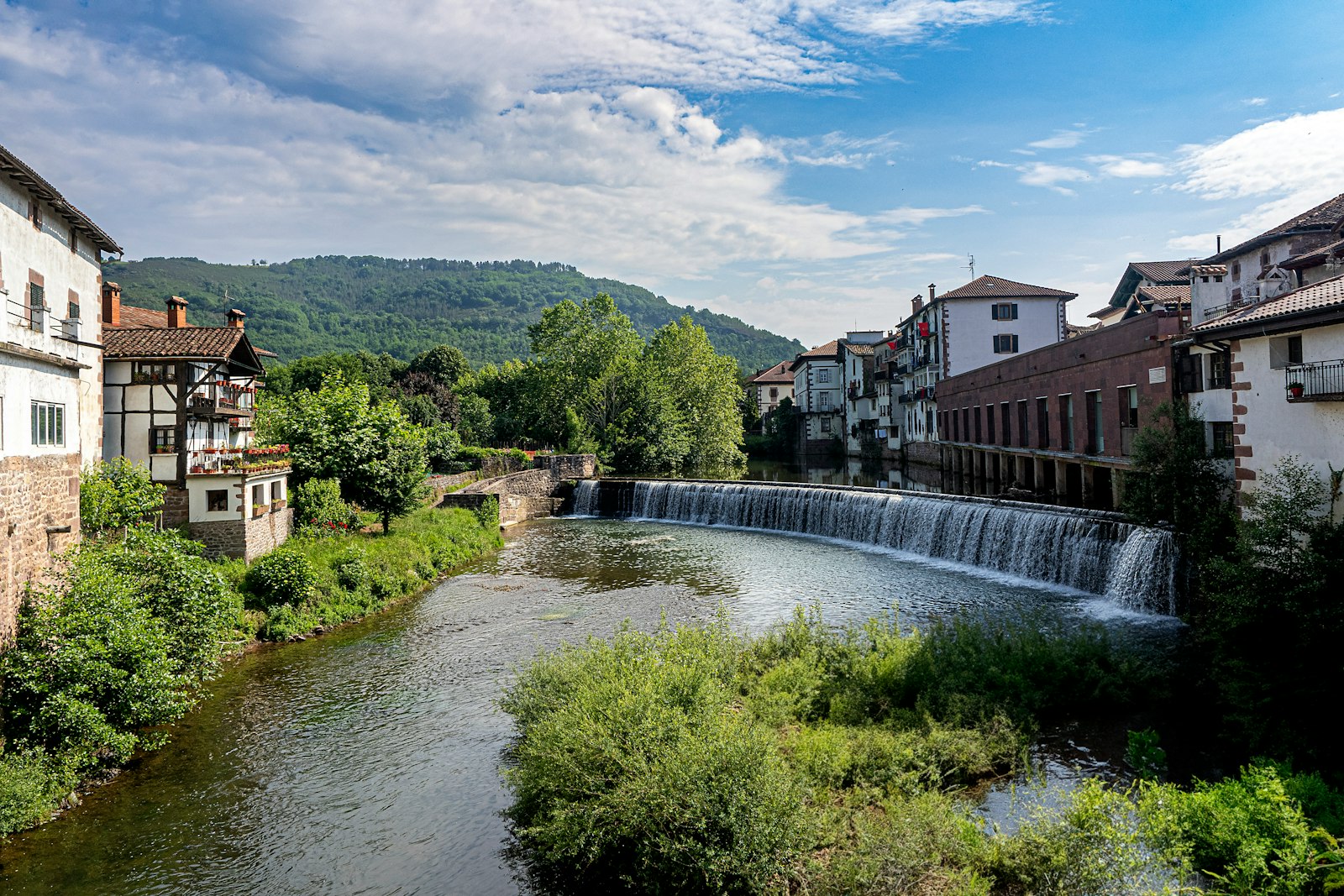
- Elizondo · Elizondo (stage 3). The capital of the Baztán valley, with palatial houses by the river, the weir and the Txokoto bridge; Dolores Redondo’s Baztán Trilogy is set here.
- Dorrea Tower · Irurita (stage 4). A medieval tower and listed heritage site, in one of the best-kept villages of the valley.
- Belate pass · Belate (stage 5). The roof of the route, at 930 m, with the ruins of the old monastery of Santa María de Belate next to the path.
- Lantz · Lantz (stage 5). A village known for its rural carnival, one of the oldest and most singular in Navarre.
- Basilica and bridge of Trinidad de Arre · Villava (stage 6). The basilica of the Trinity and the medieval bridge over the river Ultzama, where the Camino Baztanés joins the Camino Francés.
- Cathedral of Santa María · Pamplona (stage 6). About 4 km beyond the finish, already on the Francés: a 14th and 15th-century Gothic cathedral, with an exceptional cloister and the tomb of Charles III the Noble and Eleanor of Trastámara.
When to walk the Camino Baztanés
The best seasons are May to June and September to October. It is a very rainy area, green all year round, with a mild climate: average highs range from 10.7 °C in January to 27.4 °C in August. 18 of the 23 albergues are open all year, and in winter Belate may have snow or fog; in summer it is cool compared with the Meseta, but some albergues close in July.
| Month | Avg. high | Avg. low | Albergues open |
|---|---|---|---|
| January | 10.7 °C | 2.7 °C | 70 % |
| February | 12.0 °C | 2.7 °C | 74 % |
| March | 15.5 °C | 4.8 °C | 87 % |
| April | 17.2 °C | 6.3 °C | 100 % |
| May | 21.3 °C | 9.6 °C | 100 % |
| June | 24.7 °C | 12.7 °C | 100 % |
| July | 26.9 °C | 14.8 °C | 87 % |
| August | 27.4 °C | 15.2 °C | 100 % |
| September | 24.3 °C | 12.4 °C | 100 % |
| October | 19.8 °C | 9.8 °C | 96 % |
| November | 14.1 °C | 5.8 °C | 83 % |
| December | 11.2 °C | 3.5 °C | 61 % |
How to get to Bayonne
From Madrid there are 5 direct trains a day to Irún, the fastest in 3 h 24 min. From Irún or Hendaye, on the other side of the river Bidasoa, French regional trains run to Bayonne in about 35-40 minutes. You can also fly to Biarritz airport, on the outskirts of Bayonne. At the end, Villava is in the Pamplona area, which has direct trains to Madrid and buses to many cities.
Where to sleep on the Camino Baztanés
There are 23 albergues, 8 of them public, and 102 places to stay in total, including albergues, rural houses, hostales and hotels. An albergue bed costs €17.70 on average, a little more than on other caminos, especially on the French side. The stage ends with the most options are Elizondo and the Pamplona area; in Urdax, Berroeta and Olagüe there are few beds and it is worth phoning ahead. Each stage lists the accommodation with price, beds and phone number, and in the accommodation finder you can filter by town.
What to eat on the Camino Baztanés
- In Lapurdi, the Espelette pepper, from the village next to Souraïde, with its own designation of origin and visitor centre, and gâteau basque.
- In Amaiur/Maya, talos, corn flatbreads filled with cheese, chistorra or vegetables.
- In Irurita, hot chocolate, cakes and chocolates.
- In Olagüe, cheeses and desserts made from latxa sheep’s milk by an artisan dairy next to the albergue.
- On arrival in Pamplona, chistorra and Idiazabal cheese, which turns up in dishes, pintxos and even desserts.
Tips for the Camino Baztanés
- Save energy for Belate: the climb from Berroeta has ramps of over 15% and the pass is at 930 m.
- Carry a rain jacket all year: the Baztán valley is one of the rainiest places in Navarre, and there may be fog on Belate.
- If you are short of time, join stages 3 and 4 to Berroeta or walk the first one as far as Souraïde: the short stages combine well.
- Bring cash in euros from Bayonne: small villages do not always have an ATM.
- Book or phone ahead in Urdax, Berroeta and Olagüe, where there are few beds.
Credential and Compostela
To sleep in the albergues you need the credencial, which you can get from parishes, Friends of the Camino associations and authorised albergues; in Bayonne the city’s pilgrim associations provide it.
The Camino Baztanés ends in Villava, where it joins the Camino Francés. For the Compostela you have to continue to Santiago, about 700 km from Pamplona, and walk at least the last 100; it is requested at the Pilgrim Office.
Camino Baztanés FAQ
How many kilometres is the Camino Baztanés?
104.1 km from Bayonne to Villava, in 6 stages, and about 805 km to Santiago continuing along the Camino Francés.
Where does the Camino Baztanés start?
In Bayonne, in the French Basque Country, next to the cathedral of Sainte-Marie.
Where does the Camino Baztanés join the Francés?
At Trinidad de Arre, in Villava, by the medieval bridge over the river Ultzama, about 4 km from the centre of Pamplona.
Which is the hardest stage of the Camino Baztanés?
The one from Berroeta to Olagüe, 20.0 km, with about 790 m of climbing to the Belate pass, at 930 m.
Is the Camino Baztanés the same as the Camino de Baztán?
Yes. It goes by both names, and also the Baztán route, after the Navarrese valley it crosses.
When is the best time to walk the Camino Baztanés?
In spring and autumn. It is a rainy area all year; in winter some albergues close and Belate may have snow or fog.
What is there to see on the Camino Baztanés?
Bayonne cathedral, Ainhoa, Urdax, Amaiur/Maya, Arizkun, Elizondo, Irurita, the Belate pass and the bridge of Trinidad de Arre.
How do you get to Bayonne?
By train to Irún and from Irún or Hendaye on a French regional train to Bayonne. There are also flights to Biarritz airport.
How many albergues are there on the Camino Baztanés?
23, 8 of them public, with an average bed price of €17.70.
How many days does it take to walk the Camino Baztanés?
About 6 days on foot, or five if you join the shortest stages. With the planner you can split it at your own pace.
Plan your days with the planner, continue to Santiago along the Camino Francés, compare it with the Camino del Norte, which also passes through Irún, and to prepare the trip see the practical guides to the Camino de Santiago or compare routes in all the Caminos.