
The Camino de Santiago from Sarria is 114.2 km, walked in 5 stages to the Praza do Obradoiro. It is the most popular starting point on the whole Camino: in 2025, 162,040 pilgrims started there, more than 32% of those who collected the Compostela, according to the Pilgrim’s Office. Here you have everything you need to prepare it, stage by stage, and a free PDF guide with the map and elevation profile of each day to carry on your phone or print.
Contents
Download the free Camino from Sarria PDF guide (in Spanish)
Why start the Camino de Santiago in Sarria
The Pilgrim’s Office requires you to have covered at least the last 100 km on foot (or 200 km by bike) on a recognised route to issue the Compostela, with two stamps a day on your credential over that section. On the Camino Francés, Sarria is the last large town more than 100 km from Santiago, which is why it draws so many pilgrims: from there it is 114.2 km, so you meet the requirement with room to spare. That margin matters: if one day you have to skip a section because of an injury, you still have the kilometres you need. You can also start a few kilometres later, at Barbadelo, which is still more than 100 km away.
Sarria also has two important practical advantages: a train station and a bus station, both a few minutes from the start of the Camino, and all the infrastructure set up for pilgrims who start there, with dozens of albergues, guesthouses and outdoor gear shops. After Sarria, the most popular starting points in 2025 were Porto (51,574 pilgrims) and Tui (41,646), on the Camino Portugués.
What to see in Sarria before you start
It is worth arriving in Sarria the afternoon before, getting your credential stamped and taking a stroll. The upper town holds the historic pilgrim quarter: the Rúa Maior, full of albergues, pilgrim shops and traditional houses; the church of San Salvador, transitional between Romanesque and Gothic; the surviving tower of the old fortress, and the Magdalena monastery, with a long tradition of welcoming pilgrims. Down below, by the Sarria river, is the more modern area, with terraces and restaurants. It is a good afternoon to buy anything you are missing, check your backpack and have an early dinner: the first stage starts early for almost everyone.
The 5 stages of the Camino de Santiago from Sarria
This is the classic plan, with the distances and elevation gain from our planner. No stage is truly hard, but the terrain is rolling and the days add up.
- Stage 1: Sarria – Portomarín (22.2 km, +398 m). Sunken lanes between stone walls, oak trees and tiny hamlets. You pass the Romanesque church of Barbadelo, the 100 km marker and Ferreiros before descending to the Belesar reservoir and climbing the stairway into Portomarín.
- Stage 2: Portomarín – Palas de Rei (24.8 km, +519 m). The one with the most total ascent on the section, with the climb up the Sierra de Ligonde. Along the way, the Castromaior hillfort and the Lameiros stone cross.
- Stage 3: Palas de Rei – Arzúa (28.5 km, +491 m). The longest. Leboreiro, the medieval bridge of Furelos, Melide and its octopus, Boente and the Ribadiso bridge. If it feels too long, split it at Melide.
- Stage 4: Arzúa – O Pedrouzo (19.3 km, +351 m). Gentle, among eucalyptus trees and hamlets such as A Salceda and Santa Irene. It goes by quickly.
- Stage 5: O Pedrouzo – Santiago (19.4 km, +318 m). Lavacolla, Monte do Gozo with the first views of the towers, and the entry through the Porta do Camiño to the Obradoiro.
You have the day-by-day plan, with where to eat and where to stop, in the Camino Francés from Sarria in 5 days, and the full Camino on the Camino Francés page. If you want a different plan, the Camino planner works it out in a minute.
Stage 1: Sarria to Portomarín (22.2 km)
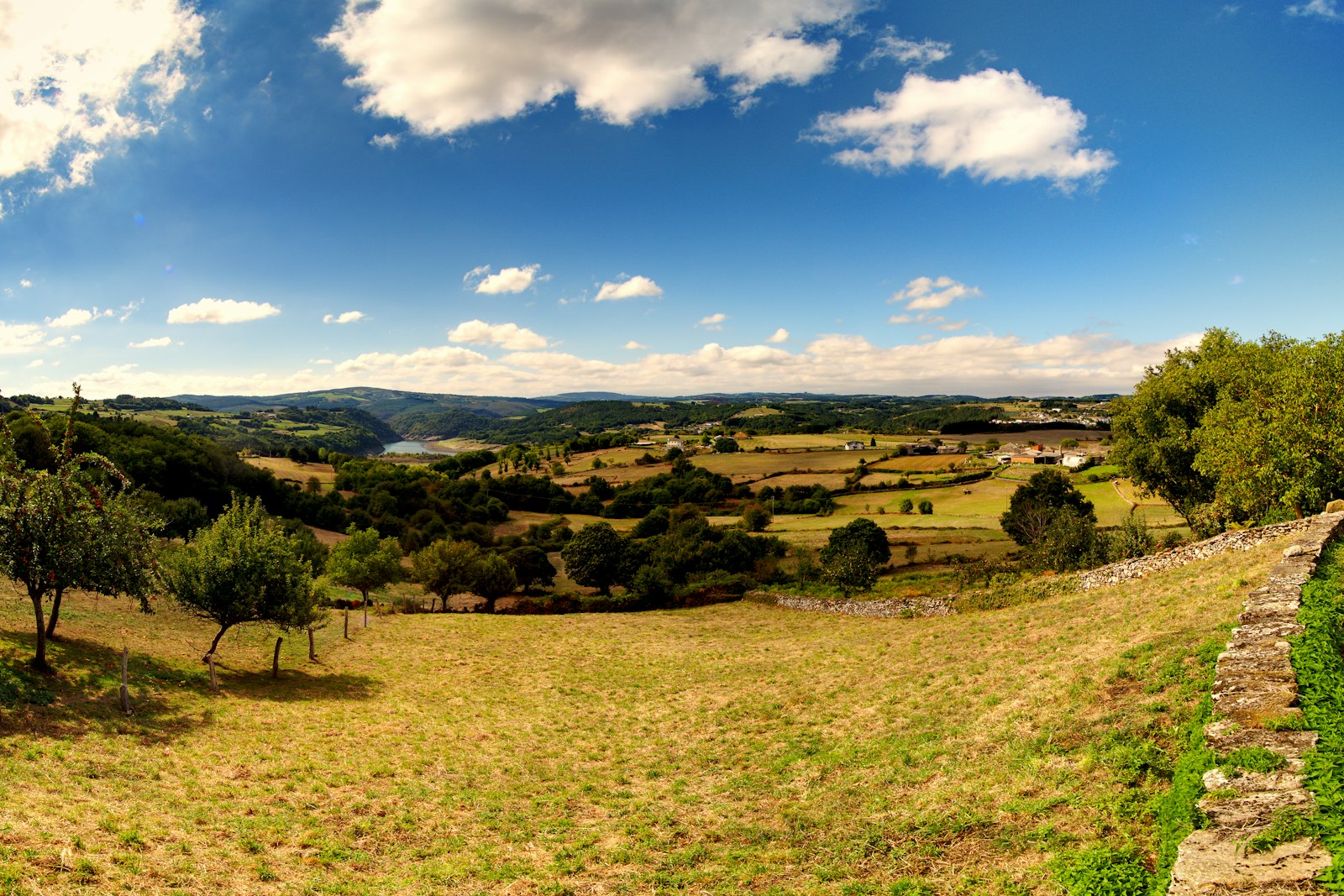
The first stage is one of the most beautiful on this section. You leave Sarria climbing up Rúa Maior, past the church of El Salvador, and the Camino soon heads into the Galician countryside: sunken lanes between stone walls, oaks, meadows and tiny hamlets. In Barbadelo it is worth stopping at the Romanesque church of Santiago.
Shortly after Ferreiros you pass the famous 100 km marker, the photo almost every pilgrim takes. The stage ends with a steep descent towards the Miño river and the Belesar reservoir, which you cross on a long bridge before climbing up to Portomarín. The present town was built when the reservoir flooded the old one, in 1963; the most valuable buildings, such as the fortress church of San Nicolás, were moved stone by stone.
- Difficulty: moderate, with gentle ups and downs and a demanding final descent.
- Services: there are bars and accommodation along the way, but some hamlets have nothing.
- Tip: get a stamp in Sarria as you leave and at a bar halfway through the stage.
Stage 2: Portomarín to Palas de Rei (24.8 km)
The second day starts with a long, steady climb from the Miño, much of it beside the road, which is easier if you set off early. You pass Gonzar and Castromaior, with the remains of a castro, a pre-Roman fortified settlement. The highest point of the section is around Ventas de Narón, at about 700 metres.
After that, the Camino descends through Ligonde, Airexe, Portos and Lestedo to Palas de Rei, a town with all services. It is a less spectacular stage than the first, but with many hamlets and stone crosses.
- Difficulty: moderate, because of the initial climb and the distance.
- Services: bars at several points; Palas de Rei has two public albergues and many private ones.
- Tip: if you are short on energy, you can split this stage at Ventas de Narón or Ligonde.
Stage 3: Palas de Rei to Arzúa (28.5 km)
This is the longest and most varied stage of the section. It passes through San Xulián do Camiño, Casanova and Leboreiro, a hamlet with a medieval paved road, and crosses the medieval bridge of Furelos to reach Melide, halfway through the stage, famous for its pulpo a feira: the perfect place for lunch. If you prefer to split the day, Melide is the natural stop.
From Melide the Camino strings together gentle ups and downs among eucalyptus and oak trees, passing Boente and Ribadiso, with its medieval bridge and riverside albergue, one of the prettiest spots on the section. A final climb brings you to Arzúa, cheese country.
- Difficulty: high because of the distance, with constant ups and downs.
- Services: plentiful; Melide and Arzúa have everything.
- Tip: set off early, stop in Melide and consider sleeping there if you feel tired or have blisters.
Stage 4: Arzúa to O Pedrouzo (19.3 km)
A short, friendly stage, ideal for resting your legs before the arrival. The Camino follows tracks through eucalyptus and oak woods and small hamlets such as A Calle, A Salceda and Santa Irene, with plenty of bars and rest areas. It ends at O Pedrouzo, in the municipality of O Pino, a town with all services where most pilgrims sleep the night before reaching Santiago.
- Difficulty: low.
- Services: plenty along the stage.
- Tip: use the afternoon to rest and prepare your arrival: register for your Compostela online.
Stage 5: O Pedrouzo to Santiago de Compostela (19.4 km)
The last stage is especially moving. You set off through woods, skirt round the airport and pass through Lavacolla, where according to tradition medieval pilgrims washed in the river before entering the holy city. Then comes the climb to San Marcos and Monte do Gozo, 4.4 km from Santiago, from where pilgrims saw the cathedral towers for the first time.
The finish is urban: you enter Santiago, reach the historic centre and, under the arch of the Archbishop’s Palace, emerge into the Praza do Obradoiro. That moment, in front of the cathedral façade, is the reward for the whole Camino.
- Difficulty: low, with a few gentle climbs.
- Services: plentiful.
- Tip: set off early so you have time to collect your Compostela and attend the pilgrims’ Mass.
Pace and timing: when to set off
With stages of 19 to 28.5 km and an average pace of 4 km an hour, allow between five and eight hours a day including stops. Setting off between seven and eight in the morning lets you walk in the cool, have lunch at the end of the stage and enjoy a free afternoon. In summer, leave earlier; in winter, wait until it is light, because in Galicia the sun rises late. On the last day, if you want to make the midday pilgrims’ Mass, leave O Pedrouzo very early or plan to attend another service in the afternoon.
Must-sees on this section
- The church of Santiago de Barbadelo, a Romanesque gem a few kilometres from Sarria.
- The 100 km marker, between A Brea and Ferreiros: the photo almost everyone takes.
- San Nicolao de Portomarín, the fortress church that was moved stone by stone when the Belesar reservoir flooded the old town.
- The Castromaior hillfort, a pre-Roman fortified settlement beside the Camino.
- The Lameiros stone cross, one of the most beautiful on the Camino, next to the chapel of San Marcos.
- Leboreiro and the Furelos bridge, two almost intact medieval scenes.
- The octopus houses of Melide, an essential food stop.
- The Ribadiso bridge, with its old pilgrim hospital turned into an albergue.
- Monte do Gozo, from where you first see the towers of the Cathedral.
- The Praza do Obradoiro, the goal of all the Caminos.
What to eat on the Camino from Sarria
The Galician section is also a food journey. In the bars along the Camino you will find caldo gallego, empanada and the pilgrim menu. In Melide, pulpo a feira, with olive oil, salt and paprika, served on a wooden plate, is a must. In Arzúa, the local cheese, soft and mild. And in Santiago, the almond cake with the cross of Saint James drawn in sugar. You will find more ideas in Camino food.
Alternative plans: 6 or 7 days
The five classic stages put almost everyone in the same towns. With a couple of extra days, you enjoy the section much more and avoid the crowds:
- In 6 days: Sarria – Portomarín · Portomarín – Palas de Rei · Palas de Rei – Melide · Melide – Arzúa · Arzúa – O Pedrouzo · O Pedrouzo – Santiago.
- In 7 days: Sarria – Ferreiros · Ferreiros – Gonzar · Gonzar – Palas de Rei · Palas de Rei – Melide · Melide – Arzúa · Arzúa – Santa Irene · Santa Irene – Santiago.
Sleeping in in-between villages such as Ferreiros, Mercadoiro, Gonzar, Ventas de Narón, Melide, Ribadiso, A Salceda, Santa Irene or Lavacolla is the best way to walk against the tide of the crowd.
Alternatives: starting before Sarria
If you have one or two more days, starting a little earlier changes the experience a lot. From Triacastela there are two routes to Sarria: via San Xil, shorter and through the mountains, and via Samos, longer, passing one of the oldest monasteries in Spain. From O Cebreiro, where the Camino Francés enters Galicia, you will have about 150 km and the most spectacular views of the route. And from Ponferrada, about 200 km, which also lets you apply for the Compostela by bike. Any of these options lets you reach Sarria already broken in, just when most people are starting. Work out stages from any town with the planner.
There is a complete guide to each: the Camino de Santiago from O Cebreiro (152.6 km), from Ponferrada (203.6 km) and from León (304.5 km).
Variants and detours on this section
The route from Sarria is very direct and has hardly any variants, but there are small detours worth taking if you have time: going up to the centre of Portomarín to see the church of San Nicolás up close, stopping to see the remains of the Castromaior hillfort or taking a walk round Melide’s old town before carrying on. None of them adds much distance and all of them enrich the experience. And if you still have energy at the end, the Camino to Fisterra awaits from Santiago.
Where to sleep from Sarria
This is the section with the most accommodation on the whole Camino. According to our finder, in November 2026 there were 37 places to stay listed in Sarria (19 of them albergues), 32 in Portomarín, 31 in Palas de Rei, 27 in Melide, 36 in Arzúa, 29 in O Pedrouzo and more than 40 in Santiago. The public Xunta de Galicia albergues cost €10 a night, only admit pilgrims with a credential, do not take bookings and give priority to those arriving on foot. Private albergues, guesthouses and hotels can be booked. Search by town in the accommodation finder or on the Sarria page, and if it is your first time in an albergue, read how albergues work.
How to get to Sarria
Sarria is in the province of Lugo and has a train station and a bus station, both a few minutes’ walk from the start of the Camino. There are three usual ways to get there:
- By train: Sarria is on the line between Lugo and Monforte de Lemos. From Madrid and other cities you usually change at Monforte de Lemos or Ourense.
- By bus: there are connections with Lugo and Santiago. It is the most common option for those who first fly to Galicia.
- By plane and then train or bus: fly to Santiago and travel up to Sarria. The advantage is that your return trip leaves from the same city you will walk into.
Timetables change every season: always check them on the operator’s website. Arriving in Sarria the afternoon before lets you stamp your credential, stroll along Rúa Maior and start rested. More options in how to get to the start of the Camino.
Before leaving Sarria
- Credential: get it at home or in Sarria, and collect your first stamp there. We explain it in the guide to the pilgrim credential.
- Training: even for 5 days, it is a good idea to have walked beforehand with the backpack and footwear you will use. There is a plan in how to train for the Camino.
- Light backpack: under 10% of your body weight. The list is in what to pack.
- Feet: those who start in Sarria don’t have the conditioning of those coming from far away, and blisters are common. Read how to prevent and treat them.
- Bookings: in high season, at least for the busiest stage ends.
The credential and the two daily stamps
This is the mistake that costs the most Compostelas, and it is easy to avoid. The pilgrim credential is essential for sleeping in pilgrim albergues and for requesting the Compostela. It costs around €2 and is available from Friends of the Camino associations, parishes, albergues at starting points and in Sarria itself. But there is a detail many people discover too late: over the last 100 km you need two stamps a day, not one.
This is what the Pilgrim’s Office requires: two stamps a day over the last 100 km on foot or on horseback, and over the last 200 km by bike, with the date. Getting stamps is easy: when you leave your accommodation in the morning and again along the way or on arrival. Bars, churches, albergues, town halls and tourist offices all count. You have all the details in our guide to the pilgrim credential.
When to walk the Camino from Sarria
Galicia is green because it rains, and it can rain in any month: a rain jacket always goes in your backpack. The high season runs from May to October. July, August and September are the months with the most pilgrims, July and August the hottest, and the week of 25 July, St James’s Day, is the busiest of the year. If you want atmosphere and don’t mind company, those are your dates. If you want peace and quiet, spring and the second half of October give you the same Camino with far fewer people. In winter the section still has services, although some places to stay close. Compare month by month in when to walk the Camino de Santiago.
How many people really walk this section
The official figures put things in perspective. 2025 closed with 530,987 Compostelas, an all-time record and 6% more than in 2024. And 2026 is running even higher: according to the Xunta de Galicia, in the first half of the year there were already more than 243,700, 5% more than in the same period the previous year. With almost a third of pilgrims starting in Sarria, this is the busiest section of the whole Camino. In practical terms: from May to October, book ahead. Improvising here means extra walking looking for a bed.
The 2027 Xacobeo from Sarria
25 July 2027 falls on a Sunday, so 2027 will be a Compostela Holy Year. The Holy Door of the Cathedral will open at midday on 31 December 2026, as announced by the Archdiocese, and the year is expected to bring the most pilgrims in history. Holy Years follow a cycle of 6, 5, 6 and 11 years: the last was 2021, extended to 2022, and after 2027 the next will be 2032. If you are going in 2027, choose your dates as soon as possible and book. We tell you everything in the 2027 Xacobeo from Sarria and in the Holy Door of Santiago. And if the crowds put you off, consider the quieter Camino Primitivo or Camino Portugués.
How to avoid the crowds in 2027
If you are setting off from Sarria in a Holy Year, these decisions will change your experience:
- Avoid the week of 25 July if you want peace and quiet: it is the peak of the peak. Easter Week and August also fill up.
- Choose the month carefully: April, May, June and October have good weather and fewer people than July, August and September, the busiest months.
- Sleep away from the classic stage ends. Almost everyone stops in Portomarín, Palas de Rei, Arzúa and O Pedrouzo. If you stop in Ferreiros or Mercadoiro, Gonzar or Ventas de Narón, Melide or Ribadiso, A Salceda or Santa Irene and Lavacolla or Monte do Gozo, you will walk against the tide of the crowd.
- Start early… or not. Setting off early gives you a clear, cool path; setting off mid-morning, once the wave has passed, works too.
- Book. On this section, and in this year, you cannot improvise a bed.
And if the crowds put you off completely, consider starting further back, in Ponferrada or O Cebreiro, or changing route: these Caminos are much quieter.
What to pack
The golden rule: your backpack should not weigh more than 10% of your body weight. For five days from Sarria, that is plenty. Your feet are non-negotiable: broken-in footwear (never brand new), seamless socks and something to treat blisters. No cotton, which dries slowly and chafes. Bring a rain jacket or poncho that covers your backpack, and cash: in many hamlets on this section there is no cash machine or card reader. If one day you cannot manage the weight, Correos’ Paq Mochila carries luggage from one place to stay to the next all year round between Sarria and Santiago, with a maximum of 15 kg per bag. You have the full list in what to pack for the Camino.
Budget for the Camino from Sarria
Spending depends mainly on accommodation. Sleeping in public albergues (€10 a night) and eating the pilgrim menu, which usually costs between €10 and €15, five days from Sarria can be done on a tight budget; with guesthouses and hotels, the cost goes up considerably. Add the journey to Sarria and the trip home from Santiago. Work out your own case with the Camino cost calculator.
Health and safety on this section
It is one of the safest sections of the Camino and one with the most services, but it pays to be prepared. There are pharmacies and health centres at the stage ends, and the emergency number is 112. Always carry water: there are fountains and bars every few kilometres, but don’t drink from rural fountains unless they are marked as drinking water. If you walk alone, share your itinerary and consider installing AlertCops, the Spanish Interior Ministry’s app, which has a «Guardián del Camino de Santiago» service. And take care at road crossings, especially on the stages from Portomarín to Palas de Rei and from Arzúa to O Pedrouzo.
Arriving in Santiago
The Compostela is free and is collected in person at the Pilgrim’s Office, at Rúa das Carretas 33, a few minutes from the Obradoiro. Beforehand, fill in the online registration (you can open it with the QR code on the official credential) and keep the code they send you. Remember that you cannot enter the Cathedral with a backpack: leave it at your accommodation or in a left-luggage locker. The pilgrims’ Mass is held daily at midday. The whole process is in how to get the Compostela.
The Camino from Sarria PDF guide
We have prepared a free guide, with no sign-up, in the same layout as our printed Sello a Sello guides, to carry on your phone or print. It is currently available in Spanish only: 52 colour pages with photos, and this is what it includes:
- The 5 stages with a fact sheet, relief map, elevation profile and step-by-step description.
- The section village by village: the kilometre point, the services in each place (beds, bar, food, shop) and what to see.
- Tables of where to sleep at the end of each stage, with the type of accommodation, beds, price per bed and phone number.
- Alternative plans for the section in 5, 6 or 7 days and the must-sees you can’t miss.
- A chapter on the 2027 Xacobeo and another on the arrival: the Compostela, the Cathedral, the pilgrims’ Mass and the extension to Fisterra.
- The practical part: credential and stamps, backpack, training and health.
- Journal pages to keep your stamps and notes, and a map of Santiago.
Prices and beds are those in our finder when the edition closed, in November 2026. They change every season, so check them before booking in the accommodation finder, where they are kept up to date.
Download the free PDF guide (in Spanish, 52 pages, 3 MB)
Official link: the Compostela requirements and the advance registration are on the website of the Pilgrim’s Office in Santiago.
FAQ
How many kilometres is it from Sarria to Santiago?
114.2 km, usually divided into 5 stages. That is more than the 100 km minimum the Pilgrim’s Office requires for the Compostela, so you have some margin.
How many days does it take from Sarria?
Five days is the classic plan. With six or seven, stopping in in-between villages, you walk more rested and with fewer people. Combining stages into four days is possible, but it means days of more than 28 km.
Is the Compostela valid if I start in Sarria?
Yes. It is exactly the same Compostela. Sarria is more than 100 km from Santiago, the minimum distance required.
What is the hardest stage from Sarria?
Palas de Rei – Arzúa is the longest (28.5 km) and Portomarín – Palas de Rei has the most total ascent. None is technically difficult.
Do I need to book an albergue?
From May to October it is highly recommended, and for the 2027 Xacobeo, well in advance. Public albergues do not take bookings and work on a first-come, first-served basis.
Can you do it with children?
Yes, it is one of the most suitable sections: many villages and services every few kilometres. With children it is best to shorten the stages; there are tips in the Camino with children.
Can you do it from Sarria by bike?
You can cycle it, but it does not qualify for the Compostela: by bike you need the last 200 km, for example from Ponferrada.
Where do I get the credential if I start in Sarria?
Ideally, bring it from home, requested from a Friends of the Camino association or your parish. Otherwise, in Sarria it is sold at several places, such as the Xunta public albergue. Get it stamped that same day: it counts as your first stamp.
Where is the 100 km marker?
On the first stage, between A Brea and Ferreiros. Its exact location has changed with new measurements, but it is still one of the most photographed spots.
How much does the Camino from Sarria in 5 days cost?
Between about €170 and €470 per person depending on where you sleep and eat, not counting travel.
How many hours a day do you walk from Sarria?
Between five and eight hours depending on the stage and your pace, including stops. The longest stage, from Palas de Rei to Arzúa, takes the most time.
Can you walk the section from Sarria in winter?
Yes. It is quiet and low-lying, but check which places to stay are open and bring good rain gear and warm clothes.
Will Sarria be very crowded in 2027?
It will be the busiest starting point of the Holy Year. Booking accommodation in advance is almost essential, especially in summer.
Is there backpack transport from Sarria?
Yes. Correos’ Paq Mochila runs all year between Sarria and Santiago, and many companies and places to stay offer the same service.
Which stage is the most beautiful?
For many pilgrims, the first, from Sarria to Portomarín, for its sunken lanes, the km 100 marker and the arrival over the Belesar reservoir.
Is the PDF guide free?
Yes, completely free and with no sign-up. It is 52 pages in PDF (about 3 MB), in Spanish, which you can download here, save on your phone or print.