
Xacobeo 2027 will be the year with the most pilgrims in history, but not every route fills up in the same way. If the Holy Year appeals to you but the crowds on the final section of the Francés put you off, there are much quieter Caminos that reach the same Obradoiro.
Contents
Why the Francés gets crowded and others don’t
The Camino Francés, especially from Sarria onwards, accounted for about 46% of pilgrims in 2025, and more than 32% of the total started in Sarria. It is the most famous and the one that will fill up most in 2027.
The route data from the Pilgrim’s Office confirms it: the other routes share out far less volume. You trade some services and infrastructure for silence, nature and a more intimate experience. In a Holy Year, that difference is even more noticeable.
The Camino Primitivo: the loneliest and wildest
It is the oldest Camino, the one made by the first pilgrim. It crosses the mountains of Asturias and Galicia, with demanding stages and mountain scenery.
In exchange for a little more toughness, it offers some of the loneliest and most beautiful sections of all. Ideal if you are looking for nature and solitude. You have it stage by stage in the Camino Primitivo.
The Camino de Invierno: the great unknown
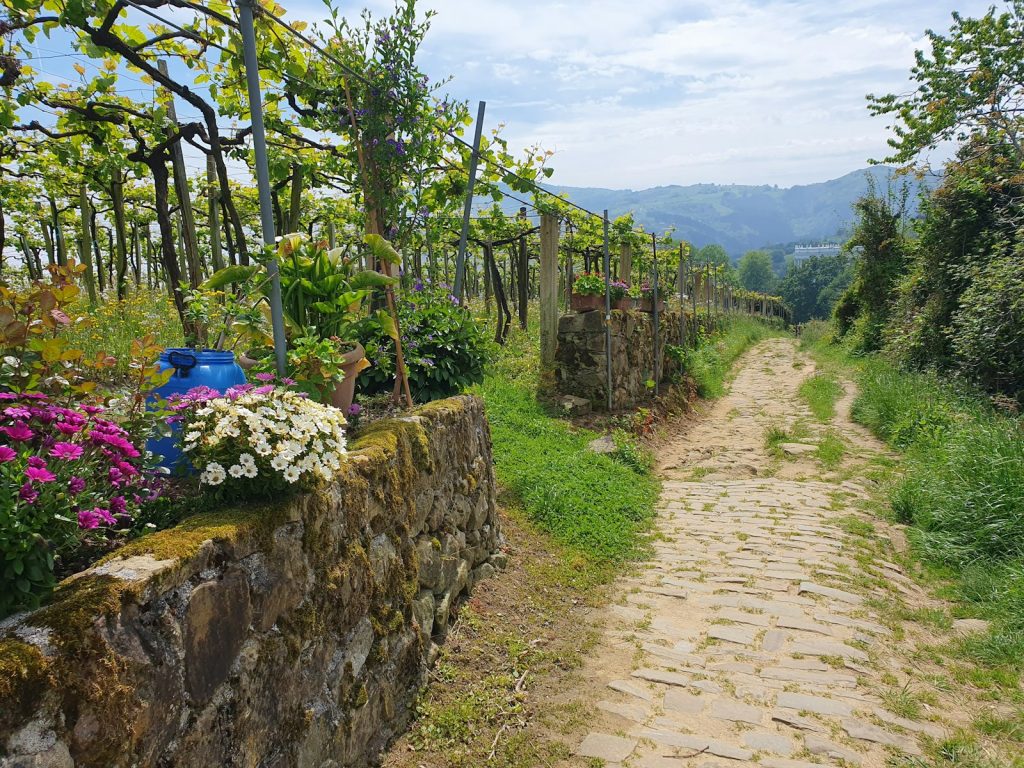
It starts in Ponferrada and avoids the snowy passes of O Cebreiro by following the Sil valley. It is one of the least walked Caminos there are, with terraced vineyards and heritage galore.
If you want to walk practically alone even in a Holy Year, it is a safe bet.
The Camino Portugués: quiet and with good services
It comes up from Portugal and is the second busiest route, but it is a long way from the saturation of the Francés. It combines the best of both worlds: a good atmosphere and good services, without the crush.
It also has the coastal variant, beside the sea. We cover it in detail in the Camino Portugués.
The Camino Inglés: short and for few people
It starts in Ferrol or A Coruña and is one of the shortest: from Ferrol it is over 100 km, so it qualifies for the Compostela. Historically it was walked by pilgrims arriving by sea from northern Europe.
It is an excellent option if you have few days and want to avoid the crowds. You have it in the Camino Inglés.
How crowded each route gets
To give you an idea of the contrast: the Francés accounts for around half of all Compostelas, and the Portugués is the second most popular route, though a long way behind. The rest (Primitivo, Inglés, Norte, Sanabrés, Invierno) share out the remaining percentage.
That means that, away from the Francés, the feeling of solitude is real and not a marketing promise. In a Holy Year, when the Francés is saturated, that difference will be even more marked.
What the Pilgrim’s Office data says
Every year the Pilgrim’s Office publishes statistics on Compostelas by route, and the pattern repeats itself: the Francés accounts for most pilgrims, with about 46% in 2025, the Portugués is the second route a long way behind and the rest is shared between the Norte, the Primitivo, the Inglés, the Vía de la Plata and the other Caminos. What is more, over 32% of the total started in Sarria. That is why moving away from the Francés, or at least from its final section in high season, is the most effective way to find peace and quiet in 2027. You can check the figures in the Office’s official statistics.
Comparison of less crowded Caminos
This table summarises the alternatives to the Francés for Xacobeo 2027, with a starting point over 100 km away for the Compostela on foot and its distance to Santiago according to our planner:
| Route | Start for the Compostela | Km to Santiago | Atmosphere | Difficulty |
|---|---|---|---|---|
| Primitivo | O Cádavo | 128.8 | Quiet until Melide | High |
| Inglés | Ferrol | 111.5 | Quiet | Medium |
| Norte | Vilalba | 119 | Quiet until Arzúa | Medium |
| Sanabrés (Vía de la Plata) | Ourense | 104.3 | Very quiet | Medium-high |
| Portuguese Coastal Way | Baiona | 125.1 | Moderate, until it joins the central route | Low-moderate |
| Central Portuguese Way | Tui | 115.6 | Moderate-high | Low-moderate |
An important detail: the Primitivo joins the Francés in Melide and the Norte in Arzúa, so you will share the last stages with Francés pilgrims. Even so, most of the route will be much quieter.
The almost empty Caminos: 28 more routes for 2027
As well as the classic alternatives to the Francés, the guide covers another 28 historic routes, all waymarked and with albergues, on which you can walk for whole days without meeting another pilgrim. They barely show up in the Pilgrim’s Office statistics: few pilgrims arrive by them and, in addition, those starting in France and Switzerland flow into the Francés or the Aragonés before Santiago. If what you are looking for in the Holy Year is real solitude, this is the place.
The table shows each route’s own section, the kilometres from its start to Santiago following the route it links up with, and the longest section without any accommodation, which is the figure that most affects planning. The figures come from our planner.
| Camino | Own section | Km of the section | Km from the start to Santiago | Longest section without accommodation (km) |
|---|---|---|---|---|
| North and Cantabrian coast | ||||
| Basque Interior Way | Irún → Burgos | 257.2 | 739.6 | 23.3 |
| Camino Olvidado | Bilbao → Villafranca del Bierzo | 495.2 | 645.9 | 21.5 |
| Baztanés | Bayonne → Pamplona | 108.1 | 783.3 | 20 |
| Lebaniego | San Vicente de la Barquera → Potes | 62.2 | 456.7 | 18.1 |
| Lebaniego Castellano | Palencia → Santo Toribio de Liébana | 220.6 | 462.3 | 31.3 |
| San Salvador | León → Oviedo | 119.4 | 425.4 | 18.4 |
| Centre and south | ||||
| Madrid | Madrid → Sahagún | 323.2 | 682.7 | 30.2 |
| Soriano | Gallur → Santo Domingo de Silos | 238.5 | 741.2 | 38.2 |
| Levante | Valencia → Zamora | 802.5 | 1,207.3 | 39.8 |
| Camino de la Lana | Alicante → Burgos | 703 | 1,168.2 | 43.4 |
| Mozárabe | Almería → Mérida | 616.2 | 1,366.6 | 33.8 |
| Camino del Sur | Huelva → Zafra | 196 | 1,008.2 | 27.2 |
| Vía Augusta | Cádiz → Seville | 180.1 | 1,139.2 | 33.3 |
| East | ||||
| Aragonés | Somport → Puente la Reina | 162.2 | 836 | 18.2 |
| Catalan Way | Barcelona → Santa Cilia | 382.4 | 1,136.9 | 28.6 |
| Camino del Ebro | Deltebre → Logroño | 441.7 | 1,045 | 36.5 |
| Girona route | Le Perthus → Montserrat | 255.8 | 1,334.7 | 23.6 |
| Tarragona route | Tarragona → Castellnou de Seana | 125.2 | 1,110.8 | 27.7 |
| Galicia and Portugal | ||||
| Interior Portuguese Way | Coimbra → Verín | 320.1 | 368.2 | 25.8 |
| Zamorano Portugués | Zamora → Verín | 214.4 | 392.3 | 53.5 |
| Muros-Noia | Muros → Santiago | 79.2 | 79.2 | 11.7 |
| France and Switzerland | ||||
| Le Puy route | Le Puy-en-Velay → Saint-Jean-Pied-de-Port | 744.6 | 1,507.7 | 18.2 |
| Arles route | Arles → Somport | 782.3 | 1,562.1 | 29.3 |
| Piedmont route | Carcassonne → Saint-Jean-Pied-de-Port | 500.3 | 1,262.9 | 33.1 |
| Vézelay route | Vézelay → Montréal-du-Gers | 767.2 | 1,701.2 | 37.2 |
| Tours route | Paris → Ostabat | 916.4 | 1,735.3 | 39.8 |
| Via Gebennensis | Geneva → Le Puy-en-Velay | 347.8 | ≈ 1,855 | 29.9 |
| Via Jacobi | Konstanz → Geneva | 429.1 | ≈ 2,285 | 18.6 |
Three warnings before choosing one of them. The first is accommodation: on the Zamorano Portugués there is a 53.5 km section with nowhere to sleep, and on the Lana, the Levante and the Tours route it exceeds 39 km, so you will have to split stages, book or use transport. The second is the season: on the French routes most albergues close in winter (in January about a third remain open on the Le Puy and Piedmont routes), while on the Mozárabe the opposite happens: almost everything is open in winter and some close in July and August, when the average maximum temperature on the route is around 35 °C. The third is the Compostela: the Muros-Noia route, at 79 km, does not on its own reach the 100 km required on foot.
For a first quiet, uncomplicated Camino, the most rewarding on this list are the Camino de San Salvador (León–Oviedo, with tough mountains but short and with a good albergue network) and the Interior Portuguese Way, with albergues open almost all year. If you have one or two months, the Le Puy route is the best served of the French routes.
The Camino del Norte: coast and green
The Camino del Norte follows the Cantabrian coast from Irún, 820.9 km from Santiago, through the Basque Country, Cantabria, Asturias and the Mariña of Lugo before turning inland into Galicia. It is more demanding than the Francés because of its constant ups and downs beside the sea, but it rewards you with beaches, cliffs and cities such as San Sebastián, Santander or Gijón. For the Holy Year, the Galician section from Vilalba, 119 km away, is a five-stage alternative for the Compostela with far fewer people than Sarria, until it joins the Francés at Arzúa.
The Vía de la Plata and the Camino Sanabrés
The Vía de la Plata comes up from Seville, 959.1 km from Santiago, largely following an old Roman road, and at Granja de Moreruela it turns off towards Galicia along the Camino Sanabrés. It is one of the loneliest routes: long distances between villages, few pilgrims and landscapes of dehesa, mountains and Galician valleys. For those seeking the Compostela with few days, Ourense, 104.3 km away, is the starting point, with stages through inland Galicia to Santiago and a high-speed railway station to get there.
The Portuguese Coastal Way
The coastal variant of the Camino Portugués leaves Porto hugging the Atlantic and enters Galicia at A Guarda. From Baiona, 125.1 km from Santiago, you have a section of about six stages with beaches and seafront promenades, quieter than the central Portugués until Redondela, where the two routes join. Watch out for Vigo: it is 99.1 km from Santiago, so starting there does not qualify you for the Compostela.
The Primitivo, stage by stage in broad strokes
The Camino Primitivo leaves Oviedo, 306.0 km from Santiago, and crosses the Asturian mountains through some of the most beautiful scenery on the whole Camino. Among the most memorable sections are the Hospitales route, a high-mountain pass that should only be done in good weather, the reservoir and village of Grandas de Salime, 178.3 km away, and the entry into Galicia at A Fonsagrada, 153.1 km away. Then it descends towards Lugo and its Roman walls and joins the Francés at Melide, 52.8 km from Santiago. For the Compostela with fewer days, O Cádavo, 128.8 km away, is a good starting point, since Lugo, at 99.3 km, falls short.
The Camino Inglés, short and full of history
The Camino Inglés has two starting points: Ferrol, 111.5 km from Santiago, and A Coruña. Only the Ferrol one exceeds on its own the 100 km required for the Compostela. From Ferrol, the route skirts the ría through Neda and Pontedeume and reaches Betanzos, 64.1 km from Santiago, one of the prettiest medieval towns in Galicia, before heading inland. It is five stages, with the odd demanding climb, and far fewer people than on the Francés even in summer.
The Camino de Invierno: vineyards and the Sil river
The Camino de Invierno (Winter Way) was born as the alternative pilgrims used when snow closed the pass at O Cebreiro. It leaves Ponferrada and follows the Sil valley, passing close to Las Médulas, the ancient Roman gold mines declared a UNESCO World Heritage Site, and through the Ribeira Sacra, with its terraced vineyards above the river. In the Lalín area it joins the Vía de la Plata to reach Santiago. It is one of the least walked routes and one of the richest in heritage, ideal if you want solitude in the middle of the Holy Year; on the other hand, it has fewer services and stages that need careful planning.
When to go to find even fewer people
Choosing a quiet route is half the strategy; the other half is the date. Even in the Holy Year, March, April outside Easter, October and November will be much more manageable than summer. Combining a little-walked route with a quiet date will give you an almost solitary Camino in the busiest year in history. We compare month by month in when to walk the Camino de Santiago.
Accommodation on the quiet routes
On the less crowded routes there are fewer pilgrims, but also fewer places to stay, and in some villages there is only one. That is why, paradoxically, booking can be as important as on the Francés. Check in the planner how many places to stay there are at each point, book the stage ends with little choice and always have an alternative lined up. We explain how they work in Camino albergues.
The quiet route for your profile
- If you have few days: the Camino Inglés from Ferrol or the Sanabrés from Ourense, both in about five stages.
- If you are going as a family: the Inglés or the Portuguese Coastal Way from Baiona, with manageable stages and good services.
- If you want a physical challenge: the Primitivo or the full Camino del Norte.
- If you want absolute solitude: the Camino de Invierno or the Vía de la Plata.
- If heritage interests you: the Camino de Invierno, via Las Médulas and the Ribeira Sacra, or the Primitivo, from Oviedo cathedral.
And if you are not sure, the which Camino de Santiago should I walk quiz helps you decide.
Credential and stamps on little-walked routes
On the quiet routes there are fewer bars, albergues and open churches, so getting the two daily stamps on the last 100 km takes a bit more attention. Ask for a stamp everywhere you stop, from the breakfast bar to the town hall or the pharmacy, and if a stamp has no date, write it yourself. We explain it in the guide to the pilgrim credential.
What about the central Portugués?
The Camino Portugués from Tui, 115.6 km from Santiago, is the second most popular route and in high season it has quite a lot of atmosphere, although far from the saturation of the Francés from Sarria. It is a good middle option if you want company and good services without the crowds of the French section, especially outside summer. If you want even fewer people, the coastal variant from Baiona or the Variante Espiritual, which leaves Pontevedra and follows the Arousa estuary, are quieter alternatives.
Quiet routes by bike
If you are cycling, remember that for the Compostela you need 200 km. Oviedo, on the Primitivo, at 306.0 km, or Puebla de Sanabria, on the Sanabrés, at 244.9 km, are valid starting points on routes much less busy than the Francés. We explain it in the Camino de Santiago by bike.
How to avoid the crowds without leaving the Francés
If you want the Camino Francés but not the crowds, there are options too:
- Start before Sarria: from O Cebreiro, at 152.6 km, or from Triacastela, at 132.0 km, you will have a few quieter days before joining the Sarria wave.
- Sleep in the villages in between instead of in Portomarín, Palas de Rei, Arzúa and O Pedrouzo.
- Choose your dates carefully: avoid July, August, September, long weekends and Easter, which in 2027 falls at the end of March.
- Play with your timing: setting off a little earlier or later than the big groups makes a big difference.
You have the final section day by day in the Camino from Sarria in 5 days.
How to plan a little-walked route
Fewer people also means fewer services. Before setting off on a quiet route, bear in mind:
- Plan each stage knowing where there is accommodation, a shop and a bar; on some routes there are sections of 20 km or more with nothing.
- Book even if there are few people: in villages with only one place to stay, one bed taken can force you to walk much further.
- Carry water and food for the whole stage.
- Check the waymarking and carry the route on your phone, because on some routes the arrows are less frequent.
- Train more if the route has a lot of climbing, such as the Primitivo or the Norte. You have a plan in how to train for the Camino.
With the planner you can see, point by point, how many places to stay and albergues there are at each place on the route and the lowest price.
Which to choose according to what you are looking for
- Maximum solitude and nature: Primitivo or Camino de Invierno.
- A balance between atmosphere and quiet: Portugués.
- Few days and no crowds: Inglés.
- The whole classic experience, accepting the crowds: Francés.
Whichever you choose, in how to prepare for Xacobeo 2027 you have the countdown to arrive ready.
What you lose and gain by leaving the Francés
It is worth being honest: the alternative routes have fewer albergues, fewer bars and fewer services than the Francés. On some stages you need to plan food and water better.
In return you gain silence, nature and a more authentic sense of the Camino, as well as finding a bed much more easily. In a saturated Holy Year, that balance clearly tips in favour of the quiet routes.
They all reach the same place
Whichever you choose, they all end in the Plaza del Obradoiro and all qualify for the same Compostela, as long as you meet the stamp and distance requirements. The Holy Door is the same for everyone: you have it in the Holy Door and the indulgence.
Official link: the Pilgrim’s Reception Office publishes pilgrim statistics by route and the Compostela requirements.
FAQ
Which is the least crowded route with a Compostela in 5 days?
The Camino Inglés from Ferrol or the Sanabrés from Ourense, both in about five stages and with far fewer people than the section from Sarria.
Is the Camino Portugués less crowded?
Yes compared with the Francés from Sarria, although it is the second most popular route. The coastal variant and the Variante Espiritual are quieter.
Do all routes qualify for the Compostela?
Yes, as long as you walk the last 100 km on foot or 200 km by bike with your credential stamped.
Which is the least walked Camino de Santiago?
Among the well-waymarked routes, the Camino de Invierno and the Sanabrés are among the quietest. The Primitivo and the Inglés also have far fewer people than the Francés.
Where should I start the Camino del Norte for the Compostela?
From Vilalba, 119 km from Santiago, in about five stages.
Can I start in Vigo for the Compostela?
No: Vigo is 99.1 km from Santiago, below the minimum. Start in Baiona or earlier.
Which is the least crowded Camino?
The Camino de Invierno and the Primitivo are among the loneliest. The Inglés also has few people.
Do these routes qualify for the Compostela?
Yes, as long as you walk at least the last 100 km on foot along an official route. The Inglés from Ferrol exceeds that.
Is it worth switching from the Francés to another route in 2027?
If peace and quiet matter to you, very much so. In a Holy Year the contrast in numbers between the Francés and the alternative routes becomes sharper.