
Camino de Santiago albergues are much more than a cheap bed: they are the social heart of the pilgrimage, the place where you share dinners, advice and stories with people from all over the world. They also have their rules, and knowing them before you set off saves you surprises from the very first night. In this guide we explain what types of albergue there are, how much they cost, how to get a bed, what you will find inside, the rules of the Galician public network and what sleeping in albergues will be like in the 2027 Holy Year.
Contents
What is a Camino de Santiago albergue
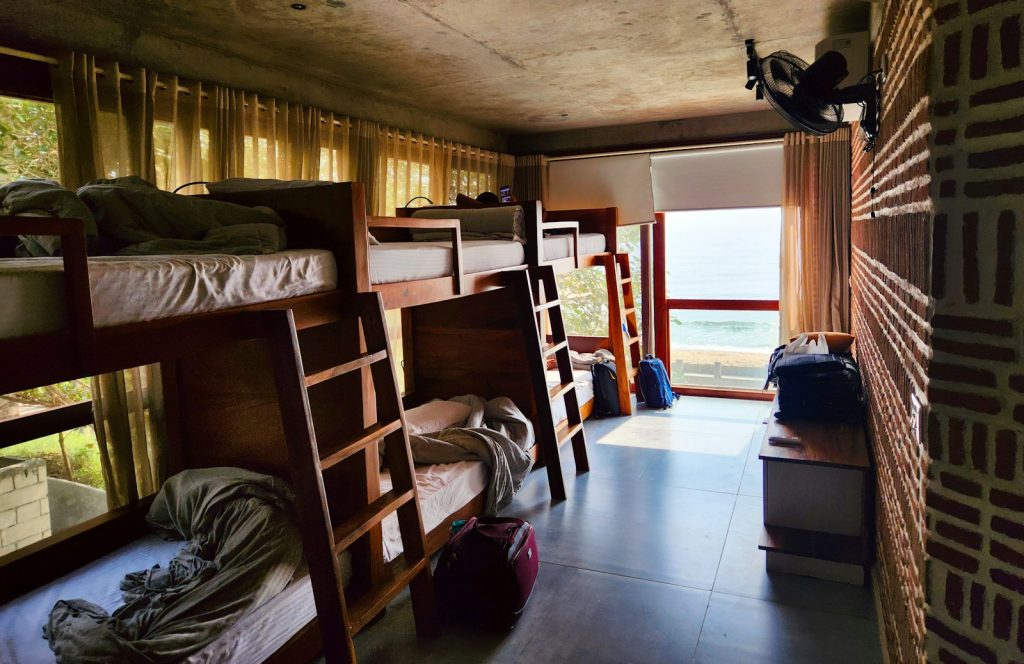
A pilgrim albergue is accommodation designed for those walking the Camino: shared dormitories with bunk beds, shared bathrooms and showers, and in many cases a kitchen, a laundry area and somewhere to hang your clothes. Most require you to show your pilgrim credential, which they stamp when you arrive, and some only admit those arriving on foot, by bike or on horseback, not by car.
They come in all sizes, from parish houses with a dozen beds to large buildings with more than a hundred. What they share is the spirit: low prices, simple rules and a coexistence between strangers that, surprisingly, works very well.
Types of Camino albergues and prices
| Type | Approximate price | How it works |
|---|---|---|
| Xunta public albergues (Galicia) | €10 a night | Galician regional network. No bookings, first come, first served. |
| Municipal | From about €6 | Run by town councils inside and outside Galicia. Simple and cheap. |
| Parish and association albergues | Donation | You pay what you think is fair. Sometimes with a communal dinner. |
| Private | 12-20 € | More services and smaller rooms. Many take bookings. |
To give you a real reference, these are the median prices of a bed in a private albergue on the main routes, calculated from the more than 2,800 places to stay in our guide:
| Route | Median price in a private albergue |
|---|---|
| Camino Francés | €15 |
| Camino Portugués | €17 |
| Portuguese Coastal Way | €20 |
| Camino del Norte | €18 |
| Camino Inglés | €16 |
| Camino Primitivo | €15 |
| Camino Sanabrés | €10 |
| Camino to Fisterra and Muxía | €15 |
You can work out the full cost of your Camino, with these prices, in the calculator in how much the Camino de Santiago costs.
The Xunta de Galicia public albergue network
In Galicia, many of the public albergues belong to the Red Pública de Albergues del Xacobeo, run by Turismo de Galicia. It was created in 1993 and today has 76 albergues and more than 3,000 beds, spread over all the Galician pilgrim routes. There is a single price: €10 per person per night.
They are simple, functional albergues, with bunk beds, showers, a kitchen in many cases and a laundry area. They cannot be booked: beds are allocated on a first-come, first-served basis, and when demand is high, pilgrims on foot have priority over those on horseback or by bike, and these over those travelling with a support vehicle. As a rule, you can only spend one night in each albergue, unless there is a justified reason such as an injury.
Demand keeps growing: between January and November 2025 the network recorded 261,073 overnight stays, 3.2% more than the previous year, according to the Xunta. August was the month with the highest occupancy, but months such as April and October already record very high figures.
How to get a bed in an albergue
The golden rule is simple: public albergues do not take bookings and work on a first-come, first-served basis. That is why, in high season and on the section from Sarria, many people get up early to reach the end of the stage in good time. Some tips so you are not left without a bed:
- Arrive with time to spare: in July, August and September, the public albergues on the final section can fill up by early afternoon.
- Don’t finish the stage where everyone else does: sleeping a village before or after the classic stage ends is usually easier.
- Have a plan B: find a private albergue or guesthouse that takes bookings beforehand in case the public one is full.
- Check availability: on our page for each stage you have all the places to stay at the end of the stage with their type, beds and price.
Private albergues, on the other hand, usually do take bookings by phone, email or online platforms. In high season booking gives peace of mind; in winter, more than booking, the important thing is to confirm that the albergue is open.
What you find inside an albergue
- Dormitories with bunk beds, from four beds to several dozen.
- Shared showers and toilets, sometimes separated by sex.
- A kitchen with utensils in many albergues, ideal for saving on dinners.
- Sink and washing line; in many private ones, a paid washing machine and dryer.
- A common area to eat, chat or rest your feet.
- Lockers in some cases: bring a small padlock.
What there almost never is, is full bedding: the norm is to sleep in your sleeping bag or liner on a mattress protected by a disposable cover. Check what to put in your backpack in what to pack for the Camino.
What a day in an albergue is like
The routine is repeated in almost every albergue on the Camino de Santiago. You arrive in the early afternoon, show your credential, pay and choose or are given a bunk. Then it’s time to shower, wash your clothes and hang them out, look after your feet and rest. Dinner can be communal, on your own in the kitchen or at a nearby bar with the pilgrim menu.
Rest starts early: many albergues turn off the lights and lock the door at a fixed time at night, and in the morning you have to leave early so they can be cleaned. Ask about the times when you arrive, because they vary from one albergue to another.
Your first night in an albergue, step by step
- Arrive and look for the hospitalero. This is the person who runs the albergue; in many cases, a volunteer who has already walked the Camino.
- Show your credential and ID. They register you, stamp your credential and charge you or tell you how to leave your donation.
- Leave your boots at the entrance if the albergue asks you to, and choose or receive your bunk. If you find ladders difficult or you get up very early, ask for a bottom bunk.
- Put on the mattress cover if they give you one and spread out your sleeping bag.
- Shower and laundry. Wash the day’s clothes and hang them out as soon as possible so they dry.
- Look after your feet and rest. This is the time to check for blisters and stretch.
- Have dinner and get ready for the next day: backpack packed, clothes to hand and head torch located so you can leave without disturbing anyone.
If you are worried about your feet, there is a complete guide on how to prevent and treat blisters.
Albergues by route
The albergue network is not the same on every Camino, and that affects how you plan your stages:
- Camino Francés: the densest network. There are albergues in almost every village, public and private, which lets you adapt your stages as you go.
- Camino Portugués: a good network, especially from Tui, with many private ones and the Xunta public ones in Galicia.
- Camino del Norte: albergues are further apart on some sections and demand is high on the coast in summer. It pays to plan further ahead.
- Camino Primitivo: fewer albergues and mountain stages with no alternative halfway. You need to be clear about where you are sleeping each night.
- Vía de la Plata: long distances between villages and simple albergues; each day needs to be well organised.
For any route, our Camino planner shows you, point by point, how many places to stay and albergues there are and the minimum price in each place.
Albergues for families, groups and pilgrims with dogs
If you are travelling as a family with children, private albergues with small rooms are the best option: more privacy and the possibility of booking. Large groups should always book, because in a first-come, first-served public albergue it is hard to find beds for everyone at once.
With a dog things get more complicated: many albergues do not accept animals, and those that do usually have limited places or a separate space. Plan each night in advance; we cover it in detail in our guide to the Camino de Santiago with a dog.
The hospitalero: the soul of the albergue
Behind many albergues are volunteer hospitaleros who give up a few weeks of their holidays to look after other pilgrims: they open up, clean, stamp credentials, treat blisters and sometimes cook for everyone. A greeting, helping to tidy up after dinner or leaving everything in order when you go is the best way to thank them. If after your Camino you feel like giving something back, many Friends of the Camino associations train new volunteer hospitaleros.
Albergue etiquette
Hundreds of strangers share space every night, and living together works thanks to a few simple gestures:
- Silence during rest hours and your phone on silent.
- Pack your backpack the night before so you don’t make noise or turn on lights when you get up early.
- Quick showers when there is a queue.
- Boots and poles where the albergue indicates, usually at the entrance.
- Leave the kitchen, bathroom and bunk as you would like to find them.
- Respect the work of the hospitalero, who in many albergues is a volunteer.
Donation albergues: how they work
Donation albergues, often run by parishes or Friends of the Camino associations, have no fixed price: each pilgrim leaves what they think is fair and can afford. Some offer a shared dinner and a short prayer or gathering in the evening, and they are among the loveliest memories of the Camino. Donation does not mean free: your contribution keeps them open for those coming behind you. Carry some cash, because they don’t usually have a card reader.
Albergue, guesthouse or hotel: which to choose
You don’t have to sleep in albergues all the time. Many people combine: albergue most nights and a guesthouse or hotel now and then to sleep better. As a reference, in our guide the median for a guesthouse or hotel is around €45 on the Camino Francés and the Camino del Norte, and €40 on the Inglés and the Portuguese Coastal Way. Choosing is a matter of budget, how you sleep and how much privacy you need.
Tips for sleeping well in an albergue
- Earplugs and eye mask: there is always someone who snores and someone who gets up early.
- Sleeping-bag liner: light and compulsory in many albergues; in winter, a warmer sleeping bag.
- Flip-flops: for the shower and to rest your feet.
- Head torch with a red light: to move around early in the morning without waking anyone.
- Bags to organise your backpack: you find everything without emptying it onto the bunk.
- Cash: small and donation albergues don’t always accept cards.
Albergues in winter
From November to March the picture changes. Many private albergues close for the low season, and in small villages there may be no option left open. Before each stage, phone to confirm which albergues are open, have an alternative lined up and bring a warm sleeping bag, because some buildings are cold. In return, you will have the albergues almost to yourself and a much quieter atmosphere. We cover it in our guide to the Camino in winter and in when to walk the Camino de Santiago.
Common mistakes in Camino albergues
- Arriving late at a very busy stage end in high season, without a plan B.
- Forgetting your credential or letting it get wet: it is your entry ticket.
- Leaving valuables in sight. Sleep with your phone, documents and money close to you.
- Packing your backpack early in the morning with noisy plastic bags. Fabric bags are better, or get everything ready the night before.
- Hanging your washing out late: with the Galician humidity, if you don’t wash it when you arrive, it won’t be dry the next day.
- Assuming there is a kitchen or blankets. Ask beforehand or bring what you need.
How to avoid bedbugs
Bedbugs turn up from time to time in accommodation all over the world, and the Camino is no exception. A few habits greatly reduce the risk: check the mattress seams before settling in, don’t leave your backpack on the bed, keep your clothes in closed bags and, if you notice bites in a line when you wake up, tell the hospitalero and wash and dry all your clothes at a high temperature as soon as you can.
Albergues in the 2027 Xacobeo
2027 is a Holy Year and more pilgrims than ever are expected, especially from May to September and in the week of 25 July. For albergues that means more competition for beds, especially on the last 100 km. If you are going that year, combine public albergues with booked accommodation, avoid ending stages in the busiest towns and consider routes with fewer people. You have the full plan in how to prepare for the 2027 Xacobeo.
If religious hospitality appeals to you, in the guide to monasteries on the Camino de Santiago we go through, route by route, the monastic albergues and guesthouses that welcome pilgrims.
Official link: the Xunta de Galicia’s Camino portal publishes the Galician public albergue network and its rules of use.
FAQ
Are there albergues open all year?
Yes, although many private ones close in winter. Before each stage, phone to confirm which albergues are open at your stage end.
Can you book Camino de Santiago albergues?
Public ones, as a rule, no: they work on a first-come, first-served basis. Many private ones do take bookings.
How much does it cost to sleep in a Camino albergue?
Xunta ones, €10 a night; municipal ones, from about €6; private ones, between €12 and €20, with a median of €15 on the Camino Francés. Donation ones, whatever each person thinks is fair.
What do I need to sleep in a pilgrim albergue?
The pilgrim credential, which shows that you are walking the Camino and which they stamp when you arrive.
How many nights can I stay in a public albergue?
In Xunta albergues, as a rule, just one night, unless there is a justified reason such as an injury or illness.
Do you need to bring a sleeping bag?
At least a sleeping-bag liner, which many albergues require. In winter, a warm sleeping bag is better.
What time do albergues open and close?
Many open in the early afternoon, lock the door at night and you have to leave early in the morning. Times vary, so ask when you arrive.
Can I sleep in an albergue if I am cycling?
Yes, although in Xunta public albergues, when demand is high, pilgrims on foot have priority.
Do you need a padlock?
It is highly recommended for lockers or to secure your backpack; it weighs little and gives peace of mind.
How many public albergues are there in Galicia?
The Xunta’s Red Pública de Albergues del Xacobeo has 76 albergues and more than 3,000 beds on the Galician routes, at €10 a night.
What do I do if the public albergue is full?
Look for a private albergue or guesthouse in the same village or walk on to the next one. Having an alternative with a booking lined up is the best guarantee in high season.
Do albergues have wifi and sockets?
Most have wifi and some sockets, although there are usually few for so many people. A multi-port charger or a power bank saves you waiting.
Sleeping in albergues is the key to walking the Camino on a small budget. Before setting off, read the tips for first-timers and find where to sleep in the accommodation finder.